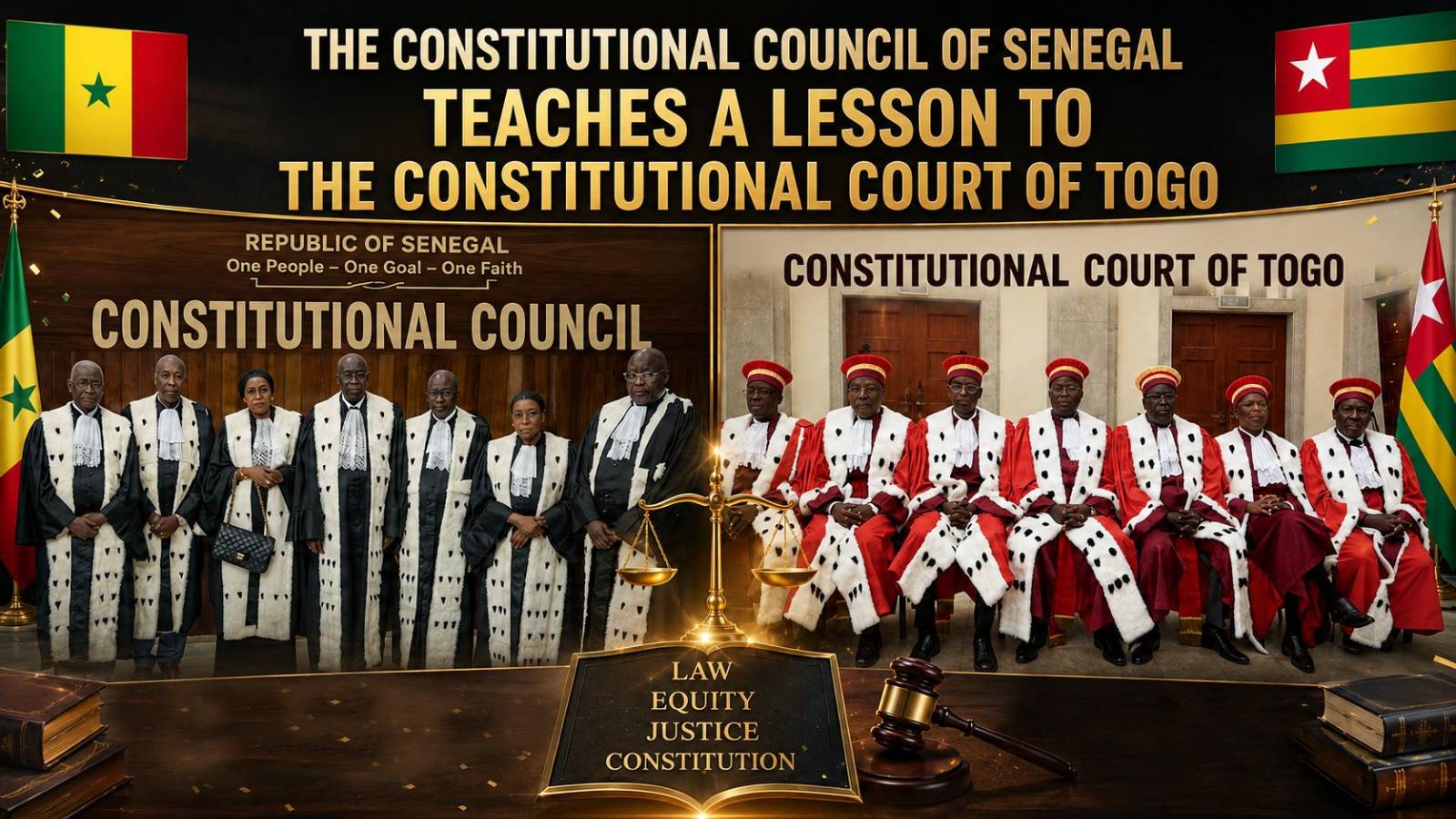
Senegal and Togo showcase opposing visions of constitutional authority
The constitutional landscapes of Dakar and Lomé today reflect two fundamentally different approaches to the rule of law. Recent legal rulings in both capitals have once again exposed how deeply these nations diverge in their interpretation of institutional authority. In Dakar, the Constitutional Council has firmly upheld the supremacy of the constitution, even when facing pressure from a newly elected majority. Meanwhile, in Lomé, the Constitutional Court’s rulings have raised concerns that it may be functioning more as an extension of executive power than a genuine check on it.
Judicial boldness in Dakar
The Senegalese Constitutional Council’s decision to strike down a proposed constitutional amendment—backed by both the government of Ousmane Sonko and parliamentary allies—serves as a stark reminder that electoral victories do not grant unlimited authority. In a functioning democracy, political legitimacy is always constrained by constitutional boundaries. The council’s ruling underscored a critical principle: no majority, no matter how decisive, can override the foundational legal framework that defines the nation’s governance.
Controversial validation in Lomé
In Togo, the Constitutional Court’s approval of a sweeping constitutional overhaul has drawn sharp criticism from opposition figures, civil society groups, and legal scholars. Critics argue that the reform process lacked genuine national consensus, despite its profound impact on the country’s institutional architecture. A constitution is meant to embody the social contract; when it appears to emerge from political bargaining rather than collective agreement, its legitimacy is inevitably weakened.
The independence of courts as a pillar of stability
A robust judiciary serves as one of the most reliable safeguards against political crises. Senegal’s Constitutional Council has demonstrated how judicial independence can protect not only legal principles but also institutional stability. By enforcing constitutional limits—even against powerful political forces—the council prevents conflicts from escalating into institutional breakdowns or legitimacy crises.
Such judicial assertiveness also bolsters public trust. When a constitutional court can challenge executive decisions without apparent interference, it sends a powerful message: the rules of democracy apply equally to all. This legal predictability fosters political stability, economic security for investors, and international credibility. Countries where courts act as neutral arbiters rather than political tools are far more attractive to foreign partners and international organizations.
The contrasting case of Togo highlights the risks of a court perceived as aligned with the ruling power. When domestic legal avenues appear ineffective, citizens and political actors may turn to regional bodies—such as the ECOWAS Court of Justice—highlighting a systemic failure of national judicial integrity. Frequent recourse to external jurisdictions often signals a breakdown in domestic trust in constitutional institutions.
A constitution should not be a tool of convenience
The process by which a constitution is amended shapes the long-term health of a democracy. In mature democracies, major constitutional reforms are preceded by extensive consultations, robust debates, and efforts to build consensus. This caution stems from the understanding that a constitution does more than govern the present—it sets the rules for future leadership transitions.
When constitutional changes are driven by short-term political goals, they create dangerous precedents. Each incoming administration may feel compelled to reshape institutional rules to its advantage, fostering chronic instability and concentrating power in the hands of a few. Such an approach erodes the constitution’s role as a neutral foundation for governance and turns institutions themselves into battlegrounds.
Learning from African models, not just foreign ones
Togo’s government has sought inspiration from constitutional transitions abroad, including studying parliamentary systems in India. While comparative research can offer valuable insights, it cannot replace the relevance of African experiences shaped by similar historical, social, and political realities.
The continent offers numerous examples of how constitutional integrity strengthens democracy. Senegal’s Constitutional Council exemplifies how institutions earn credibility not through rhetoric but through decisive action—even when it challenges the powerful. This distinction is not merely symbolic; it influences governance quality, citizen confidence, international standing, and economic attractiveness.
Investors, development partners, and global institutions closely monitor the strength of a nation’s institutions and the predictability of its legal framework. A country that demonstrates stable, respected constitutional governance inspires far greater confidence than one where institutions seem to shift with political winds. Ultimately, the gap between Dakar and Lomé is not about their constitutions themselves, but about how their institutions interpret and uphold the rule of law. A resilient democracy is measured not by the frequency of constitutional reforms, but by its capacity to protect citizens from the excesses of all branches of power.