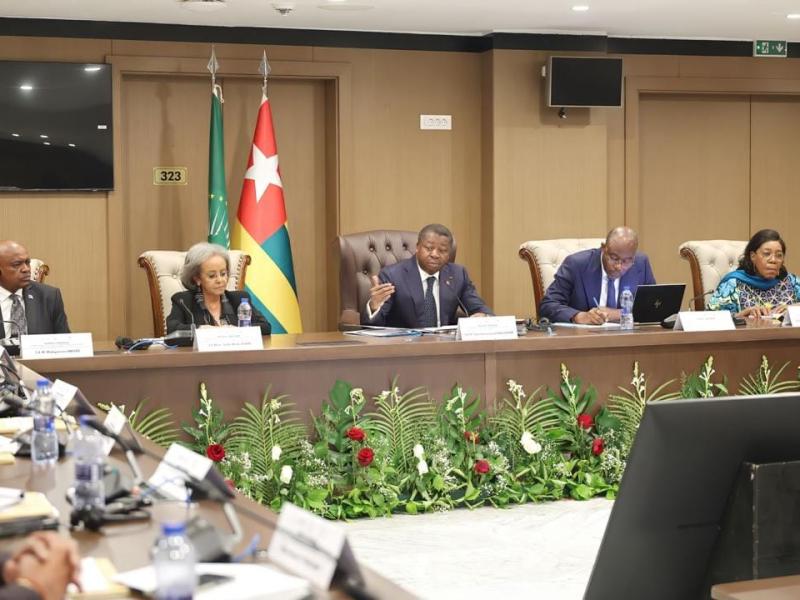
Faure Essozimna Gnassingbé, president of the Togolese Council and African Union mediator for the crisis in eastern Democratic Republic of the Congo (DRC) and the Great Lakes region, chaired a meeting in Lomé on Monday 8 June 2026. The session focused on a six‑month review of activities under the African mediation, amid a diplomatic stalemate and ongoing hostilities between government forces and the Rwanda‑backed AFC/M23 rebellion.
Attendees included members of the College of Facilitators appointed by the African Union, as well as representatives of the United Nations, the East African Community (EAC), the Economic Community of Central African States (ECCAS), the Southern African Development Community (SADC), the International Conference on the Great Lakes Region (ICGLR), and the International Committee of the Red Cross (ICRC).
The two‑day gathering, held on 7–8 June 2026, aimed to evaluate progress since the mediation architecture was adopted in Lomé on 17 January 2026, and to set priorities for the second half of the year in support of the Washington and Doha processes, led respectively by the United States and Qatar.
Strategic directions for the second half of 2026
According to the Togolese presidency’s communiqué, the review meeting adopted several orientations, including strengthening internal coordination among the Mediator’s Office, the Panel of Facilitators, the African Union Commission, and the independent joint secretariat.
Stakeholders also stressed the need to structure and provide an African contribution to the complementary Washington and Doha processes, in order to increase ownership, legitimacy, and implementation.
Participants called on all states and organisations engaged in mediation efforts to enhance cooperation in a spirit of solidarity, while respecting the responsibilities and mandates defined in the mediation architecture adopted in Lomé on 17 January 2026.
Immediate decisions
The meeting adopted several measures to boost the mediation process’s effectiveness. These include adjusting the work plans of Panel of Facilitators members for the second half of 2026, and drafting within fifteen days a detailed operational action plan specifying how the decisions will be implemented.
“Driven by a renewed collective will and a spirit of shared responsibility, participants committed to diligently and coherently implementing the decisions of this meeting, honouring their commitments, and working together for lasting peace in eastern DRC and the Great Lakes region,” the Togolese presidency stated.
This meeting followed the high‑level gathering on coherence and consolidation of the peace process in the DRC, held on 16–17 January in Lomé, Togo. Initiated by Faure Essozimna Gnassingbé, it aimed to build trust, advance dialogue, and ensure compliance with commitments by all parties.
That earlier meeting brought together a panel of facilitators comprising former heads of state, Togolese Foreign Minister Robert Dussey, representatives of the EAC and SADC, and several international partners, as part of ongoing diplomatic efforts for stability in eastern DRC.
At the conclusion of those talks, the African Union unveiled the mediation architecture for the peace process in eastern DRC. The structure places mediation under the authority of Togolese President Faure Gnassingbé as African Union mediator, supported by a Togolese mediation support team from the foreign ministry and the presidency.
Five co‑facilitators, all former African heads of state, are responsible for specific thematic areas. Former Nigerian President Olusegun Obasanjo handles military and security matters. Former Ethiopian President Sahle‑Work Zewde oversees humanitarian issues. Former Kenyan President Uhuru Kenyatta supervises dialogue with local armed groups. Former Botswanan President Mokgweetsi Masisi is in charge of regional economic cooperation. Former Central African Republic transitional President Catherine Samba‑Panza leads files on civil society, reconciliation, and gender.
The mechanism also includes an independent joint secretariat involving Togo, the African Union, the East African Community, the Southern African Development Community, and the International Conference on the Great Lakes Region (ICGLR). The African Union Commission coordinates with international partners, including the United Nations, Qatar, the European Union, and the five permanent members of the UN Security Council.