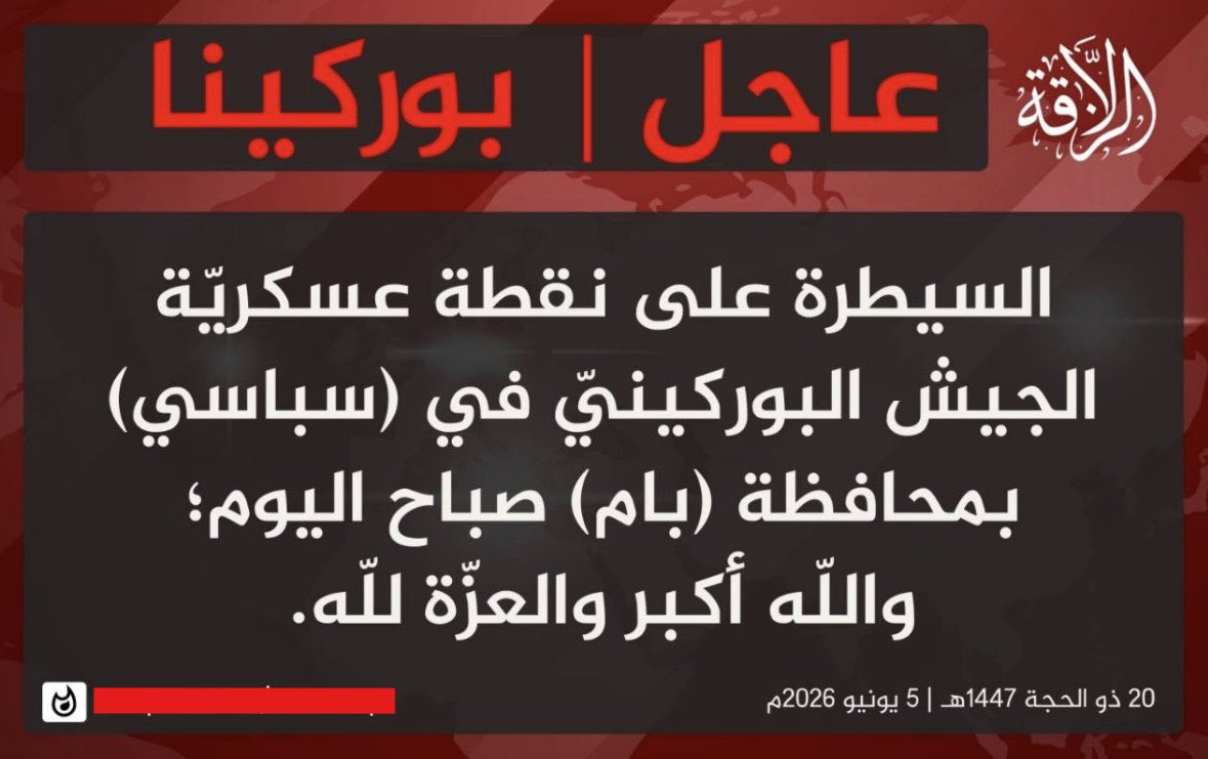
Another major security incident has rocked Burkina Faso‘s Centre-Nord region. On the morning of June 5, 2026, militants from the Group for the Support of Islam and Muslims (JNIM) launched a coordinated assault on a military outpost in Sabcé, located in the Bam province. The attackers, arriving on motorcycles and heavily armed, briefly overpowered the local security forces before air reinforcements arrived, forcing the militants to retreat. While official casualty figures remain undisclosed, the operation has exposed critical vulnerabilities in the nation’s defense strategy.
Sabcé under siege: a morning of chaos
The attack unfolded just before dawn, catching security personnel off guard. The JNIM fighters, exploiting the element of surprise, overwhelmed the outpost’s defenses despite the presence of Burkinabè armed forces and Volunteers for the Defense of the Homeland (VDP). Local reports indicate the militants looted military equipment and ammunition before withdrawing as aerial support closed in. The incident has reignited concerns about the security of key transit routes linking the Centre-Nord to the rest of the country.
Security flaws exposed: the limits of a static defense
This latest assault underscores the limitations of Burkina Faso’s current security model. Despite increased troop deployments, modernized equipment, and community-based defense initiatives like the VDP, terrorist groups continue to exploit gaps in the system. Analysts point to persistent challenges, including delayed reinforcement responses and the lack of proactive intelligence gathering, which allow militants to isolate detachments, disrupt communications, and strike strategic targets with impunity. The enemy’s mobile and cross-border nature demands a more dynamic and collaborative approach.
Wadagni’s regional initiative gains urgency
The timing of this attack amplifies the significance of Benin‘s recent diplomatic push for military collaboration across West Africa. President Romuald Wadagni, in his first major regional engagement, visited Niamey and Ouagadougou to advocate for a unified defense strategy. “An enemy that ignores borders cannot be defeated by isolated nations,” Wadagni asserted during his address, emphasizing the need for intelligence sharing and joint operations.
His proposal, widely praised by regional security experts, represents a shift from fragmented responses to a coordinated regional effort. The assault on Sabcé serves as a stark reminder that Burkina Faso cannot combat terrorism in isolation—neighboring countries must act as one.
Breaking down barriers for a collective response
Implementing Wadagni’s vision requires more than diplomatic rhetoric. Terrorist networks like JNIM and the Islamic State exploit border regions as safe havens and transit routes. A true partnership would entail real-time intelligence sharing, synchronized military operations across borders, and mutual pursuit rights. Benin, Niger, and Burkina Faso—particularly in areas like the W National Park—share interconnected ecological and security challenges. By extending cooperation to Ouagadougou and Niamey, Wadagni has laid the groundwork for a unified front essential to dismantling militant supply chains.
The moment for strategic decisions
The attack on Sabcé is not just another security breach—it is a clarion call for change. While Burkina Faso’s military remains resilient, the repeated successes of JNIM highlight systemic weaknesses that demand urgent action. The path forward requires both tactical adjustments within the country’s defense apparatus and a willingness to embrace regional partnerships, starting with Benin’s initiative. The future of Burkina Faso’s security hinges not on isolated efforts, but on collective determination and coordinated defense. The time for action is now.