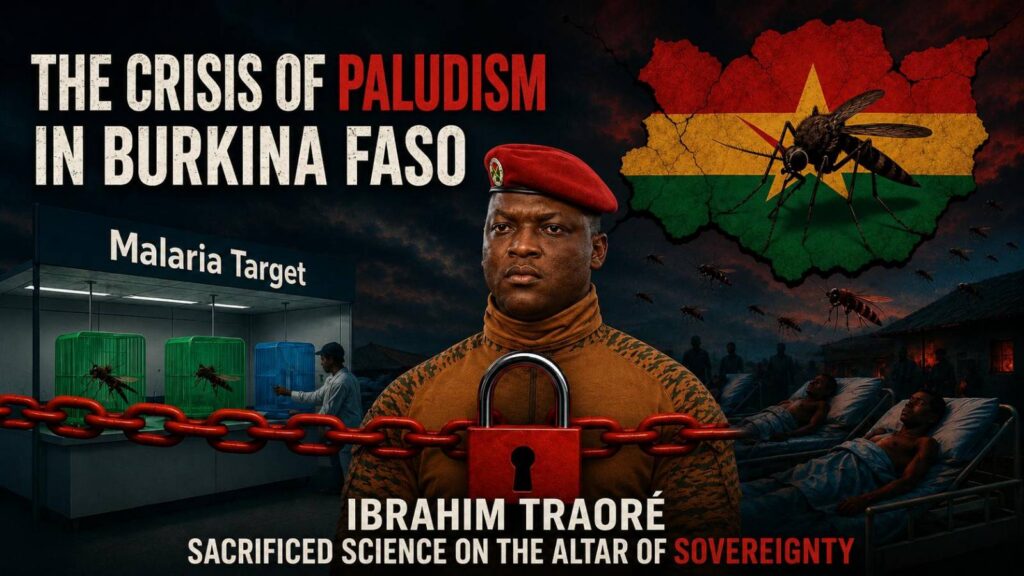
The Burkina Faso government’s recent decision to permanently shutter the Target Malaria research project and destroy its genetically modified mosquito samples marks a decisive turn toward scientific isolation, with far-reaching implications for both public health and economic stability. Under the leadership of Captain Ibrahim Traoré, the regime has elevated sovereignist rhetoric to a new level, framing the move as a necessary assertion of national autonomy. Yet beneath the political symbolism lies a troubling reality: the abandonment of cutting-edge medical research at a time when malaria continues to claim countless lives across Sub-Saharan Africa.
The end of an ambitious scientific endeavor
The Target Malaria initiative, which had operated in Burkina Faso for nearly a decade, represented one of the most promising frontiers in the global fight against malaria. Funded primarily by the Bill & Melinda Gates Foundation, the project explored innovative gene-drive technology aimed at reducing the fertility of malaria-carrying mosquitoes. Its closure, following a suspension of activities earlier this year, signals not just a policy shift but a fundamental rupture in the country’s approach to scientific collaboration and public health innovation.
Sovereignty at what cost?
While proponents of the decision argue that it safeguards Burkina Faso’s biological sovereignty, critics warn of severe consequences. The project involved leading Burkinabè researchers, including those from the Institut de Recherche en Sciences de la Santé (IRSS), who now face the loss of critical funding and access to advanced research infrastructure. The abrupt termination of international partnerships risks accelerating a brain drain, as scientists seek opportunities beyond the country’s borders.
The erosion of trust in Sahelian markets
More than a domestic issue, this decision sends shockwaves through the international community, reshaping perceptions of Burkina Faso as an investment destination. Three key shifts are particularly alarming:
- Contractual security in freefall: Prior to the 2022 political transition, state agreements were generally honored, fostering a climate of predictability. Today, unilateral policy reversals have shattered this trust, prompting investors to withdraw long-term commitments.
- Regulatory opacity: Once governed by regional and international standards, Burkina Faso’s regulatory environment has become increasingly unpredictable, driven by sudden decrees rather than structured governance. This volatility has already begun to redirect capital toward more stable markets.
- Distrust in international R&D cooperation: Long seen as engines of development, cross-border research initiatives are now viewed with suspicion by authorities, who allege foreign interference. This climate of distrust threatens to isolate Burkina Faso from global scientific advancements.
The paradox of self-sufficiency
The Burkinabè government’s insistence on protecting its ‘biological heritage’ from external influence reflects a broader trend in the region: the pursuit of autarky in the name of sovereignty. However, malaria does not respect national borders, and the fight against it demands sustained investment and cross-border collaboration. Without access to international expertise and resources, Burkina Faso risks falling behind in the global race for medical innovation, leaving its most vulnerable populations—particularly children under five—to bear the brunt of this policy shift.
A cautionary tale for West Africa
The Burkina Faso experience serves as a stark reminder of the dangers of conflating sovereignty with isolation. For nations in West Africa and beyond, the challenge lies in balancing national autonomy with the necessity of international cooperation. As the Sahel grapples with escalating health and economic crises, the question remains: will the pursuit of sovereign ideals come at the expense of the very populations these policies aim to protect?