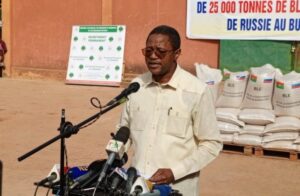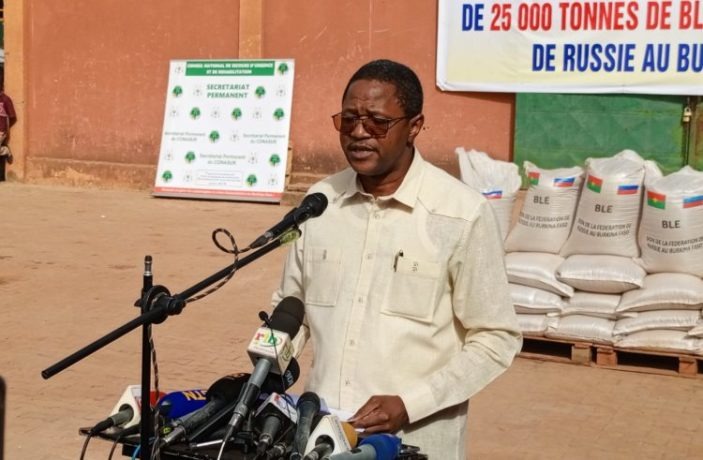
How can a government proclaim food self-sufficiency in the same breath as it welcomes a foreign grain shipment with full honours? That is the dilemma now facing Burkina Faso, after the transitional authorities staged a high-profile reception on 23 September 2026 for a consignment of 25,000 tonnes of wheat offered by the Russian Federation. On one side stands the rhetoric of a nation feeding itself; on the other, the concrete reality of cereal sacks arriving from abroad to fill the gaps. The distance between the two has rarely looked so wide.
The gap between the official narrative and what ends up on the plate
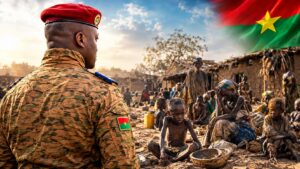
Captain Ibrahim Traoré has built a substantial part of his public messaging around the idea that Burkina Faso is closing in on food self-sufficiency, crediting agropastoral offensives and what he describes as recovered sovereignty. Yet the arrival of another massive foreign cereal delivery tells a different story — one in which the country still depends on outside supplies to keep markets and displacement camps provisioned.
An agricultural crisis that speeches cannot cover
The contradiction is not merely rhetorical. Large swathes of rural territory have slipped out of state control, and farming communities displaced by insecurity have been forced to abandon cultivable land. Under those conditions, national granaries cannot realistically absorb the demand of cities and camps without external shipments arriving to bridge the shortfall.
Symbolism versus storage capacity
If self-sufficiency were a measurable fact rather than a slogan, domestic harvests alone would be enough to supply urban centres and displaced populations, with no need to wait for vessels sailing in from distant seas. Celebrating the supposed end of dependency while rolling out the red carpet for emergency grain is a difficult position to defend.
Is the Russian delivery a gift, or a bill settled in strategic concessions?
The label of humanitarian generosity attached to the operation deserves closer inspection. Behind the official language of partnership with Moscow, the contours of a political and financial arrangement remain deliberately blurred. The phrase “free donation” functions less as a description than as a screen.
What Moscow stands to gain
Analysts who follow the relationship closely detect either a disguised purchase or a highly political barter. In exchange for grain, Russia is seen to be deepening its geopolitical, security and economic footprint in the country — trading food for strategic access to gold mining, economic contracts and unwavering diplomatic alignment.
A price paid in sovereignty
Seen through that lens, the 25,000 tonnes are anything but costless. They are settled at the steep rate of external dependency and sovereign concessions. Rather than a disinterested act of solidarity, the transfer looks more like a political invoice ultimately footed by the Burkinabe taxpayer in indirect form.
Aid as a lever of influence: the stakes Ouagadougou cannot ignore
Turning an external resupply operation into a symbol of sovereignty amounts to reversing the meaning of the word. A genuinely sovereign nation produces what it consumes on its own soil, protected by its own security forces. Food aid, however warmly received, is a lever of influence — and levers cut both ways.
The question that will not go away
As long as the narrative of rupture promoted by Captain Ibrahim Traoré keeps colliding with the reality of imported wheat sacks used to answer immediate emergencies, sovereign self-sufficiency will remain what it is today: a communication device rather than an achieved objective. The real test is not the ceremony at the port, but what farmers, herders and displaced families find in their bowls next season — and who ultimately decides what lands there.