Can Burkina Faso still hold the ground just beyond its own capital? That is the uncomfortable question hanging over Boussouma, a village barely 77 kilometres north-east of Ouagadougou that has been emptied of its inhabitants under pressure from armed groups. Once a trading crossroads and a symbol of community cohesion, the locality now stands as a test case: if a settlement this close to the seat of power can slip away, how far has the state’s reach actually retreated?
A trading hub 77 km from the capital, now emptied
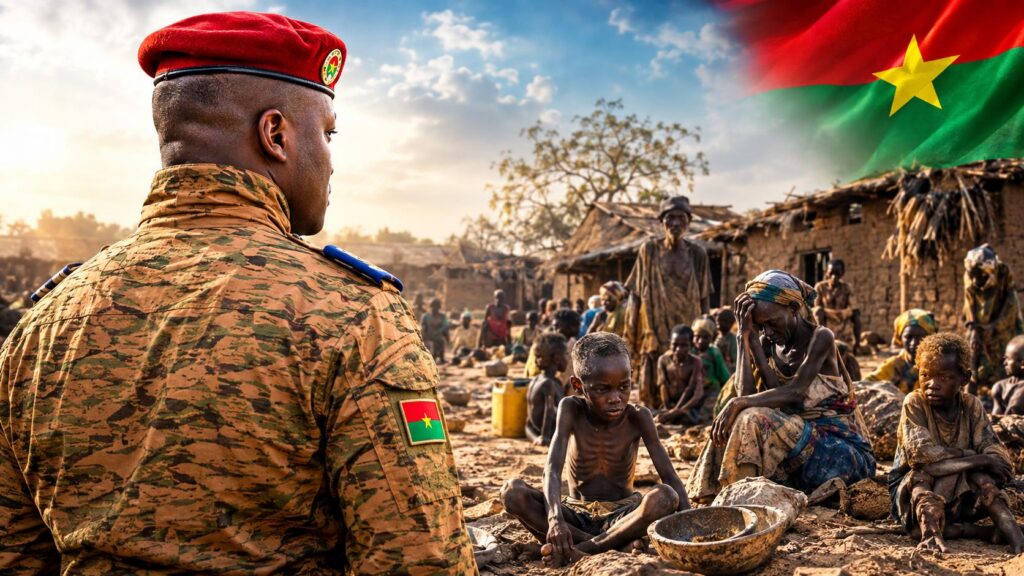
Less than an hour’s drive from Ouagadougou, Boussouma was for years a place where merchants met and where community ties held firm. Today it is a village in flight. Faced with the relentless advance and gradual entrenchment of armed terrorist groups, residents had little choice but to leave, transforming a once lively hub into a forced rural exodus with no visible end.
Why the overhaul of traditional authority became the turning point
The security collapse did not happen out of nowhere. It followed the recent reorganisation of the administrative and customary framework imposed by the authorities. By dismantling local customary authorities and disrupting the historic administrative network — through the application of the law on the status of customary chiefdom (law no. 002-2026/ALT) and the adjustments made within the Royal Court of Boussouma — the central government broke the social shield and the informal security anchor that had kept the area together.
Customary chiefs sidelined, an informal shield disappears
Customary leaders were never just ceremonial figures. They carried the community relay and the local intelligence that helped keep the zone stable. Once that layer was destabilised, the region lost the quiet architecture that had been holding it in place.
A vacuum that armed groups read as a green light
That institutional void, and the loss of bearings it produced, was quickly understood on the ground as a starting signal. Exploiting the weakened traditional structures that had once provided the community link and neighbourhood information, the attackers moved in fast to impose their control.
What does losing Boussouma mean for Ouagadougou?
The gradual installation of armed groups and the near-total departure of Boussouma’s population mark a critical stage in the country’s deteriorating security. Seeing a village positioned less than 80 kilometres from the capital deserted under terrorist pressure lays bare how much territory the state has effectively given up.
Displaced families head for neighbouring towns and the capital’s outskirts
As the displaced arrive in nearby localities or attempt to reach the outskirts of Ouagadougou with almost nothing, the abandonment of Boussouma raises a sharp question about the relevance of the institutional reforms currently under way — measures that local populations read as disconnected from the vital emergencies they face every day.
The stakes: can reforms survive contact with reality?
The empty streets of Boussouma force the dilemma into the open. Rebuilding state authority around the capital while weakening the very customary bodies that once underpinned it looks increasingly contradictory, and the practical consequences are already visible:
- Can the state reassert its presence so close to Ouagadougou without the local structures it has just sidelined?
- How much longer can the current institutional course be justified when villages this near the capital are emptying?
- What will it take for displaced families to return to the land they have left behind?
The question Burkina Faso cannot postpone
Boussouma’s fate is no longer a local matter. It measures the cost of decisions taken far from the ground, and it asks whether a reform designed to reorganise authority has instead handed space to those who want to control it. For a country fighting to protect its centre, that is a question with no comfortable answer.