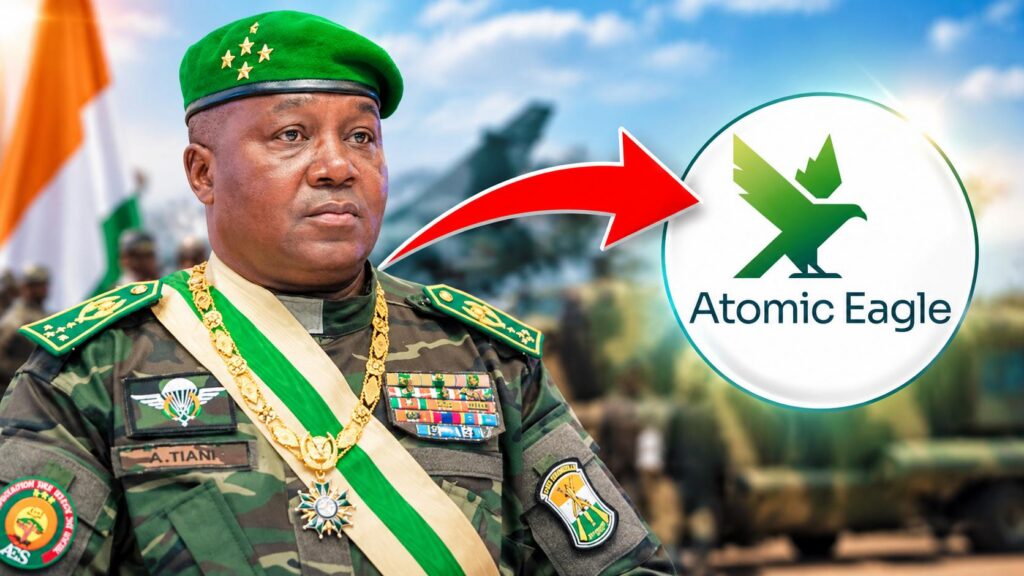
Presented by Niger’s transitional authorities as a landmark victory for mining sovereignty, the uranium agreement signed on 23 September 2026 around the Madaouela deposit raises a far more uncomfortable question: who actually absorbs the risk if the project never reaches production? The convention with Atomic Eagle grants the state a 40% shareholding, a direct payment of 10 million dollars and a pledge to create 1,000 jobs. Behind that triumphant staging, however, the real feasibility of the venture — and what Niger can genuinely expect from it — remains largely undefined.
An operator picked for speed rather than technical proof
The choice of Atomic Eagle stands out above all for the technical guarantees it does not bring. Anxious to show that it had replaced the Canadian company GoviEx, pushed out in 2024, Niamey turned to a player that has never built or operated a uranium mine at industrial scale. Its only notable project, located in Zambia, is still stalled at the preparatory study stage.
Madaouela requires colossal investment, complex infrastructure and advanced expertise. Handing a strategic deposit of this kind to an actor with no demonstrated production capacity amounts to an irresponsible gamble. Without a binding schedule or financial penalties, the permit could easily end up as a financial asset traded abroad while the site itself sits abandoned.
The 40% stake: a political headline that may conceal a trap
Announcing a 40% public shareholding is a ready-made political message designed to dazzle public opinion. The central question, carefully avoided by the authorities, remains untouched: how much of that equity will the state actually have to fund?
Who pays for the state’s share of the investment?
If Niger must finance its own portion of development, equipment and construction spending, the contract could quickly turn into a financial trap. A country already facing a fragile economic situation would expose itself to massive cash calls to underwrite the operational risks of an inexperienced partner, opening the door to heavy indebtedness or inevitable dilution.
Ten million dollars and 1,000 jobs: symbolic figures, vague commitments
The 10 million dollars paid by Atomic Eagle looks like a token payment when set against the true value of the reserves being transferred and the cost of developing a mine. Selling that initial cheque as a commercial success is an optical illusion that hides the absence of guarantees on future tax revenues and on the repatriation of profits.
Nothing detailed on hiring, training or local subcontracting
As for the cosmetic promise of 1,000 jobs, it rests on no precise data. Are these temporary construction positions or permanent posts? Nothing is spelled out about local recruitment targets, training plans or national subcontracting. Without published regulatory constraints, those figures belong to propaganda rather than planning.
Sovereignty on paper is not sovereignty in practice
In truth, this agreement looks less like a carefully considered industrial development strategy and more like a political compromise aimed at closing the chapter on the dispute with GoviEx.
Sovereignty is not decreed by percentages written on paper. It is exercised through the ability to frame foreign capital, verify real costs and secure direct benefits for the population. By refusing transparency and keeping the terms of the convention out of public view, the authorities are handing the country’s subsoil over to uncertainty. Madaouela should not be sacrificed on the altar of political communication.