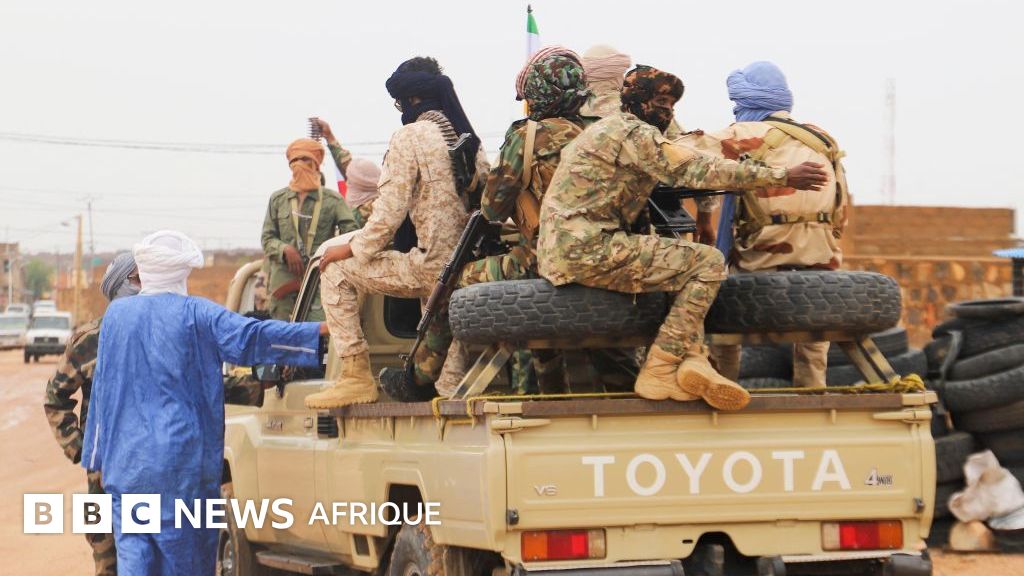
The coordinated assaults that rocked Mali this past weekend have spotlighted a troubling new reality: an unprecedented alliance between jihadist factions and Tuareg separatists is now challenging the military government’s grip on power.
From Bamako to Kidal, the joint operations carried out by the Jama’at Nusrat al-Islam wal Muslimin (JNIM) and the Front de Libération de l’Azawad (FLA) revealed a level of tactical coordination never before witnessed in the Sahel’s ongoing conflict.
This merger of forces marks a critical shift in the Malian crisis. For years, these two groups operated in opposition—one driven by a transnational jihadist vision, the other by a separatist agenda rooted in Tuareg identity. Yet, for now, they have set aside ideological differences to target a common adversary: the military junta.
The implications are far-reaching. The alliance signals a dangerous recalibration of power dynamics across the Sahel, where traditional fault lines are dissolving in favor of tactical convergences. Observers warn that this emerging cooperation could permanently disrupt regional stability.
The attacks not only expose the junta’s military vulnerabilities but also deepen internal fractures within Bamako’s leadership. Tensions with external partners—particularly Russia and members of the Alliance of Sahel States (AES)—have intensified, raising concerns about the regime’s growing isolation in the face of a more coordinated and unpredictable insurgency.
From rivalry to uneasy cooperation
The JNIM, an Al-Qaeda-affiliated coalition, operates across the Sahel with a goal of establishing a transnational Islamic order. Its tactics rely on guerrilla warfare, bombings, and terror to destabilize governments.
The FLA, on the other hand, is a Tuareg separatist movement seeking independence or autonomy for the Azawad region. Its strength lies in local legitimacy, deep community networks, and a legacy of armed resistance tied to Tuareg identity.
Historically, these groups were rivals. The FLA viewed the JNIM’s agenda as a threat to its territorial ambitions, while the JNIM saw the separatists as competitors for influence. Their alliance today hinges on a pragmatic convergence: the FLA brings local knowledge and legitimacy, while the JNIM contributes combat experience, firepower, and transnational logistics.
Despite their conflicting long-term visions—the FLA seeks a secular autonomous state, while the JNIM aims for a strict Islamic caliphate—their tactical cooperation is proving effective. Together, they are weakening state institutions and sowing uncertainty at the heart of Mali’s political and military leadership.
An alliance that defies logic
« This is not the first time such an alliance has formed, » notes Emmanuel Odilon Koukoubou, a political scientist and senior researcher at the Civic Academy for Africa’s Future (CiAAF). He points to a similar configuration in 2012–2013, when the National Movement for the Liberation of Azawad (MNLA) allied with jihadist groups like Al-Qaeda in the Islamic Maghreb (AQMI) and Ansar Dine to push Malian forces out of northern Mali.
« That alliance quickly collapsed, » Koukoubou explains. « The MNLA lacked the manpower and resources, so it turned to the jihadists for support. But the jihadists soon turned on them, driving the MNLA out of key territories. »
The current FLA-JNIM partnership, while tactical, carries even greater risks. « The FLA is seeking independence for the north, while the JNIM wants to impose an Islamic caliphate across the Sahel. Their goals are fundamentally incompatible, » Koukoubou emphasizes. « Their cooperation is purely circumstantial—based on a shared enemy: the Malian state. »
The junta under siege
The coordinated strikes have not only exposed military weaknesses but also struck at the heart of the junta’s credibility. The assassination of Sadio Camara, Mali’s Defense Minister and a key strategist within the military, sent shockwaves through Bamako. The attack, carried out in his own residence in Kati, revealed glaring security failures and underscored the regime’s vulnerability even in its strongholds.
« The killing of Camara is a major blow, » says Alioune Tine, founder of the Afrikajom Center in Dakar and former UN independent expert on Mali. « He was not just a defense minister; he was an ideologue, a strategist, and a central figure in the military command. His death weakens the entire chain of authority. »
The government’s delayed response—with no public statement from the president for 48 hours—only fueled speculation about instability within the regime. Prime Minister Abdoulaye Maïga eventually addressed the nation, acknowledging the « asymmetric » nature of the threat and vowing to adapt security measures accordingly.
« The government must learn from these incidents, » Maïga stated. « We will strengthen our strategies and implement the necessary corrections to better secure our people. »
Regional domino effect feared
The crisis comes at a precarious diplomatic moment. Mali, increasingly isolated from Western partners, has pivoted toward Russia and the Alliance of Sahel States (AES). Yet, this shift has done little to bolster its security posture.
« The Malian regime is exposed in its fragility, » warns Koukoubou. « Its external support is limited, and the risk of further isolation is real. This could accelerate its decline. »
For Tine, the stakes extend far beyond Mali’s borders. « The collapse of Mali could trigger a domino effect across West Africa, much like the spread of jihadist insurgencies did in the past, » he cautions. « The priority now is to develop a collective regional strategy—one that prioritizes shared security, governance, and defense. Without a unified response, there is no way out. »
« If I were the ECOWAS or the AES, I would recognize that our fates are intertwined, » Tine concludes. « We need an extraordinary summit on regional security. The top priority today is security—and the only way to build it is together. »