Dakar 2026: the first olympic event in africa faces immense challenges
With fewer than six months until the Youth Olympic Games (YOG) in Dakar, Senegal is under the spotlight. The event, postponed from 2022 due to the Covid-19 pandemic, marks a historic milestone as the first Olympic competition ever held on African soil. Scheduled for October 31 to November 13, 2026, these Games will bring together 2,700 young athletes under the age of 17, competing across 25 sports and 153 events — including disciplines like breaking, skateboarding, and 3×3 basketball.
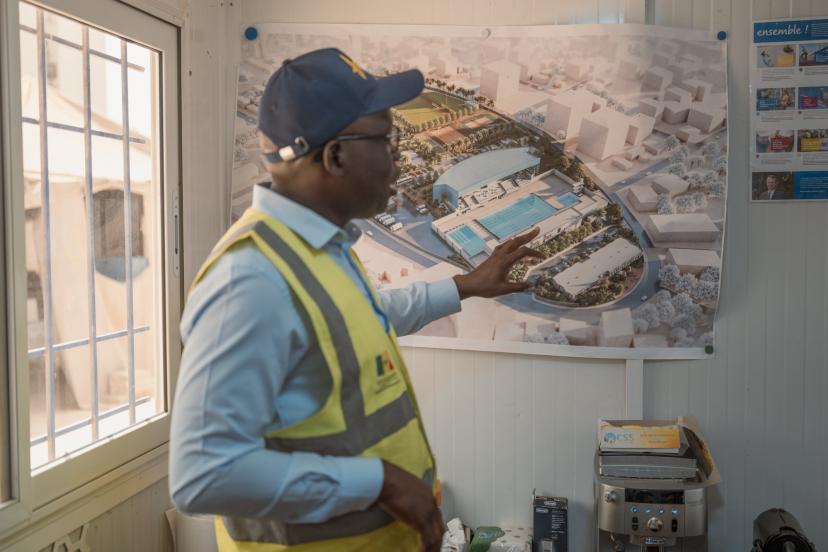 Babacar Senghor, coordinator of the Dakar 2026 Youth Olympic Games project, reviewing plans for the Olympic swimming pool.
a monumental task: organization, infrastructure, and legacy
The Senegalese government, led by Minister of State Ahmadou al-Aminou Lo — who oversees the Senegal 2050 Transformation Agenda — is spearheading the preparations. Lo chairs a monthly oversight committee that includes government, local, and institutional stakeholders, ensuring every detail is managed with precision. As he emphasizes: «Our role is to minimize all risks associated with delivering these Games. The goal is to ensure Senegalese state structures are agile and ready on time. I serve as the quality assurance for these preparations.»
The stakes are high. Lo underscores the dual pressure: «It’s about Senegal’s image and Africa’s reputation. We must prove we can host world-class sporting events.» This responsibility extends beyond logistics; the Games are seen as a catalyst for long-term development.
cleanliness, innovation, and infrastructure
The Olympic swimming pool complex at the Tour de l’Œuf in Dakar’s Point E district is a focal point of the preparations. This site, under renovation by Sogea-Satom (a subsidiary of Vinci), will host swimming, diving, basketball 3×3, baseball, breaking, and skateboarding events. Over 450 workers have been mobilized since construction began, with tribunes and facilities being upgraded to meet international standards.
Innovation is a key component: the pools feature water and energy-saving technology, a first for Senegal. A full test fill of the three basins is scheduled for May 15, with the complex set to be handed over to the organizing committee on August 15 — just two and a half months before the Games begin.
Senegal is also prioritizing cleanliness. Minister Lo has declared: «Our first medal will be for cleanliness.» The country aims to emulate Kigali, Rwanda, which ranked as Africa’s cleanest city in the 2025 Jeune Afrique report. Dakar, currently in 17th place, has launched a comprehensive cleanliness plan to transform its image.
french-senegalese partnership: lessons from Paris 2024
A 2019 agreement between France and Senegal has been pivotal in the preparations. The Alliance Dioko collaboration links the organizing committees of Paris 2024 and Dakar 2026, facilitating the exchange of best practices in areas like volunteer recruitment and event security. Bruno Le Ray, former Paris 2024 security director, recently visited Dakar to assess needs.
Christine Fages, France’s Ambassador to Senegal, highlights the partnership’s impact: «Around 30 experts from Paris 2024 have been integrated into the Dakar 2026 team. Additionally, 419 young Senegalese were trained in the Learning Academy to gain expertise in event organization and facility management.» This initiative, supported by a €1 million fund from the French Embassy, also includes a €80 million sovereign loan from the French Development Agency (AFD) for renovating the Iba-Mar-Diop Stadium and the Tour de l’Œuf complex, and building 12 new sports facilities.
The Ambassador adds: «Hosting the Olympics in Paris allowed us to witness the unifying power of such an event. Our collaboration with Senegal is about sharing this experience and ensuring its success.»
The French Embassy is also contributing €233,000 to support the Lamine Gueye High School Judo Academy, funding renovations to the dormitory and dojo, and providing sports and medical support for young judokas ahead of the Games.
legacy: a vision for Senegal’s future
Beyond the event itself, Senegal aims to create a lasting legacy. Minister Lo envisions the Games as a springboard for: «developing training programs, sports-study excellence centers, and promoting high-level competition.» The Senegal 2050 Agenda seeks to double the sport industry’s contribution to the country’s GDP, currently at €15 million, by leveraging the MICE industry (Meetings, Incentives, Conferences, and Exhibitions).
With over half of Senegal’s population under 19 years old, the Games are seen as an opportunity to inspire the next generation and position Senegal as a hub for sports and tourism in West Africa.
the countdown begins
As Dakar races against the clock, the country is determined to deliver an event that reflects its ambition and sets a new standard for Africa. The pressure is palpable, but so is the pride. As Lo puts it: «The Youth Olympic Games in Dakar are not just about sport. They are about our future, our image, and our place on the world stage.»
Stay tuned for updates as the countdown to Dakar 2026 continues.