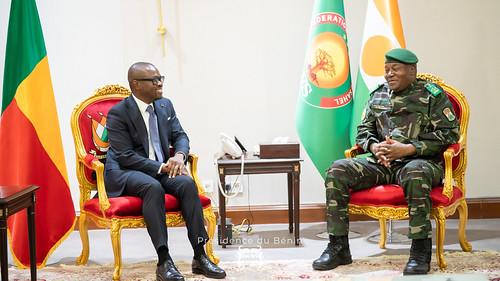
An official delegation from Niger touched down at Cotonou International Airport this week, marking a pivotal moment in bilateral relations that had been frozen for months. The warm welcome extended by Beninese authorities was not merely ceremonial—it signalled the resumption of high-stakes negotiations between two West African nations whose economies and security architectures remain deeply intertwined.
From diplomatic silence to actionable talks
The meeting in Cotonou follows a landmark encounter in Niamey, where the Presidents of both countries laid the groundwork for dialogue. Behind closed doors, teams of diplomats, military advisors, and economic analysts from Niger and Benin had spent two weeks refining proposals, addressing mutual grievances, and aligning their positions before the formal talks. The urgency is palpable: the reopening of their shared border, closed after political upheavals in Niamey, is no longer a distant hope but an immediate necessity.
Observers describe the atmosphere as a mix of solemnity and cautious optimism. The stakes are enormous, and the pressure from both business communities and ordinary citizens has never been greater. After years of mutual suspicion, the two governments appear ready to prioritize pragmatism over rhetoric, seeking solutions that transcend political posturing.
Economic lifelines hang in the balance
The closure of the Benin-Niger border has had a devastating impact on both nations, exposing the fragility of their shared economic ecosystem. For landlocked Niger, the Port of Cotonou is not just a trade gateway—it is a lifeline. The prolonged blockade has forced transporters and traders in Niamey to reroute shipments through distant, often hazardous corridors, driving transport costs to unsustainable levels. Inflation has surged, eroding purchasing power and deepening economic hardship for millions of households.
Benin, too, has felt the ripple effects. The transit corridor linking Cotonou to Niamey is a vital artery for regional trade, generating substantial customs revenue and supporting thousands of informal jobs. With trucks stranded on both sides of the border, small businesses—from market traders to roadside eateries—have seen their livelihoods vanish overnight. The economic fallout has made it clear: no nation in the subregion can afford to ignore the other’s suffering.
Security and sovereignty: the unspoken red lines
Beyond economics, the negotiations in Cotonou hinge on pressing security concerns. Niger’s transitional authorities have repeatedly emphasized that any agreement must not compromise national sovereignty or expose their territory to infiltration by armed groups. Key sticking points include joint surveillance of the Niger River, a natural border often exploited by militant factions, and the establishment of real-time intelligence-sharing mechanisms to thwart cross-border threats.
The challenge for negotiators is to design a border management system that is both watertight against asymmetric threats and seamless for legitimate commerce. Striking this balance will require unprecedented cooperation—one that acknowledges past mistrust while recognizing the irreversible interdependence of the two states.
Toward a new chapter in regional stability
The outcome of these talks is being watched closely by neighboring countries and international partners, who see the Benin-Niger axis as a bellwether for regional resilience. A lasting agreement would not mean a return to the status quo, but rather the birth of a more cautious, mutually accountable partnership. Success would demonstrate that even in times of political rupture, geographic and economic realities can force a pragmatic reset.
For the people of Niamey and Cotonou, the stakes are deeply personal. Months of uncertainty have taken a toll, and the promise of reopened borders is more than a policy decision—it is a lifeline to stability, dignity, and shared prosperity.