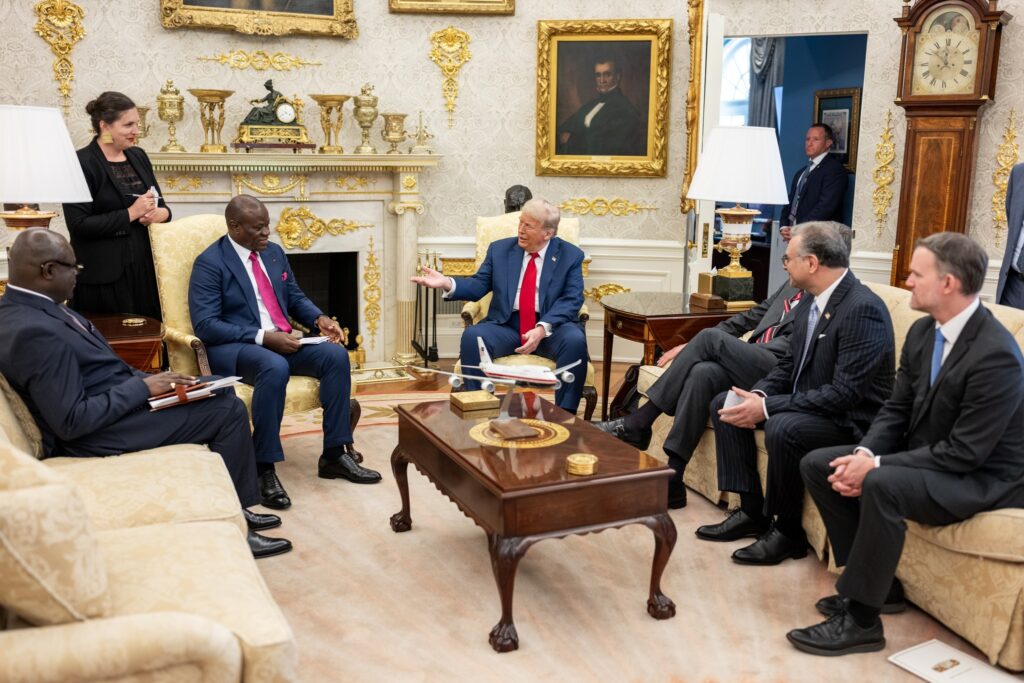
President Donald Trump speaks with President Brice Clotaire Oligui Nguema of Gabon in the Oval Office, Wednesday, July 9, 2025, before a multilateral luncheon with African leaders. (Official White House Photo by Daniel Torok)
Gabon rejects Trump’s migrant plan with firm sovereign stance
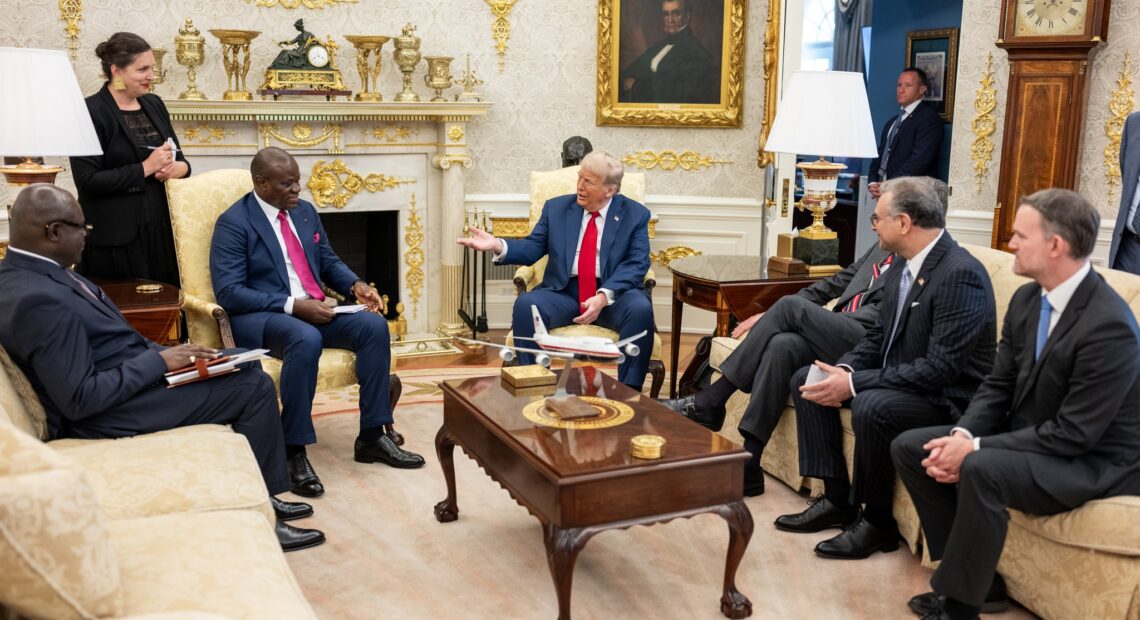
Libreville, June 4, 2026 — By firmly rejecting a proposal to host migrants expelled from the United States, Gabonese President Brice Clotaire Oligui Nguema has underscored a bold political stance that extends far beyond migration policy.
This decisive move, announced during a televised address, reflects Gabon’s evolving diplomatic doctrine—one that prioritizes national interests while maintaining balanced relations with global powers.
The Gabonese leader left no room for doubt during his remarks. Addressing a direct appeal from Washington regarding the resettlement of migrants, he made his position unequivocal: “On this matter, we did not reach an agreement. I did not accept them on my soil. I say this with complete transparency. Gabon is not prepared to sign an agreement that does not serve our interests. The decision is final.”
This firm rejection arrives at a time when Western nations, particularly the United States under Donald Trump’s administration, have intensified efforts to outsource migration management by seeking partner countries willing to accept expelled individuals.
Global migration challenges reshape diplomacy
For years, cross-border migration has emerged as one of the most pressing geopolitical challenges. Western nations and emerging economies alike have increasingly looked to third countries to manage migration flows outside their borders.
A number of African states have already entered into such agreements. Rwanda, for instance, has signed multiple deals with the United Kingdom to host relocated migrants. Similar discussions have taken place with other African governments.
Gabon’s refusal, therefore, carries significant weight in this broader context.
Yet the decision does not signal a diplomatic rift with Washington. Instead, President Oligui Nguema carefully framed the rejection to preserve the strong ties between Gabon and the U.S. He even invoked a light-hearted reference to Donald Trump as “my red-tie friend,” underscoring the personal rapport while making clear that strategic interests remain non-negotiable.
The message is clear: partnership endures, cooperation continues, but Gabon’s sovereignty takes precedence.
A growing emphasis on national independence
This decision aligns with a series of recent actions by Gabon that reflect a deepening commitment to sovereignty. From local processing of manganese to renegotiating economic agreements with foreign partners and reclaiming the Camp de Gaulle military base, Libreville is steadily building a policy centered on self-determination.
In this framework, migration policy has become a symbolic battleground. Accepting transferred migrants would have imposed administrative, social, security, and financial burdens—risks that are difficult to quantify. With Gabon engaged in a sweeping economic and social modernization drive, the government’s focus remains squarely on meeting domestic needs.
This stance also resonates with widespread sentiment across the African continent. Many view the continent as increasingly becoming a dumping ground for the migration challenges of wealthy nations—a role no African country should accept.
Balancing diplomacy without confrontation
The true significance of this episode may lie in its diplomatic finesse. Gabon has demonstrated it can decline a major power’s request without escalating into open conflict.
This measured approach contrasts sharply with the escalations seen elsewhere, where migration disputes often spark political crises. By publicly rejecting the proposal while maintaining a respectful tone toward Washington, President Oligui Nguema has projected an image of a sovereign state that defends its interests without resorting to confrontation.
For international observers, this move signals a shift in Africa’s relationship with global powers. Partnerships remain essential; cooperation is still vital. But African nations are now entering negotiations with greater confidence and autonomy.
Beyond migration alone, the message from Libreville is unambiguous: Gabon remains open to the world but will not allow its future to be dictated by external forces. In an increasingly fragmented global order, this assertion of sovereignty may well define Gabon’s diplomatic identity in the years ahead.