The recent announcement regarding the Guinean group SONOCO’s ambition to produce 15 million chickens annually in Gabon has reignited crucial discussions surrounding national economic sovereignty and the support extended to local entrepreneurs. While authorities present this initiative as a significant stride toward enhancing food security, various voices, including that of former transitional deputy Jean-Valentin Leyama, question the apparent lack of attention given to SOGADA, a Gabonese entity that has diligently invested in the poultry sector for over a decade. This inquiry extends beyond the agricultural realm, touching upon the fundamental philosophy guiding national economic development.
Gabon’s aspiration to increase domestic production of goods it consumes is undeniably valid. For a nation still heavily reliant on food imports, any endeavor aimed at bolstering local output warrants commendation. It is within this framework that the Presidency of the Republic’s announcement of SONOCO’s arrival, projecting an annual production exceeding 15 million broiler chickens, has been framed.
However, beneath the official enthusiasm, a critical question quickly emerged in public discourse. This isn’t to challenge foreign investment, which Gabon certainly requires for accelerated development, but rather to scrutinize the consistency of a political narrative that champions economic sovereignty and the promotion of national entrepreneurship as core tenets. How, indeed, can a nation speak of economic re-conquest without first empowering those who have already committed to investing within Gabon’s borders?
SOGADA: a forgotten national leader?
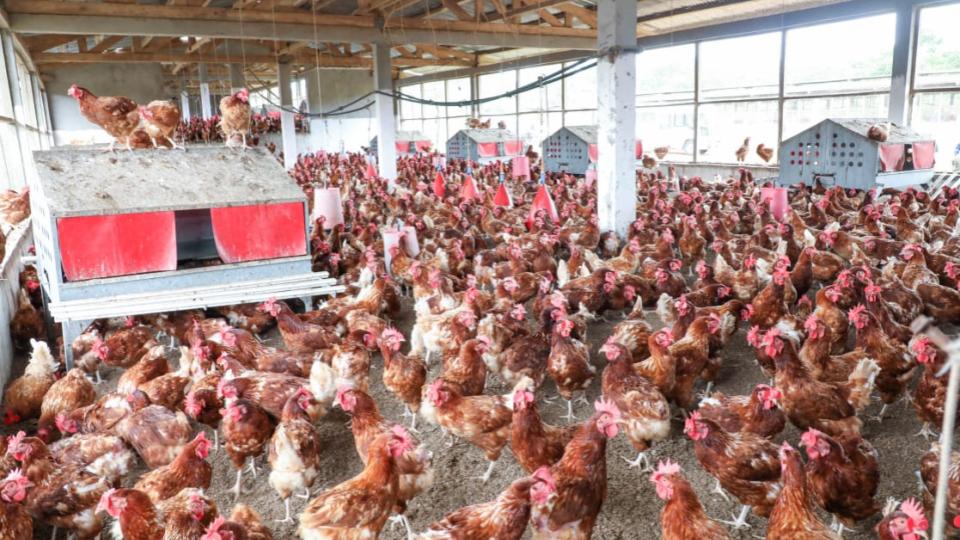
This sentiment precisely underscores Jean-Valentin Leyama’s intervention. The former deputy from the Transition period highlighted the existence of the Gabonese Agricultural Development Company (SOGADA), strategically located in Meyang, approximately 50 kilometers from Libreville. This enterprise is not merely a proposed project or a future promise; it represents a tangible economic reality, meticulously built over ten years with private Gabonese capital.
Established in 2013, SOGADA spans over 160 hectares and boasts investments totaling nearly 16 billion CFA francs. The company’s operations extend far beyond simple chicken farming. It has cultivated a comprehensive agro-industrial complex, integrating aviculture, egg production, pig farming, the processing of local agricultural products, and even an industrial unit for manufacturing egg cartons. In essence, SOGADA embodies an integrated value chain approach—precisely the model authorities currently advocate.
Actions over announcements
The fundamental distinction between SOGADA and recently unveiled projects lies in a simple fact: SOGADA is already producing. For several years, this company has actively contributed to import substitution efforts. It employs Gabonese citizens, invests within the national territory, pays its taxes, and plays a vital role in the country’s food security.
Consequently, the issue transcends economics to become distinctly political. Why do national entrepreneurs, who believed in Gabon’s agricultural potential when the sector was neither publicized nor deemed strategic, now appear to be relegated to the background? Why does the state not more prominently feature these pioneers who invested their own capital in a domain long perceived as high-risk? A coherent policy of economic sovereignty should inherently prioritize strengthening those who have already demonstrated their commitment.
Economic sovereignty is more than a slogan
This debate extends well beyond poultry production. It delves into the developmental vision Gabon seeks to embrace. In every nation that has successfully achieved economic transformation, the state has played a pivotal role in supporting its national entrepreneurs. It has not merely attracted foreign investors; it has also fostered an environment enabling its own businesses to evolve into national champions.
South Korea, for instance, strategically bolstered its industrial conglomerates. Morocco actively supports its enterprises across agriculture, finance, and industry. Rwanda proactively encourages the emergence of local actors capable of fulfilling its economic ambitions. Why then does Gabon still struggle to cultivate this same logic? Why do foreign investors sometimes appear to receive superior institutional visibility compared to national operators who have been investing on the ground for years?
The challenge of a strategic state
No one disputes the potential benefits of the SONOCO project. If its stated objectives are met, Gabon could significantly reduce poultry imports and generate thousands of jobs. However, the core challenge lies elsewhere. The real question is whether the state intends to forge genuine economic sovereignty or simply welcome investors capable of local production.
True economic sovereignty is not solely defined by the geographical origin of production. It also hinges on a nation’s capacity to nurture its own entrepreneurs, provide them with financing, protect them, and support their expansion. A nation that fails to back those who invest locally with their own resources will ultimately find itself importing its development as much as its products.
A question demanding official response
Ultimately, the announcement of the SONOCO project raises a question that public discourse cannot ignore. If economic sovereignty is indeed a national priority, why are Gabonese actors who invested ahead of others in strategic sectors not positioned at the very heart of this ambition?
SOGADA is more than just an agricultural enterprise. It stands as clear evidence that Gabon possesses entrepreneurs capable of substantial investment, risk-taking, and building entire value chains. The true inquiry is therefore not why SONOCO is coming to Gabon. Instead, it is to understand why those who have already proven their capabilities are still awaiting recognition from the Republic as the national champions they have become. For credible economic sovereignty is not built in opposition to foreign investment; it is primarily constructed by trusting its own builders.