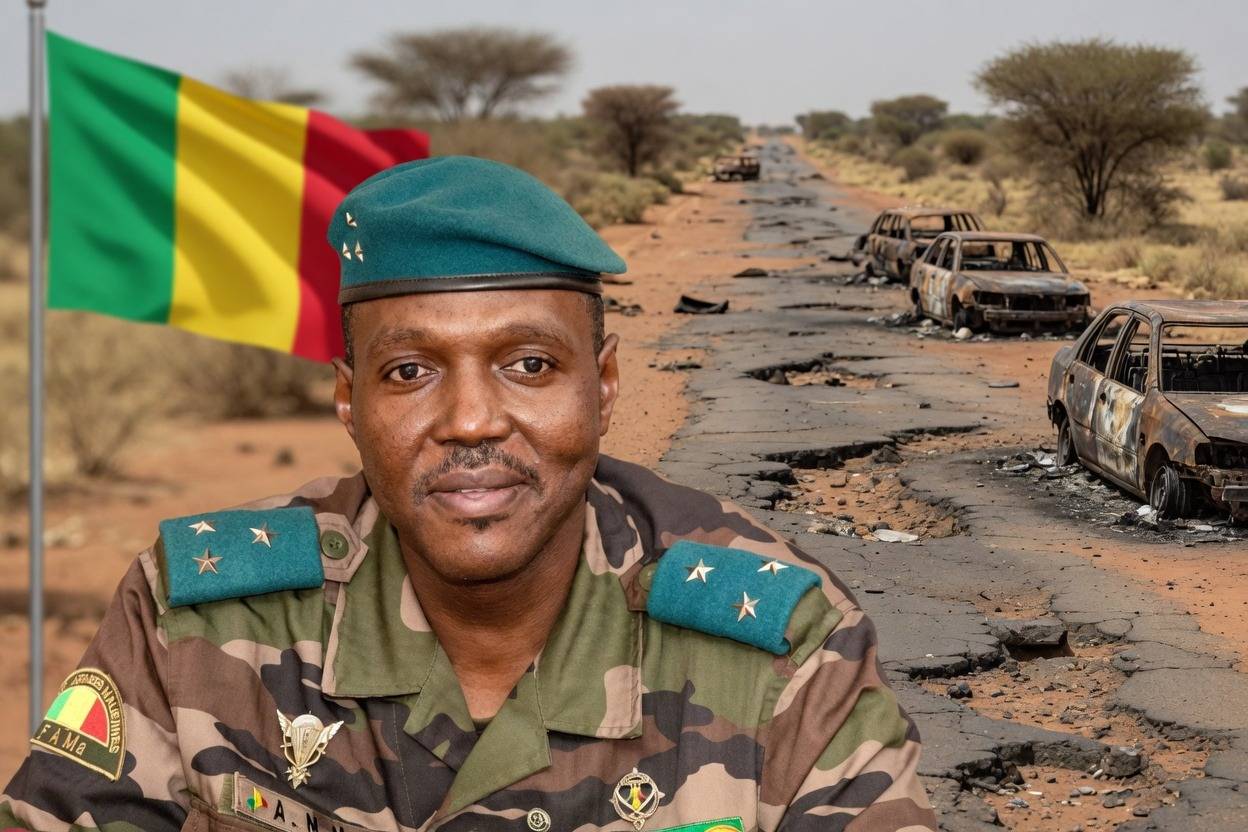
The once-vital supply routes in northern Mali now resemble graveyards strewn with charred vehicle wrecks, rotting food supplies, and abandoned bodies lining the roadsides. The air carries a heavy stench of death, a grim reminder of the violence gripping the nation. Yet, in Bamako, the transitional authorities cling to a narrative of denial, insisting that no blockade exists and that freedom of movement remains intact. Prime Minister Abdoulaye Maïga reinforces this delusion with forceful declarations, claiming, « There is no blockade on the roads. Everyone moves freely in Mali », as if words alone could erase the humanitarian and security collapse unfolding beyond the capital.
a tale of two realities: words vs. suffering
The disconnect between Bamako’s rhetoric and the ground reality has never been starker. While military officials in the capital celebrate phantom victories through official statements, the lifelines connecting southern Mali to its northern regions have become death traps. The junta’s obsession with projecting an image of restored sovereignty has overshadowed its failure to protect its own people. Dissent is met with accusations of treason, and any mention of civilian suffering is dismissed as subversive propaganda. By prioritizing a manufactured image of strength over the urgent needs of its citizens, the regime has retreated into an ivory tower, the cost of which is measured in lives lost.
security collapse: the aftermath of broken alliances
The strategic missteps of the transitional government are glaring. The abrupt severance of long-standing partnerships with international allies has not delivered the promised security dividend. Instead, the withdrawal of foreign forces has left a dangerous void, one rapidly filled by armed terrorist groups. These factions have tightened their stranglehold on towns and villages across the Mali’s central and northern territories, imposing brutal sieges that choke off vital supplies. Rather than securing convoys or establishing a sustained territorial presence, the regime resorts to sporadic airstrikes—tactics that do little to break the economic asphyxiation strangling the nation. On the ground, the government has lost the initiative entirely, reduced to a reactive posture that offers no long-term solution.
a nation suffocating under political stagnation
The crisis in Mali is not merely a military or security failure—it is a systemic collapse rooted in political paralysis. The suppression of dissent has reached alarming levels, with journalists, opposition figures, and civil society activists silenced or imprisoned for daring to expose the truth. Independent voices, once a potential source of resilience, are now choked into silence. With no clear electoral roadmap and a tightening grip on power, the regime’s priorities have shifted from addressing the crisis to entrenching its own survival. Nationalist rhetoric fills the airwaves in Bamako, but in the heartlands of the Mali, where the real suffering unfolds, the nation continues to decay by the roadside, abandoned to its fate.