In the Mali, a wave of anxiety has gripped the northern regions as the security landscape undergoes a dramatic shift within a matter of days. Following the symbolic fall of Kidal, armed factions have accelerated their advance, while the Group for the Support of Islam and Muslims (JNIM) escalates its campaign with an unprecedented political maneuver—calling for the overthrow of the transitional government.
Military setbacks evoke memories of past crises
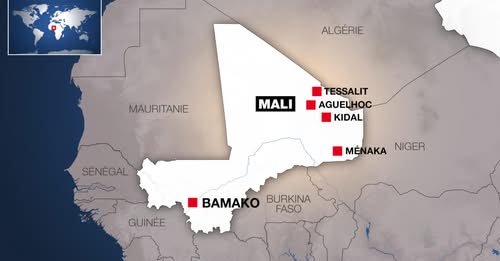
The unfolding crisis mirrors the bleak scenario of 2012. On May 1, 2026, militants from JNIM and separatists from the Azawad Liberation Front (FLA) seized critical military outposts in Tessalit and Aguelhoc. The withdrawal of Malian Armed Forces (FAMa) and their Russian partners, Africa Corps, paved the way for the attackers to enter unopposed.
A verified image captures the humiliation: Seidane Ag Hitta, a prominent JNIM leader, is seen proudly displaying the keys to the Tessalit base—a stark reminder of the Barkhane mission’s departure five years prior. Since April 25, towns such as Ber, Tessit, Hombori, and Gourma Rharous have fallen, leaving residents of Gao and Tombouctou in a state of dreadful anticipation.
Bamako’s counteroffensive and Moscow’s unwavering support
Despite this crushing setback, the Koulouba Palace remains resolute. General Assimi Goïta has issued a rallying cry for a « national awakening, » declaring that no « threats » will deter Mali from its chosen path.
The war effort is now concentrated along two critical fronts:
- Air and Ground Operations: The Malian army has intensified precision airstrikes on Kidal, targeting the governorate and logistical depots. While the FLA disputes casualty figures, Bamako claims to have « neutralized multiple terrorists. »
- Logistical Resilience: As jihadist forces tighten their grip on roads leading to the capital, a massive convoy of 800 tanker trucks broke through the blockade this Friday, under heavy air and ground escort.
From Moscow, the Kremlin, through spokesman Dmitri Peskov, has reaffirmed its full backing for the transitional authorities, dismissing concerns of a potential Russian withdrawal following the losses in Kidal.
JNIM’s strategic pivot: blending politics with ideology
The most significant development in this crisis is the group’s shift in rhetoric. In a statement released late on April 30, JNIM abandoned its usual bellicose language in favor of a political discourse reminiscent of its adversaries.
The group now appeals to « the nation’s vital forces, » political parties, and even religious leaders to form a « united front » aimed at establishing a « peaceful transition » and ending the « dictatorship of the junta. » By invoking terms such as « sovereignty » and « dignity, » JNIM seeks to sway public opinion, exhausted by years of conflict, while reaffirming its ultimate goal: the imposition of Sharia law.
« When faced with the worst, one must seek the least harmful option, » remarks a former opposition minister, highlighting the dilemma plaguing Mali’s political elite: should they engage in dialogue with yesterday’s enemy to stem the tide of collapse?
A regime besieged from within
The strain is evident even within the halls of power. The Bamako Prosecutor’s Office has announced the arrest of several Malian military personnel, suspected of colluding in last weekend’s attacks.
With rebel factions gaining ground, JNIM’s ambiguous political overtures, and the economic stranglehold of the blockade, the transitional government is navigating its most precarious crisis yet. The battle for Mali is no longer confined to the sands of the North—it is now a contest for political legitimacy in Bamako itself.