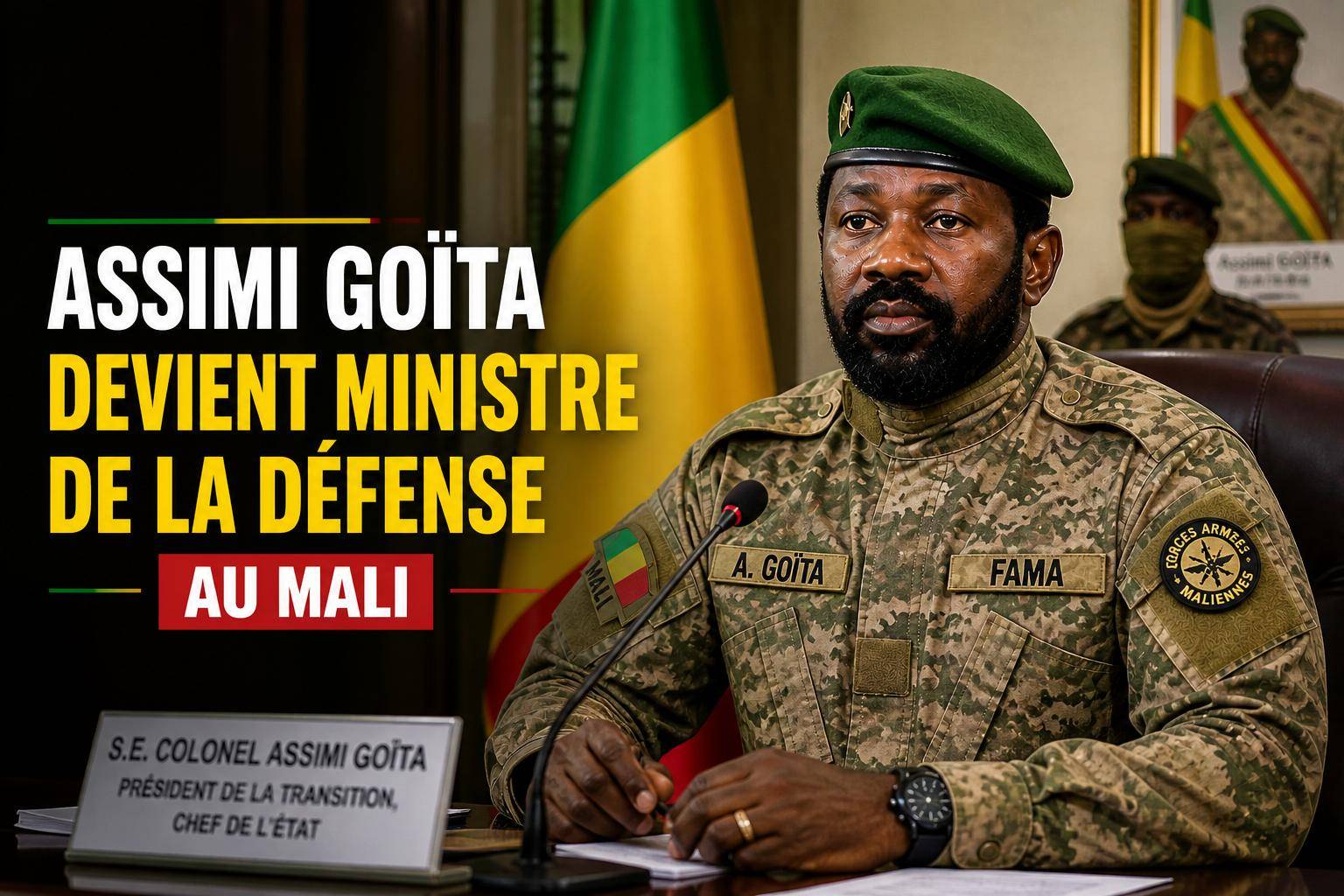
The recent appointment of Colonel Assimi Goïta as both President and Defense Minister in Mali marks a significant consolidation of power in Bamako. This strategic move, far from being a routine administrative decision, underscores deepening concerns about a military chain of command in disarray and an increasingly faltering counterinsurgency strategy.
Centralization of power at the heart of the crisis
By merging the roles of Head of State and Defense Minister, Assimi Goïta has positioned himself not only as the architect of national policy but also as the operational leader of the Malian armed forces. For regional observers, this unprecedented concentration of authority signals growing skepticism within the inner circle of power. With a prolonged political transition still unresolved, the move raises a critical question: can a single individual realistically manage state affairs, regional diplomacy, and the tactical demands of an asymmetric war? By eliminating intermediary roles, Goïta has placed himself directly in the line of fire—every military setback will now be seen as his personal failure.
Kidal’s fall: from symbolic victory to strategic collapse
Once hailed as a triumph of Mali’s regained sovereignty, the so-called “liberation” of Kidal has now become a stark symbol of lost control. The strategic northern city has fallen back into the hands of armed groups, including the Jama’at Nusrat al-Islam wal Muslimeen (JNIM) and factions of the Coordination des Mouvements de l’Azawad (CMA/FLA). This reversal is more than symbolic—it exposes the fragility of Bamako’s military operations. Despite claims of improved capacity, Malian forces struggle to hold reclaimed territories. The absence of civilian administration and persistent security vacuums have allowed insurgents to swiftly reoccupy the region. The JNIM, in particular, has demonstrated a refined strategy, isolating garrisons and severing supply lines, turning fleeting military gains into hollow victories.
Wagner’s fading influence in Mali’s security strategy
The other pillar of Mali’s security approach has been its partnership with Russian paramilitary forces, now operating under the banner of the Africa Corps. While marketed as a sovereign alternative to France’s former influence, the results on the ground remain unconvincing. Russian advisors, though deployed to frontline positions, appear to favor a scorched-earth approach that fuels radicalization rather than stabilizing the region. Reports of human rights abuses have surged, providing fertile ground for terrorist recruitment. More critically, the technical effectiveness of these forces is questioned as Malian military convoys continue to fall victim to deadly ambushes. With Russia’s own resources stretched thin by its conflict in Europe, doubts persist about its ability to deliver the air and technological support needed to counter the JNIM’s mobility.
Regional isolation deepens Mali’s diplomatic woes
Mali’s security crisis is compounded by growing diplomatic isolation. Since withdrawing from ECOWAS to form the Alliance of Sahel States (AES), Bamako has bet on self-reliance. Yet, borders remain porous, and terrorism knows no national boundaries. By severing regional cooperation mechanisms, Mali has deprived itself of critical intelligence and logistical support from neighboring countries. The centralization of power under Goïta is perceived by regional capitals as an authoritarian hardening, further complicating dialogue. The paradox is striking: Mali seeks to assert sovereignty through force, yet it remains increasingly dependent on opaque external forces and a command structure concentrated in the hands of one leader.
A looming quagmire: what future for Mali?
The outlook for central and northern regions of Mali is bleak. Despite leadership changes and shifting geopolitical alliances, insecurity continues to escalate. Attacks on civilian and military convoys have become almost daily occurrences. Assimi Goïta’s gamble as “President and Defense Minister” now hinges on rapid improvements in security. If the situation does not stabilize, simmering public discontent—currently suppressed by heavy-handed security measures—could erupt into open unrest. African history offers many examples where excessive power concentration has preceded major instability. To break the deadlock, Mali must reconsider its overall strategy. Military force and mercenary alliances have proven insufficient. Without inclusive governance and a genuine strategy for social reoccupation of territory, Colonel Goïta’s sword may soon blunt against the resilience of armed groups. The time for wartime rhetoric is over; urgent political realism is needed. Beneath the headlines and uniforms, the very existence of the Malian state hangs in the balance on the shifting sands of the North.