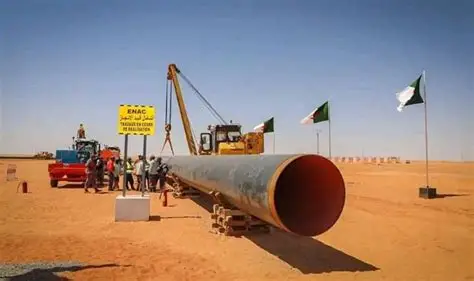
The African energy landscape is poised for a historic transformation, with Niger firmly establishing itself as a central player. Officially launched on June 4 in coordination with strategic partners Algeria and Nigeria, the Trans-Saharan Gas Pipeline (TSGP) project has reached a decisive phase. Spanning over 4,000 kilometers, this mega-project aims to deliver Nigerian natural gas directly to the European market, cutting across Niger from its southern to northern borders.
For Niamey, the significance extends far beyond a mere infrastructure project: it represents a powerful statement of economic sovereignty and an elevated geopolitical standing on the world stage.
The Niger corridor: Africa’s energy bridge
The TSGP route will link the abundant gas fields of the Niger Delta to Algeria’s existing pipeline network—specifically Medgaz and Transmed—which are directly connected to European consumers. At the heart of this vast transit equation lies Niger.
Key project metrics:
- Total length: Over 4,000 km, with a substantial segment crossing Niger from south to north.
- Annual capacity: Approximately 30 billion cubic meters of natural gas for export.
- Estimated investment: More than $13 billion.
By providing a secure and efficient transit corridor, Niger becomes the indispensable link between Abuja and Algiers. Far from being a passive participant in this energy route, the country is determined to leverage its unique geography to revitalise its domestic economy.
Major local benefits and development opportunity
Beyond macroeconomic gains and transit royalties that will strengthen state finances, the TSGP offers an unprecedented industrial development opportunity for Niger. Preliminary agreements include provisions for local supply.
- Electrification and energy access: A portion of the transported gas can be diverted to power local thermal electricity plants, a critical advantage for addressing the country’s energy deficit.
- Job creation and skills transfer: The construction phase and subsequent operation of compression stations on Nigerien soil will generate thousands of direct and indirect jobs, fostering the emergence of local expertise in gas engineering.
A strategic response to European demand
The timing of the project’s launch is no coincidence. The European Union, pursuing an aggressive diversification strategy to permanently reduce dependence on Russian gas, views the TSGP as a prime alternative. By guaranteeing the security of this energy flow to Europe, Niger substantially enhances its diplomatic leverage with Western partners. The country demonstrates its capacity to engage in complex, large-scale multinational industrial partnerships.
Challenges to overcome: Security and financing
While enthusiasm runs high in Niamey, Algiers, and Abuja, the path is strewn with obstacles. The foremost challenge is securing a 4,000-kilometre route that traverses Sahelian regions plagued by persistent security threats. The three partner nations must coordinate their defence forces in an unprecedented manner to safeguard the infrastructure. Furthermore, securing definitive financial closure and attracting international investment will require political stability and a transparent regulatory framework—signals the Nigerien government is actively working to convey to markets.
The June 4 launch marked the dawn of a new era. By establishing itself as the indispensable link between the Nigerian gas giant and Algeria’s distribution networks, Niger is no longer a passive subject of regional geopolitics—it is actively shaping it. The success of the TSGP could permanently transform Niger into a pivotal energy hub between sub-Saharan Africa and the European continent.