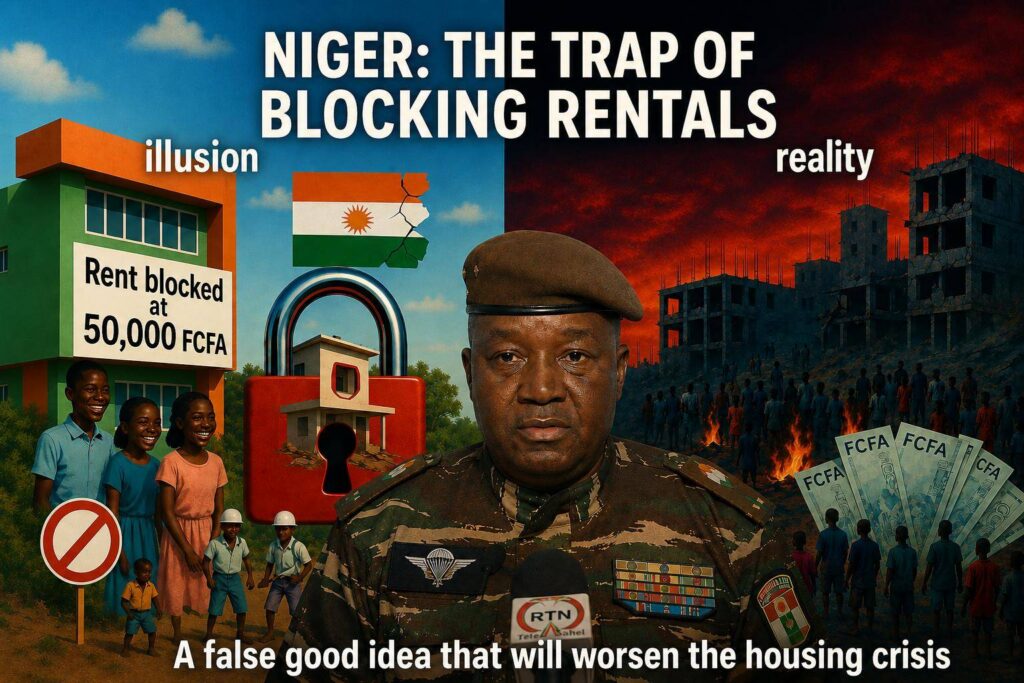
In a move aimed at easing pressure on urban populations, Niger’s transitional authorities have implemented a decree capping residential rents across the country, with maximum rates set between 15,000 and 80,000 FCFA in Niamey. While the initiative appears to address immediate concerns of affordability, economists warn it could trigger unintended consequences that exacerbate housing shortages.
The government frames the policy as a safeguard against exploitative pricing and a means to make housing accessible to low-income households. However, historical precedents demonstrate that administrative price controls rarely succeed in resolving structural economic challenges. Instead, they often distort markets, discourage investment, and create parallel economies.
How price controls can backfire
The fundamental principle of supply and demand governs the housing sector as it does all markets. When demand outstrips supply, prices naturally rise. The most sustainable solution to high rents is to increase housing stock through new construction. Yet, by imposing artificially low rent ceilings—particularly 80,000 FCFA for social housing in Niamey—the decree introduces critical vulnerabilities:
- Investment paralysis: Developers and property owners may withdraw from the market if guaranteed returns are eliminated, halting new construction projects.
- Deteriorating living conditions: Reduced rental income discourages maintenance, leading to neglected properties and deteriorating infrastructure.
- Informal market distortions: Scarcity created by price controls often drives corruption, with prospective tenants resorting to under-the-table payments to secure housing.
Public sector limitations and economic ripple effects
The success of rent control hinges on the state’s ability to replace private investment with large-scale social housing projects. However, Niger’s transitional government faces severe fiscal constraints, compounded by reduced international aid and internal political challenges, making such an undertaking financially unfeasible.
Moreover, the policy sends a discouraging signal to local financial institutions. Reduced real estate activity curtails lending, dampening economic activity across related sectors—from construction material suppliers to local artisans. The ripple effects could slow broader economic growth, affecting livelihoods beyond the housing market.
A short-term political gamble with long-term costs
The decree appears to be a populist measure designed to bolster public support during a period of political transition. Yet, by discouraging the very actors who drive housing development, the government risks transforming a cost-of-living issue into a full-blown housing crisis. In Niamey, securing decent accommodation may become even more challenging than it already is, turning the promise of affordability into a distant mirage.
Economic interventions that disregard market realities often yield counterproductive results. While the intention to protect vulnerable citizens is commendable, the long-term consequences of this decree could deepen housing insecurity and undermine economic stability in Niger.