When Niger’s military government moved against Orano, the French nuclear giant that had mined the country’s uranium for more than fifty years, it triggered a rupture that went far beyond a simple corporate dispute. The nationalisation of Somaïr, the withdrawal of the Imouraren permit, a strategic opening toward Russia, and expressions of interest from China and Iran have all reshaped the landscape. Yet the most pressing question is no longer who Niger will sell to — it is what the country actually gets in return, and who benefits from the new arrangements.
A break with Orano that reshaped the entire sector
The split between Niamey and Orano was never merely diplomatic. It carried industrial and financial consequences that are still unfolding.
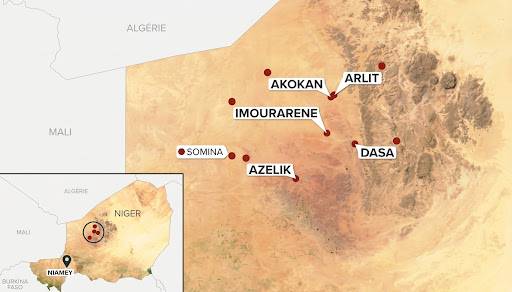
Orano lost operational control of its Nigerien activities in December 2024, and Somaïr — the historic operator of the Arlit mine — was nationalised on 19 June 2025. The French group, which held 63.4% of Somaïr against 36.6% for the Nigerien state, disputes the move and has launched several international arbitration proceedings.
The difficulty for Niamey is that taking over a mine does not automatically secure a market. Nigerien production has fallen sharply over the past decade, dropping from 4,116 tonnes in 2015 to just 962 tonnes in 2024. The country now operates only one producing mine, while several projects remain undeveloped. In other words, mining sovereignty has advanced faster than the country’s industrial and commercial capacity.
Why comparing uranium prices is more complex than it looks
A widespread belief holds that Niger was previously paid a “French price” far below the current world market. That comparison is misleading.
Uranium does not trade like oil. There is no single exchange setting a daily price at which every producer sells. Contracts are negotiated directly between producers, intermediaries, and nuclear utilities, often using formulas that combine spot indices and long-term prices.
Historical data nonetheless offers a useful benchmark. In 2020, available figures indicated that Niger received around 48.1 billion CFA francs for 1,113 tonnes from Cominak and 103.3 billion CFA francs for 1,879 tonnes from Somaïr. For Somaïr, that worked out to roughly 83.75 euros per kilogram of uranium, based on calculations from public data at the time.
Another analysis drawing on Extractive Industries Transparency Initiative data estimated that uranium purchased from Orano had been around 45,000 CFA francs per kilogram in recent years — about 33 dollars per pound — while some European or Japanese buyers reportedly paid closer to 60,000 CFA francs per kilogram.
The market has since shifted dramatically. In 2025, the average spot price paid by European utilities was 70.33 dollars per pound, up from 53.59 dollars in 2024. The average price of multi-year contracts, however, was much lower at 54.70 dollars per pound.
By late September 2026, the spot indicator stood around 89.63 dollars per pound, while the long-term price reached approximately 96.50 dollars per pound.
The key takeaway is that Niger now operates in a far more favourable price environment than in the early 2020s. But that does not prove Niamey is actually selling its uranium at 90 or 100 dollars per pound. This is where the picture becomes opaque.
The unanswered questions around the Russian deal
The most striking case concerns the yellowcake stockpile accumulated at Arlit.
In 2025, several French sources claimed that Niamey had reached an agreement with Russia covering 1,000 tonnes of uranium concentrate for about 170 million dollars. If confirmed, that would equate to roughly 170 dollars per kilogram, or nearly 77 dollars per pound.
That price would be below the spot price of late September 2026, but comparable to some contractual levels seen on the international market.
The problem is that the agreement has never been officially confirmed by either party. The Nigerien government denied selling the stock, and Rosatom stated it was not party to the arrangement in question.
Yet the matter is not simply an unfounded rumour. In November 2025, about 1,000 tonnes of yellowcake were indeed loaded onto trucks at Arlit. Around thirty vehicles then headed to Niamey under military escort. The convoy ultimately ended up immobilised at the capital’s airport.
This is precisely where the grey zone begins. A physical transfer of that scale does not by itself prove a sale, but it does indicate that Nigerien authorities were actively working to commercialise the stock.
The figure of 170 million dollars should therefore be presented as an allegation documented by multiple sources, not as an established contract.
What the Iran talks reveal about the wider debate
The Russian case is not the first opaque episode.
In 2024, confidential negotiations between Niamey and Tehran came to light, concerning 300 tonnes of yellowcake valued at an estimated 56 million dollars. Several Western and Nigerien sources confirmed that discussions had taken place.
The Nigerien government nevertheless denied concluding a sale. A government adviser acknowledged that Iran had wanted to buy the 300 tonnes, explaining that Niamey had refused for lack of available stock.
Once again, three distinct notions must be separated: negotiation, agreement, and executed contract.
Available information establishes that negotiations occurred. It does not demonstrate that a clandestine delivery took place.
New allies, new clients — but do they pay more?
Russia is now Niamey’s most visible geopolitical partner in the nuclear sector.
In December 2025, the Nigerien company Timersoi National Uranium Company signed a cooperation agreement with Uranium One Group, a subsidiary of Russia’s Rosatom, to explore deposits and eventually develop new mines.
China has also shown interest in the Arlit stockpile. In 2025, sources indicated discussions potentially covering around 1,000 tonnes.
But these new partners do not necessarily guarantee better prices. What they primarily offer Niger is more negotiating options.
That is a fundamental difference.
Is Niger actually selling its uranium on better terms?
At this stage, the most honest answer is: not yet demonstrated.
Niger now holds three advantages it did not possess with the same intensity before.
First, the international uranium price is much higher. Second, Niamey is seeking to diversify its partners — Russia, China, but also Canadian, Australian, and American actors. Third, the government now directly controls an essential part of the mining chain.
But three weaknesses constrain this strategy: falling production, logistical problems, and legal uncertainty linked to the dispute with Orano.
In September 2025, an ICSID arbitral tribunal ordered Niger not to sell or transfer to third parties the uranium produced by Somaïr that is subject to the litigation.
Political sovereignty alone is therefore not enough to create a solvent market.
The paradox facing Niamey
Niger now wants to sell its uranium “at the best price.” But to achieve that, it must be able to produce regularly, transport its ore securely, attract capital, and provide legal guarantees for its contracts.
The country is precisely trying to rebuild that capacity. In 2026, it even created the Teloua Safeguarding Uranium Mining Company, intended to replace the nationalised Somaïr. At the same time, new Western investors are returning: in September 2026, the United States approved up to 414 million dollars in financing for the Dasa project of Global Atomic, a Canadian company.
This may be the real turning point.
Niger is not simply replacing France with Russia. It is gradually trying to turn its uranium into a lever of competition among several powers.
For now, however, no public evidence allows the claim that new contracts bring Niger more than those concluded under Orano. International price levels are higher, yes. Negotiating possibilities are more numerous, yes. But the contracts actually signed, their pricing formulas, premiums, logistical costs, and the net share returning to the state remain largely opaque.
As for “secret contracts,” there are confidential negotiations and accusations serious enough to justify investigations, particularly involving Iran and Russia. But speaking of definitively established secret deals would, to date, go beyond the available evidence.
The real issue for Niamey is therefore no longer simply knowing whom to sell its uranium to. It is knowing at what price, with what guarantees, and above all what share of that value will actually remain in Niger.