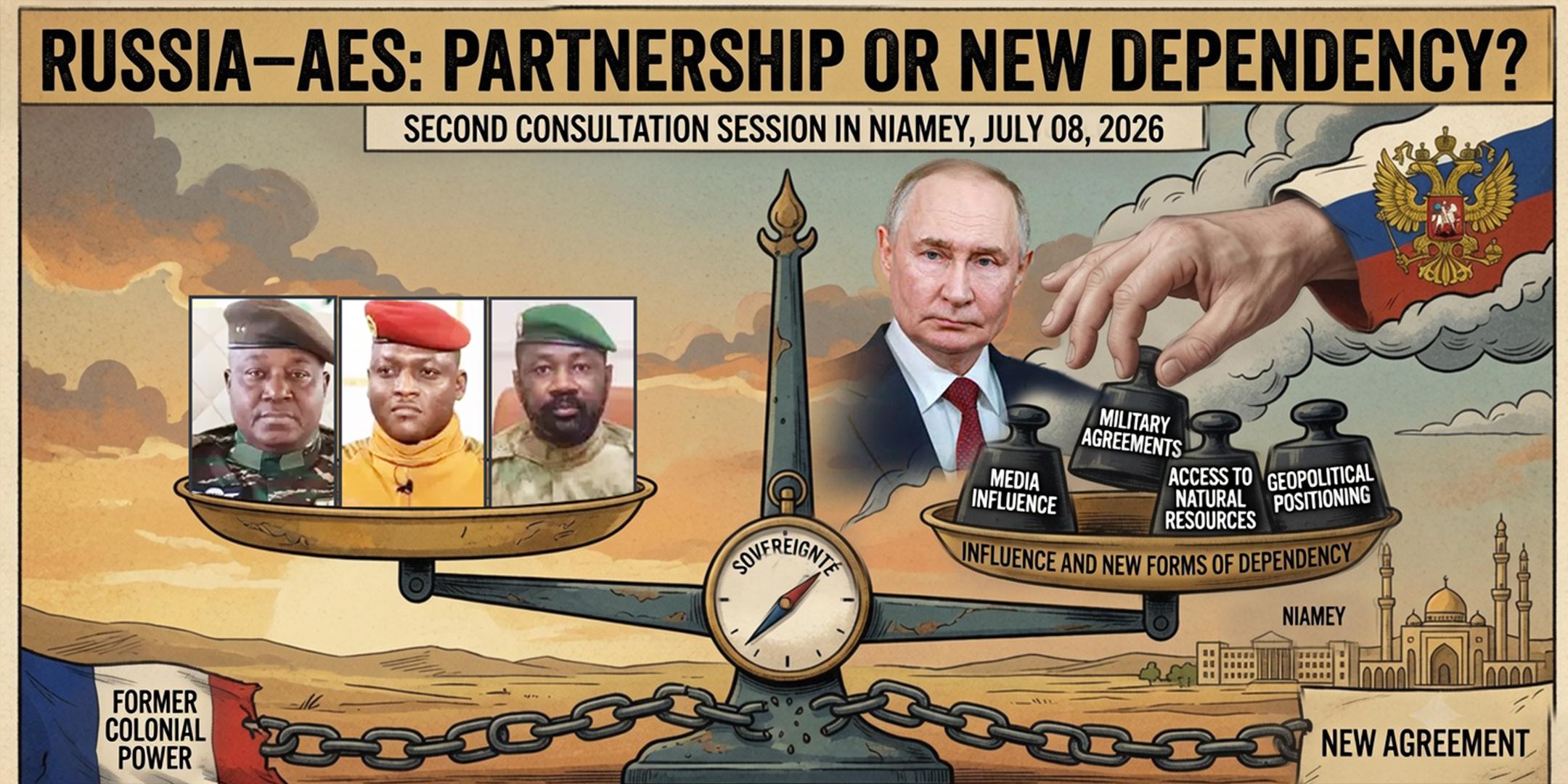
On 8 July 2026, Niamey hosted the second round of high-level consultations between the Confederation of Sahel States (AES) foreign ministers and Russian counterpart Sergei Lavrov. While officials frame the meeting as a landmark step toward a partnership rooted in sovereignty and mutual respect, a critical question lingers: could this alignment introduce a new form of dependence—one anchored in Moscow rather than Paris?
For years, AES leaders have criticised the entrenched influence of former colonial powers, particularly France, under the banner of national sovereignty. Yet substituting one foreign power for another does not inherently guarantee greater autonomy. Historical precedent suggests that state-to-state relations are frequently governed by geopolitical, economic and strategic interests that may not align with the declared principles of the partner nations.
Russia’s footprint across the Sahel has expanded markedly in recent times. Military cooperation, bilateral agreements, economic exchanges and cultural outreach now span multiple domains. AES governments portray this diversification as a sovereign choice. Critics, however, question where the boundaries of this influence lie and whether it might inadvertently foster a fresh dependency.
Major powers rarely engage in regions without expecting measurable returns. Whether securing access to natural resources, securing diplomatic leverage or positioning themselves strategically on the African continent, such partnerships serve national agendas. Moscow is no exception to this pattern.
Political observers also warn of potential drawbacks. Over-reliance on a single external actor can constrict a nation’s diplomatic flexibility, narrow its scope for alternative alliances and expose it to broader geopolitical tensions. In an era defined by great-power rivalry, the Sahel risks becoming a battleground for influence rather than an autonomous player shaping its own destiny.
Sovereignty is not merely a matter of selecting a new ally; it is measured by a state’s capacity to preserve independent decision-making, sustain balanced partnerships and advance its interests without defaulting to rigid alignment. AES authorities insist the partnership is ‘mutually beneficial.’ Yet such claims must ultimately be judged against tangible outcomes: lasting security gains, sustained economic development, job creation, skills transfer and institutional strengthening. Absent visible progress in these areas, rhetoric on sovereignty may ring hollow for the populations most directly affected.
The coming years will reveal whether cooperation with Russia enables the AES countries to bolster their autonomy or simply shifts them from one sphere of influence to another. Many analysts argue that genuine independence lies not in swapping one dominant partner for another, but in cultivating a diplomacy capable of engaging with multiple actors without falling under the sway of any single one.