Benin is preparing to load and sell its first cargo of crude oil in decades — close to 250,000 barrels lifted from the offshore Sèmè field and bound for international buyers in October 2026. The real question is no longer whether the shipment will leave the terminal, but what the country can honestly expect to get out of it.
The stakes reach far beyond a single tanker. A first sale of crude writes the international “identity card” of a nation’s oil, sets the benchmark for everything that follows, and tests whether years of technical studies, negotiations and heavy spending will translate into money in the public purse. For Benin, a country long known in West Africa as a trading crossroads and an agricultural exporter, this is the moment its growth model starts to look different.
A dormant offshore block pulled back into the national plan
From a late-1960s discovery to a decades-long pause
The Sèmè field is not a new find. Lying off Benin’s south-eastern coast, close to the maritime border with Nigeria, it was identified in the late 1960s and worked intermittently during the 1980s and 1990s. Technical difficulties, a modest barrel price at the time and falling output eventually pushed the site into sleep mode.
Why the government chose this moment to reopen it
Three factors changed the calculation. New offshore drilling and reservoir redevelopment techniques made the block viable again, global energy demand shifted the economics of marginal fields, and the government’s own action plan placed a premium on squeezing more value out of national resources. Geological surveys carried out in recent years pointed to recoverable reserves worth pursuing, which in turn justified strategic partnerships and the capital needed to rebuild extraction infrastructure.
The first 250,000 barrels: a trial shipment with real financial weight
An opening delivery of this size is never just about immediate cash. It is a test run, and the market will judge it on the quality of the barrel rather than the volume.
What refiners and traders will look at first
Laboratory analysis will establish the density, sulphur content and overall quality of Beninese crude, and those readings will determine how it is priced against reference grades such as Brent. That pricing, in turn, shapes how attractive the cargo looks to refiners and trading houses deciding whether Sèmè becomes a regular name on their buying lists.
Three channels feeding the state budget
- Steadier foreign currency: incoming export earnings bolster foreign-exchange reserves and ease pressure on the balance of payments.
- Taxes and production-sharing: the sharing mechanism hands the state a direct slice of extracted volumes on top of the taxes levied on petroleum activity.
- A stronger sovereign signature: a new, predictable revenue stream improves how lenders and rating agencies read Benin’s credit profile.
In a global economy where commodity prices swing hard, widening the state’s sources of income amounts to a macroeconomic shield.
Industrial spillovers: contracts, skills and a coastal hub
The economic footprint of the project stretches well past the sale of crude. Rebuilding the field has already pulled in substantial financing and generated work for local firms and the maritime supply chain.
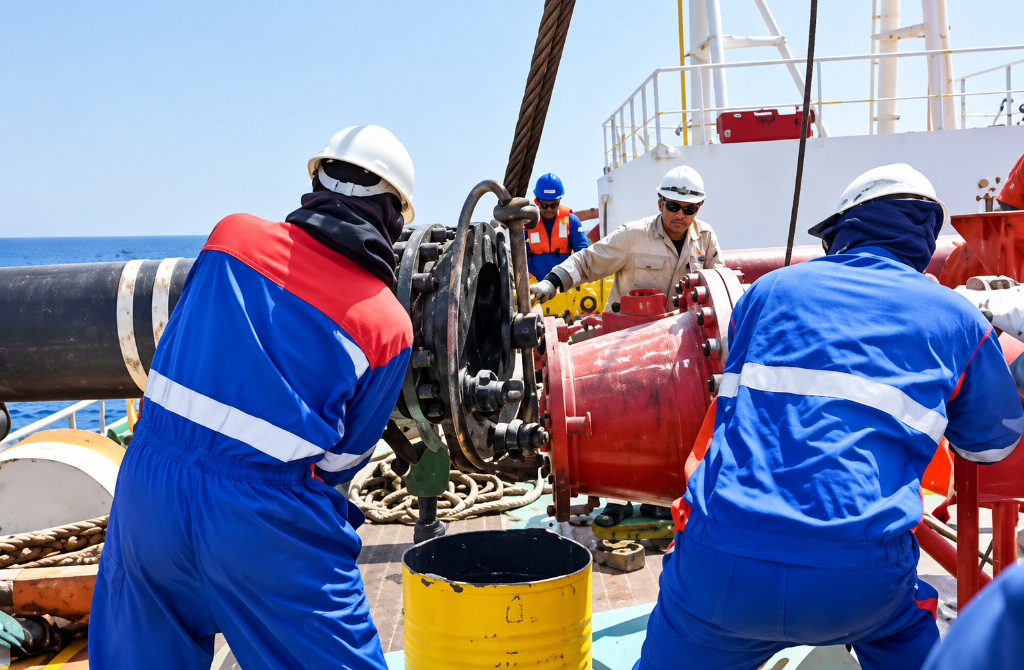
Offshore operations are logistics-heavy: support for installations at sea, towing services, technical maintenance, procurement of specialised equipment and engineering services. Beninese companies in shipping, construction and logistics are gradually picking up subcontracts, which helps transfer know-how and creates skilled jobs for young workers.
There is a geographic effect too. Strengthening the petroleum cluster around Cotonou and Sèmè encourages investment in coastal infrastructure, since storing, moving and processing crude requires upgraded port facilities — turning the shoreline into something closer to an integrated industrial platform.
A producer that is also a transit country
The restart of national output comes at a strategic moment for Benin’s energy sector, which also hosts the marine terminal of the export pipeline carrying crude from Niger’s Agadem fields to the port of Sèmè-Kpodji.
The two projects are legally and operationally separate, but the overlap is obvious. Benin is consolidating its position as an oil crossroads in the Gulf of Guinea, and the expertise built up managing another country’s export infrastructure sharpens the local technical capacity needed to run its own offshore resources efficiently.
Holding both roles at once — producer and transit hub — raises Benin’s profile in regional and international energy circles considerably.
The decisive question: can Benin dodge the usual oil pitfalls?
Managing the coming revenues sustainably and transparently is now the central test for economic policymakers. Regulatory oversight and sound governance of extractive income are the priorities if the country wants to avoid the traps that have caught other producers.
Money raised from selling Sèmè crude is intended to feed development funds aimed at priority sectors: education, health, road networks and the modernisation of agriculture. The underlying goal is to treat a finite resource as a catalyst for structural change across the wider economy rather than as a short-lived windfall.
October 2026 is a starting line, not a finish line
The first cargo is a chapter opener, not a conclusion. Compared with the output of the world’s oil giants, 250,000 barrels is a modest figure — yet its symbolic weight and its potential to pull other sectors along give Benin a credible foundation on which to build. Whether that foundation holds depends on the choices made in the months and years after the tanker sails.