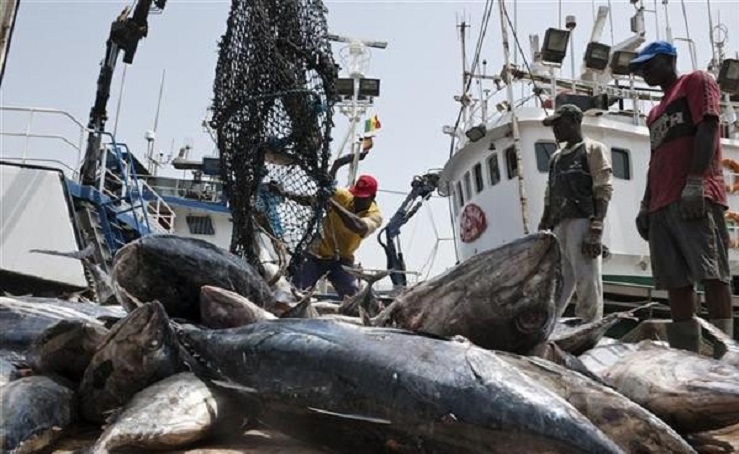
Skipjack and Yellowfin tuna from the Spanish purse seiner 'Iribar Zulaika' waiting to be exported.
The Ministry of Fisheries and Maritime Economy has granted four new coastal demersal fishing licenses—specifically for fish and cephalopod species—to a Senegalese fishing company. This strategic move aims to stabilize the national market’s seafood supply and reinforce the country’s food sovereignty.
In an official statement released on May 19, 2026, the ministry clarified that the licenses were awarded following the recommendations of the Consultative Commission for Fishing License Allocation (CCALP), which convened on May 12 to review applications in compliance with national regulations.
The decision aligns with the resolutions adopted during the Council of Ministers meeting on November 26, 2025, which prioritized ensuring the availability of affordable seafood for domestic consumers. Authorities emphasized that the selection process was transparent, inclusive, and grounded in rigorous scientific assessments conducted by the Dakar-Thiaroye Oceanographic Research Center.
Last November, multiple fishing companies were invited to express their interest and outline their commitments under this public-private partnership framework. Ultimately, only one company met the criteria, committing to dedicate its entire catch to the local market. Additionally, the company pledged to invest in cold storage and distribution infrastructure, particularly in remote regions, to improve access to high-quality seafood at reasonable prices.
The ministry highlighted that prior to granting the licenses, updated scientific evaluations confirmed that limited, gradual, and strictly regulated access to coastal demersal fisheries would not deplete fish stocks. This initiative marks a significant step for Senegal, introducing a formalized industrial fishing mechanism designed to ensure a steady supply of seafood to the domestic market.
In a context of rising seafood prices and growing concerns over dwindling fish stocks, officials reiterated their commitment to balancing sustainable resource management, economic growth, and food security. The strategy reflects a broader effort to promote responsible, transparent, and long-term fisheries governance while strengthening local consumption and reducing reliance on imports.