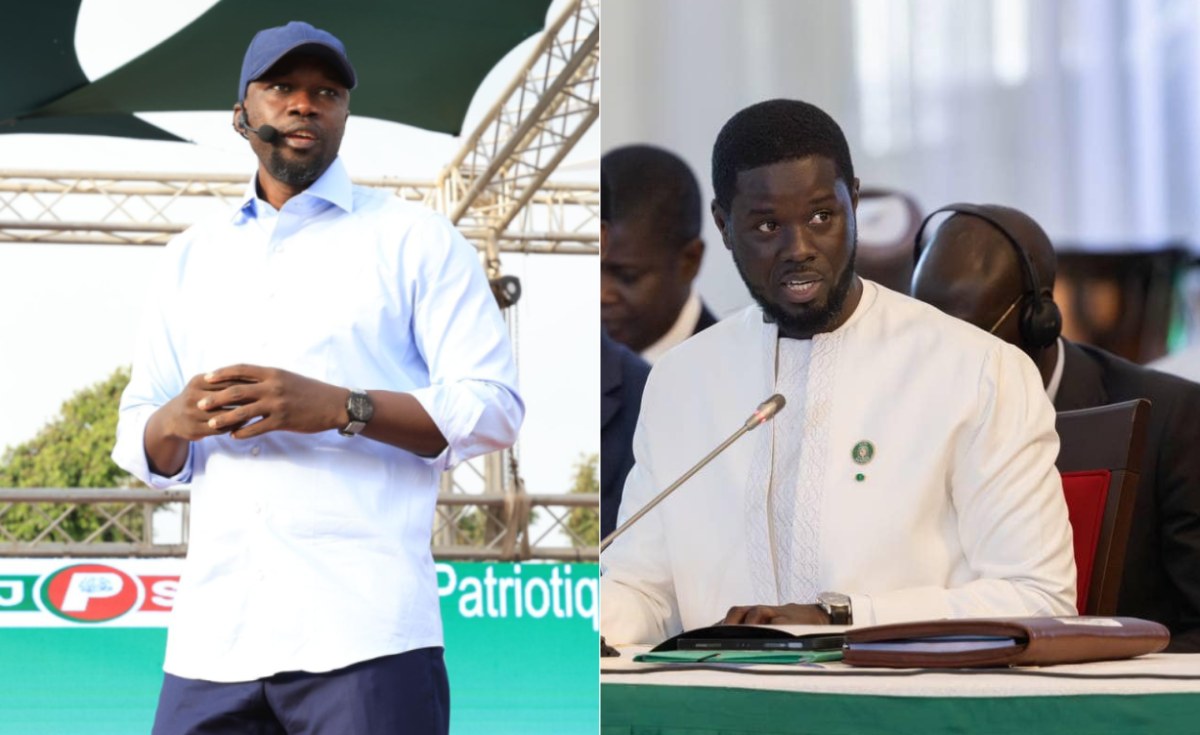
Senegal is navigating one of the most challenging political phases since Bassirou Diomaye Faye and Ousmane Sonko assumed power in March 2024. Once portrayed as an inseparable duo behind the Pastef’s political vision, the two leaders now face increasingly visible disagreements as their visions for governance diverge.
This unfolding situation comes at a pivotal moment. In 2024, Ousmane Sonko, barred from running due to legal issues, chose Bassirou Diomaye Faye—then also imprisoned—to represent the Pastef in the presidential election. Their victory was seen not only as a triumph over the outgoing administration of Macky Sall but also as the dawn of a transformative era for Senegal’s political landscape.
The dynamics of power often shift once leaders transition from opposition to governance. Over a year into this new administration, tensions between the president and the party’s founding leader appear to be intensifying. Recent remarks by Ousmane Sonko, including pointed critiques and revelations about alleged political agreements tied to their rise to power, signal a clear bid to reclaim political dominance.
As the nation prepared to swear in Al Aminou Lo as the new Prime Minister, Sonko declared that no Pastef members would be part of the incoming government. This decision represents a symbolic break from the governance model established after the 2024 victory and hints at a growing divide between the state apparatus and the party structure.
At the heart of this unfolding scenario lies a fundamental question: legitimacy. President Bassirou Diomaye Faye draws his authority from universal suffrage and the functioning of democratic institutions. Meanwhile, Ousmane Sonko remains, for many activists, the mastermind behind the movement that propelled them to power and the driving force behind the Pastef’s rise.
A familiar challenge in African politics
This kind of tension is not uncommon in African political history. Many movements that have secured power have later faced internal rivalries between the leader with electoral legitimacy and the figure who retains political control within the party. When these two sources of power clash, the risks of institutional paralysis and political fragmentation escalate significantly.
For now, it may be too soon to declare a definitive rupture. Both leaders still share a common electoral base and a political agenda that remains broadly supported by their supporters. However, the escalating rhetoric and hardening positions suggest that a power realignment is already underway.
The stakes are no longer merely personal ambitions but the very stability of Senegal’s institutions. In a country often hailed as a democratic model in West Africa, the evolving relationship between Bassirou Diomaye Faye and Ousmane Sonko could shape the future of the Pastef and the nation’s political trajectory for years to come.
In the coming months, the path forward will become clearer—whether this crisis leads to strategic reconciliation, a tense cohabitation, or an outright political split between the two key architects of the 2024 transition.