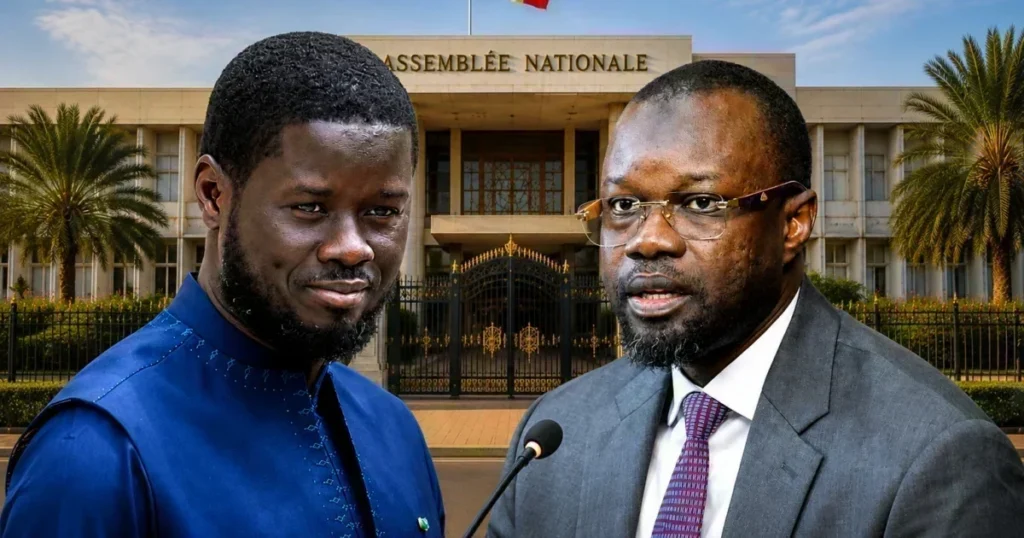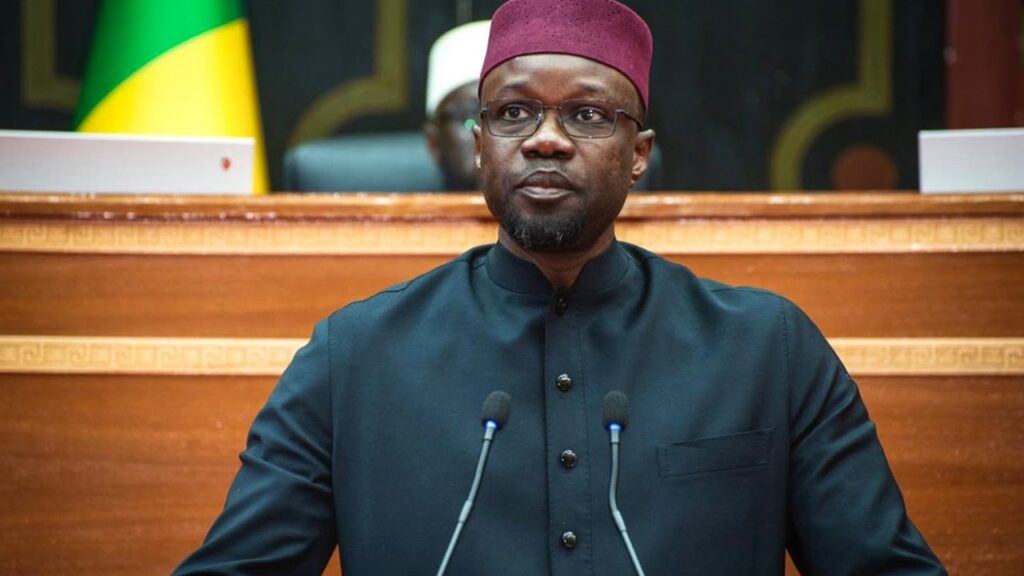
In Senegal, the dynamic between Prime Minister Al Aminou Lo and ruling party leader Ousmane Sonko is under the microscope. During a recent address, the head of government delivered a message in Wolof, using the phrase « Gatt xèl weessu wul »—a call to avoid haste and shortsightedness. The remark, directed at Sonko, serves as a gentle yet firm reminder of the importance of measured decision-making in a political climate where every utterance carries weight.
Public rebuke disrupts official narrative
The Prime Minister’s approach contrasts sharply with the usual communication discipline expected from presidential circles. By opting for a widely understood proverb, he grounds his message in everyday language while directly addressing the most influential figure within the majority. This move is far from accidental; it reflects a deliberate effort to assert his own political voice amid a landscape where one voice often overshadows the rest.
Ousmane Sonko, leader of the Pastef party, remains the driving force behind the 2024 administration that emerged from political transition. His influence extends across economic, diplomatic, and security policies, making any divergence in messaging from government members inherently political. By framing his remarks with a proverb rooted in popular wisdom, the Prime Minister seeks to de-escalate tensions without resorting to direct confrontation, signaling a difference in strategic approach.
What the Prime Minister’s choice of words reveals
The Wolof expression used by Al Aminou Lo carries the weight of moral wisdom, emphasizing thoughtful deliberation over impulsive judgment. Against a backdrop of pressing national issues—from fiscal consolidation to negotiations with international financial partners—this recalibration hints at differing perspectives on both timing and execution. The technocratic leadership embodied by the Prime Minister, a former senior official at the Central Bank of West African States (BCEAO), operates within a framework distinct from the grassroots-driven discourse of the political sphere.
This duality lies at the heart of the current administration, formed in 2024. On one side stands a party leader renowned for his transformative rhetoric and unwavering popular support. On the other, an executive tasked with navigating the constraints imposed by global markets, the International Monetary Fund, and bilateral donors. The Prime Minister’s public statement may well be interpreted as a defense of procedural rigor at a juncture when Senegal’s financial credibility remains under scrutiny following revelations of irregularities in public debt accounting.
A signal to markets and the ruling coalition
For investors and international observers, this public display of internal divergence carries significance beyond mere political infighting. It underscores that the Senegalese government is not a monolithic entity and that internal checks and balances exist within the state apparatus. The stability of economic policies hinges partly on the Prime Minister’s ability to uphold a technical framework, one that demands a degree of autonomy from the party’s immediate priorities.
Yet the power imbalance remains unmistakable. Ousmane Sonko’s electoral legitimacy, forged through grassroots mobilization, and his entrenched influence within the state machinery make him a formidable figure. The Prime Minister’s room for maneuver will thus depend heavily on presidential backing and his capacity to deliver tangible economic outcomes—be it through greater fiscal transparency, eased tensions with external partners, or an improved business climate.
In the short term, this episode introduces a new variable into the political calculus in Dakar. Analysts will be closely watching for any reaction from the President, whose role as ultimate arbiter could determine whether this tension escalates or de-escalates. The trajectory of this relationship may also hinge on the two leaders’ ability to publicly align on key national issues; failure to do so could plunge the ruling coalition into a more volatile phase.