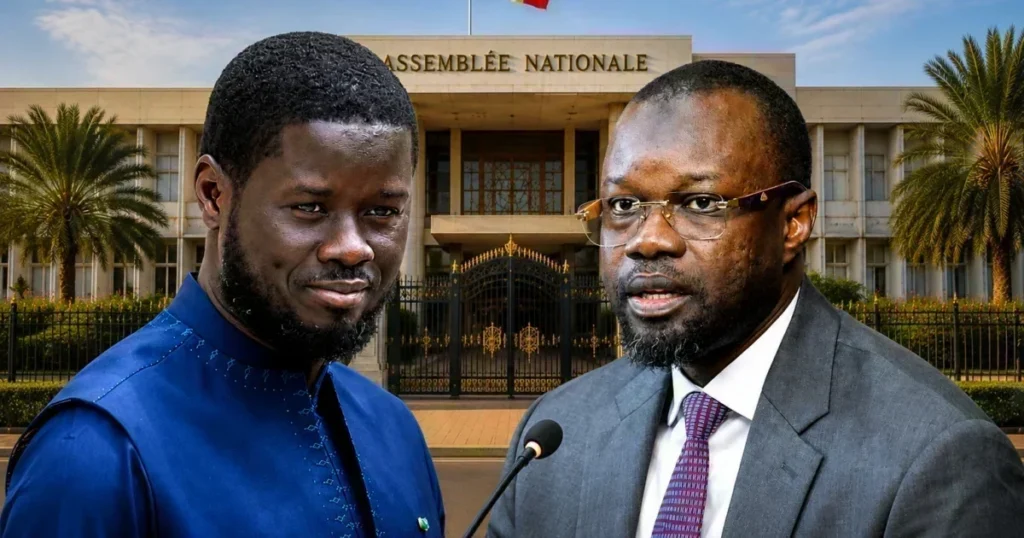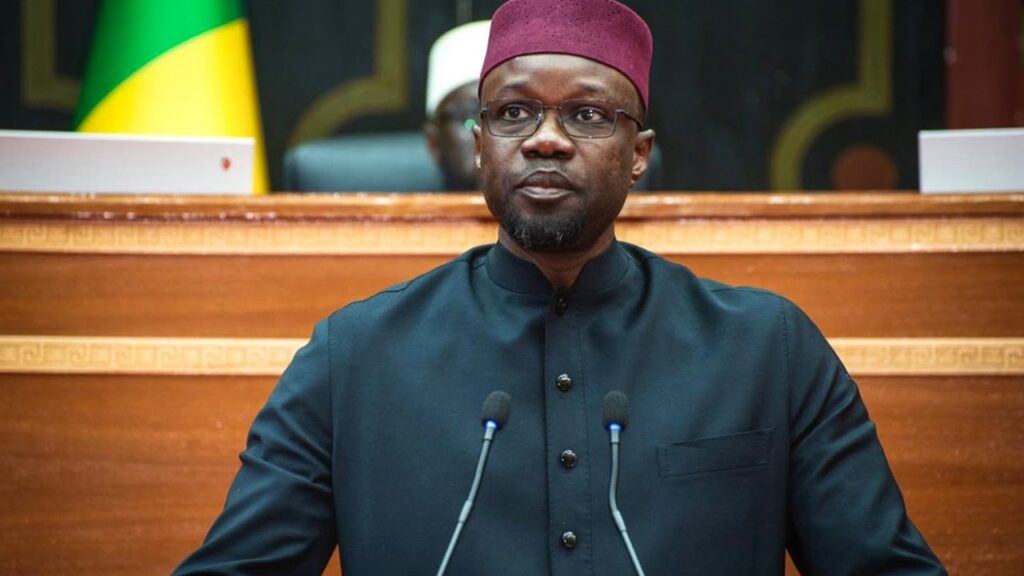
In Sénégal, the relationship between Prime Minister Al Aminou Lo and Ousmane Sonko, the influential leader of the ruling party, is currently a focal point of public discourse. During a recent public address, widely reported by local media, the head of government delivered a pointed message in Wolof: « Gatt xèl weessu wul ». This phrase, which translates to an admonition against acting with haste or short-sightedness, was clearly directed at Ousmane Sonko. It serves as a potent call for measured judgment within a political environment where every statement is meticulously analyzed.
A public rebuke unsettling the official narrative
Al Aminou Lo’s communication style starkly contrasts with the typically disciplined messaging seen within presidential circles. By employing a popular, accessible Wolof expression, the Prime Minister embedded his message in common parlance while explicitly targeting the majority’s most prominent figure. This deliberate approach is significant; it underscores a clear intent to assert his political presence in the face of a party leader whose influence extends far beyond formal governmental roles.
Ousmane Sonko, at the helm of Pastef, remains the driving force behind the administration that emerged from the 2024 political transition. His pronouncements carry considerable weight, shaping the nation’s economic, diplomatic, and security directions. Consequently, any perceived distancing by a cabinet member immediately acquires significant political resonance. The Prime Minister’s choice of words, imbued with popular wisdom, appears designed to defuse direct confrontation while simultaneously signaling a difference in approach.
Unpacking the language used by the head of government
The Wolof maxim invoked by Al Aminou Lo falls within the realm of moral proverbs, emphasizing deep reflection over superficial judgment. In a period marked by several sensitive public issues—ranging from budget rectification to relations with international financial partners—this type of public correction hints at potential divergences regarding the pace and methodology of public policy implementation. The technocratic structure, personified by the Prime Minister, a former senior executive at the Central Bank of West African States (BCEAO), operates with different instincts than the militant party base.
This inherent duality characterizes the regime established in 2024. On one side stands a party leader advocating for radical change, supported by a massive popular base. On the other, an executive branch compelled to navigate the constraints imposed by financial markets, the International Monetary Fund, and bilateral donors. The Prime Minister’s intervention can be interpreted as an appeal for procedural orthodoxy, particularly as Sénégal’s financial credibility remains under scrutiny following revelations of accounting irregularities concerning public debt.
A signal to markets and the ruling majority
For international investors and diplomatic missions, this public display of internal divergence holds interest beyond a mere domestic squabble. It suggests that the Senegalese executive is not monolithic, indicating the presence of internal checks and balances within the state apparatus itself. The stability of economic decisions partly hinges on the Prime Minister’s ability to uphold a technical framework, which necessitates a degree of autonomy from the impulses of the majority party.
Nevertheless, the power dynamic remains asymmetrical. Ousmane Sonko retains direct electoral legitimacy stemming from the mobilization of the militant base and an unparalleled capacity to influence state institutions. Al Aminou Lo’s room for maneuver will therefore depend on presidential backing and his ability to deliver measurable economic results. Tangible improvements such as increased budgetary transparency, a de-escalation of tensions with external partners, or an enhanced business climate would provide crucial leverage.
In the short term, this episode introduces a new dimension to understanding power dynamics in Dakar. Observers will closely monitor any potential reaction from the President of the Republic, who serves as the natural arbiter of any tension between his Prime Minister and the leader of the ruling majority. The subsequent trajectory will also hinge on the two men’s ability to publicly align on major issues; failure to do so could usher in a more turbulent phase for the governing coalition.