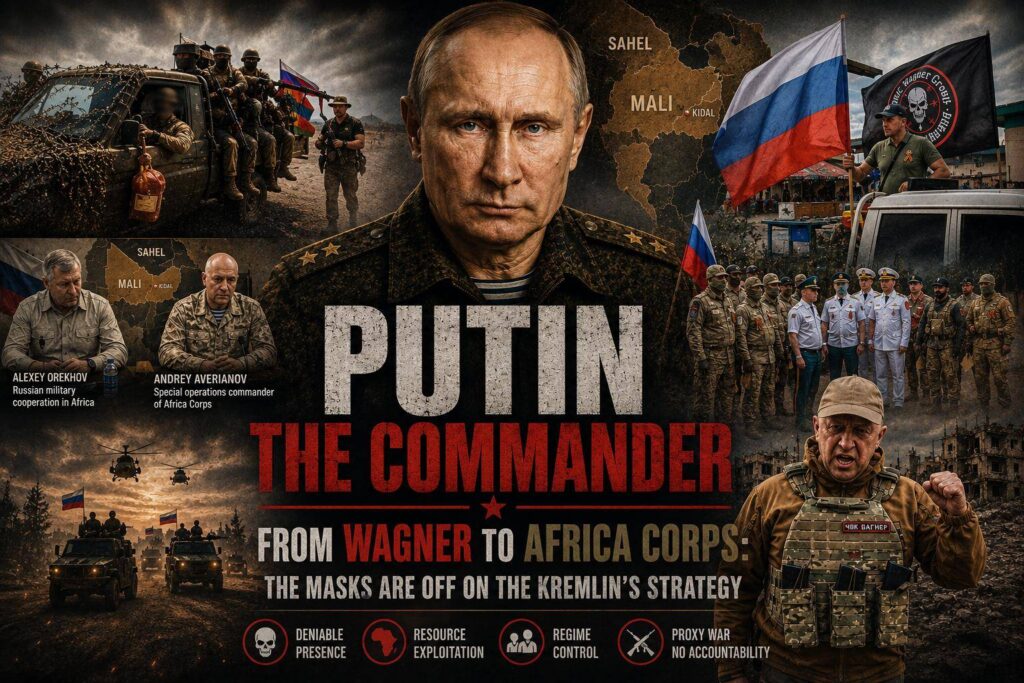
Following a decade of rapid expansion under the guise of mercenary operations, disinformation campaigns, and anti-Western populism, the Kremlin’s African strategy has now encountered an insurmountable reality. Once hailed as a viable alternative to traditional powers, Moscow’s model—built on unconditional security partnerships and resource extraction—has begun to crumble under the weight of unmet expectations, military setbacks, and growing public disillusionment. The notion of a waning Russian imperial influence on the continent is no longer speculative; it is an unfolding reality.
the mirage of russian-backed security
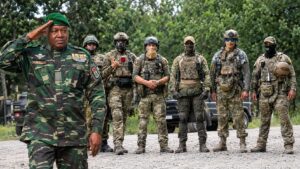
In the mid-2010s, as Western powers receded from their former spheres of influence—particularly in Francophone West Africa—Russia seized the opportunity to position itself as a pragmatic alternative. From Bamako to Bangui, via Ouagadougou and Niamey, Moscow marketed a ready-made security doctrine: one devoid of human rights conditionalities, exemplified by the Wagner Group (now rebranded as Africa Corps).
Yet, a few years later, the results are damning. Far from stabilizing the region, the Sahel has witnessed a dramatic deterioration in security conditions. The myth of Russian military invincibility was shattered in Tinzawatane, near the Algerian border, where dozens of Russian mercenaries and Malian soldiers perished in a single battle. The truth is now undeniable: Moscow’s primary objective was not peacekeeping, but securing access to mineral resources—gold, diamonds, uranium—in exchange for political allegiance. This extractive calculus, a hallmark of imperial ambition, has become increasingly evident to local populations, who now recognize that the face of colonial domination has merely changed.
three structural factors behind Russia’s retreat
An analysis of current trends reveals three fundamental weaknesses underpinning Russia’s declining influence on the continent:
1. the ukrainian quagmire
The prolonged conflict in Ukraine has drained Russia’s financial and military resources. Elite units have been redeployed to the European front, while heavy weaponry—once freely exported to Africa—now faces severe rationing. The war has left Moscow with neither the funds nor the personnel to sustain its African ambitions.
2. the absence of an economic model
Russia remains a military and ideological power, not an economic one. With a GDP comparable to that of Spain, it cannot compete with the European Union’s development aid or China’s infrastructure investments. Once the initial political honeymoon faded, African juntas and governments realized that emergency wheat shipments and social media disinformation campaigns do not feed populations or build economies.
3. the rise of african nationalism
Moscow’s strategy relied heavily on the rhetoric of a “second decolonization,” positioning itself as a liberator from Western dominance. However, the new generation of African leaders and citizens, highly connected and politically aware, rejects any form of foreign tutelage—whether French or Russian. The shift from the tricolour flag to the Russian tricolour is no longer seen as emancipation, but as a cynical substitution of one master for another.
a shifting geopolitical landscape
The decline of Russian influence does not imply an automatic return of former colonial powers. Instead, the continent is witnessing a redistribution of influence toward more pragmatic actors, free from the ideological baggage of Moscow.
China continues to expand its economic footprint, prioritizing long-term stability over the volatility of Russian-style military posturing. Meanwhile, Turkey and the United Arab Emirates are emerging as key alternative partners, offering advanced drone technology and substantial financial investments without the geopolitical entanglements that have plagued the Kremlin’s engagements.
the end of the geopolitical shortcut
Russia’s imperial adventure in Africa, though intense, has proven historically brief. It has demonstrated a critical lesson: influence cannot be sustained through force and manipulation alone. For African leaders, the message is clear—there are no shortcuts in geopolitics. Security and development cannot be outsourced to foreign mercenaries, regardless of their origin. The fading of Russian dominance may mark the beginning of a new era: one where Africa seeks not masters, but genuine partners.