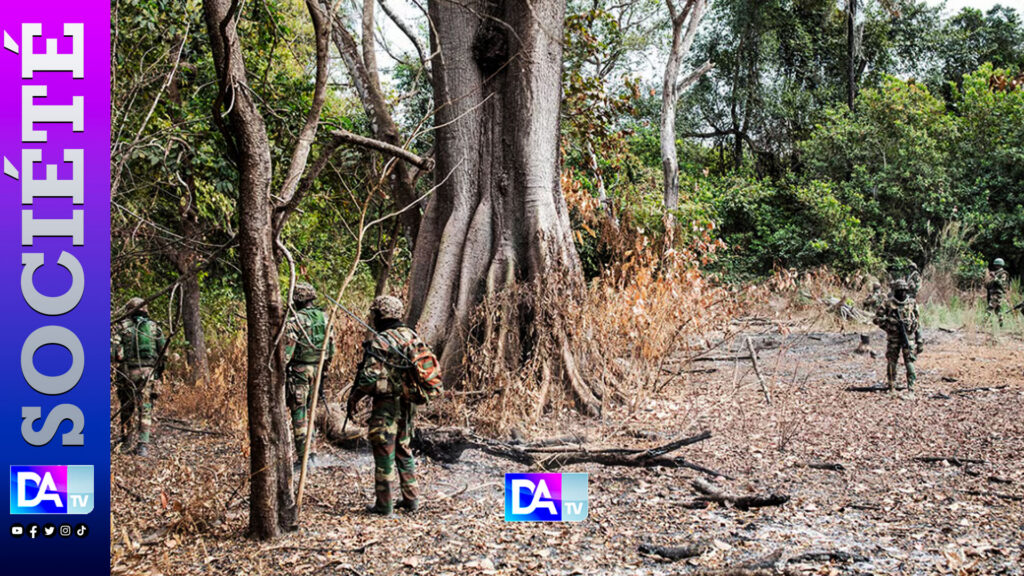
In early May, Senegalese military forces, supported by trained detection dogs, launched a major operation to dismantle cannabis cultivation sites in the volatile Casamance region. This latest campaign marks another chapter in a decades-old conflict that has simmered since 1982, despite the lingering presence of a weakened separatist movement.
The crackdown took place near the Gambian border, where remnants of the Movement of Democratic Forces of Casamance (MFDC)—a group that has fought for Casamance’s independence since December 1982—operate. According to Colonel Cheikh Guèye, regional military commander in Ziguinchor, the operation proceeded smoothly, resulting in 14 arrests, the seizure of military-grade weapons, and over six tons of cannabis.
The MFDC, once a formidable insurgent force, now faces severe setbacks. “The rebellion is significantly weakened,” explained a regional security analyst. “Their ranks have dwindled due to aging fighters, failed recruitment efforts, and internal factional divisions. Meanwhile, the armed forces have bolstered their capabilities with enhanced training and equipment.”
Compounding their decline, the MFDC struggles with supply shortages after neighboring Guinea-Bissau and Gambia—longstanding sanctuaries for rebel logistical networks—tightened cooperation with Dakar to curb cross-border crime.
A local civil society leader noted that the movement’s decline stems from a “loss of political and emotional support” among Casamance communities, who now prioritize stability over separatist ideals. “Years of conflict have bred disillusionment,” they said. “People are tired of war and yearn for peace.”
The shift in public sentiment aligns with national political progress. The rise of leaders from Casamance, including Prime Minister Ousmane Sonko, has given locals a renewed sense of representation in Senegal’s governance. “They no longer feel excluded,” the analyst added. “The region now holds real political influence.”
During a March visit to Ziguinchor, Sonko underscored the rebels’ stagnation: “For over 40 years, they haven’t controlled a single village.” His remarks followed a surge in violence, including a March 17 explosion that killed three soldiers and injured three others during an anti-narcotics raid. Just days earlier, another soldier was killed and six wounded in a separate attack.
Sonko emphasized that while the MFDC may still cling to independence rhetoric, the primary driver of rebellion is now cannabis cultivation. “We will deploy all necessary means to dismantle this criminal economy,” he declared. The May operation targeted the rebels’ financial lifeline, with Colonel Guèye calling it a “direct strike at their war chest.”
The porous border region near Guinea-Bissau remains a hotspot, despite a 2021 military offensive that dismantled rebel bases in that area. Recent clashes have shifted northward to Sindian, close to Gambia, where dense forests and limited infrastructure—despite fertile land—fuel illicit activities.
Mamadou Sadio, a former elite army officer, explained that the terrain’s remoteness and lack of roads force impoverished communities to rely on illegal trade for survival. Some locals have even sought religious justification for cannabis farming, consulting imams for guidance.
Sonko has extended an olive branch to the MFDC, but firmly stated: “We will not tolerate any erosion of Senegal’s territorial integrity.”
Progress toward peace is uneven. A factional peace accord signed three years ago is being celebrated in Ziguinchor, and another agreement reached in Bissau in early 2025 shows promise. Yet, as civil society observers note, the return of refugees and displaced families to their villages signals cautious optimism. However, lingering resistance among armed groups continues to threaten lasting stability.
Rebel factions: a fractured movement
The MFDC’s struggles extend beyond military setbacks. Internal divisions have splintered the group into competing factions, each pursuing divergent agendas. Analysts highlight logistical vulnerabilities, including restricted access to arms and ammunition, as key obstacles to their survival.
Local leaders argue that the rebellion’s fading relevance stems from its inability to adapt to changing times. The once-strong ties between fighters and rural communities have eroded, replaced by a collective desire for normalcy. “People want schools, roads, and jobs—not decades of conflict,” a community elder shared.
Meanwhile, the national government’s commitment to addressing Casamance’s grievances has strengthened. The appointment of Sonko, a native of Casamance, as Prime Minister symbolizes a new era of inclusivity. His administration has prioritized regional development, signaling that political representation may finally heal old wounds.
Cannabis: the unseen fuel of rebellion
While independence remains the MFDC’s stated goal, experts agree that cannabis is the lifeblood sustaining its remnants. The lucrative trade funds weapons, recruits, and operations, turning the region into a drug trafficking hub. Military raids, like the one in May, aim to cripple this underground economy.
However, eradication efforts face resistance. Some farmers view cannabis as their only viable income source, especially in areas where legitimate agriculture is stifled by poor infrastructure. The lack of economic alternatives perpetuates the cycle of crime and conflict.
The government’s strategy combines military action with development initiatives. By improving road networks and fostering legal trade, authorities hope to wean communities off illicit revenue streams. Yet, the path to peace remains fraught with challenges, as pockets of armed resistance persist.
Hope on the horizon?
Despite the obstacles, signs of progress offer a glimmer of hope. Partial disarmament agreements and the return of displaced populations suggest that dialogue may eventually prevail over armed struggle. Yet, the road ahead demands sustained effort from all stakeholders—government, rebels, and civil society—to transform Casamance into a region of lasting peace.