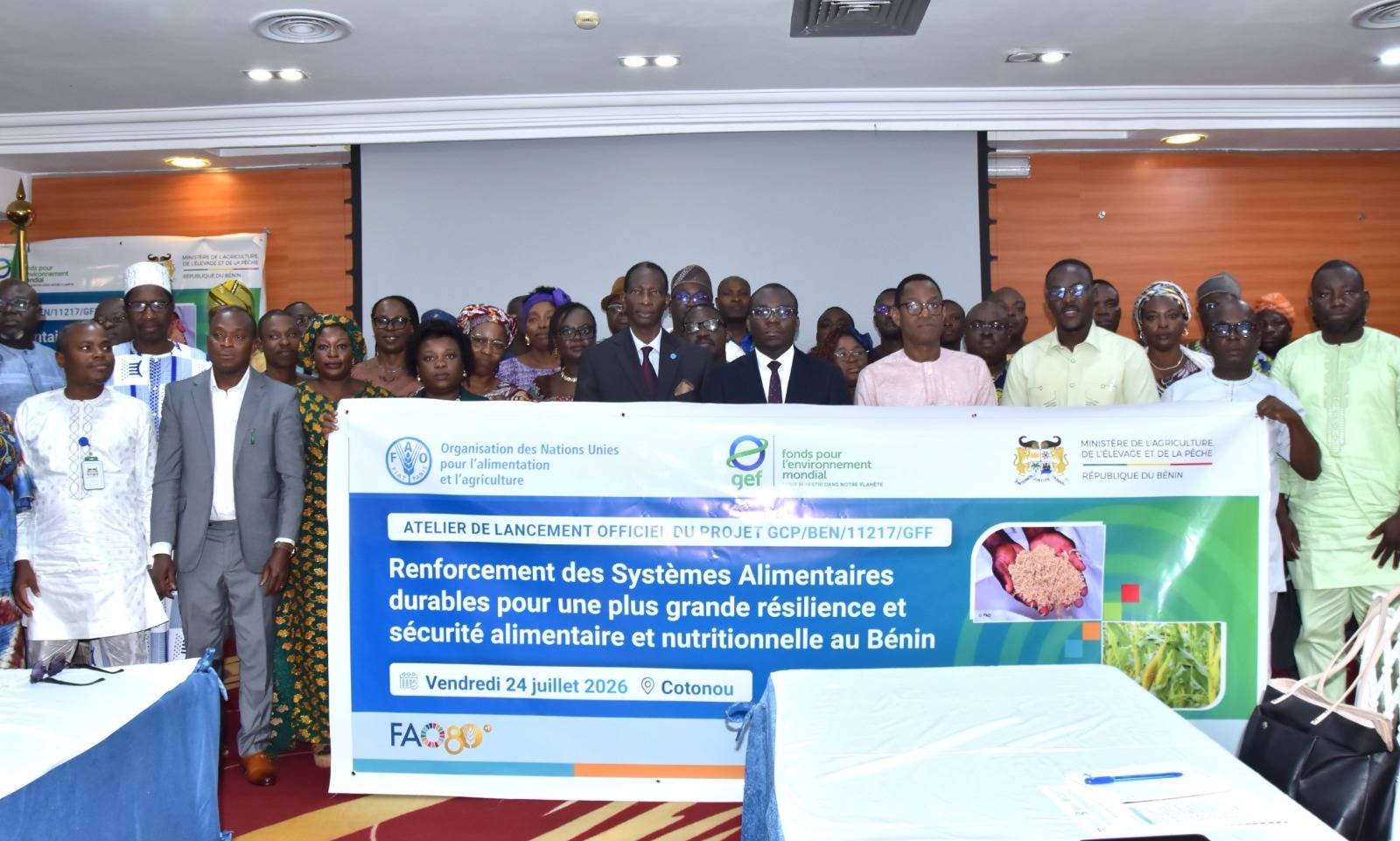
The Beninese government, backed by global partners, has launched an ambitious initiative to revitalize the nation’s agricultural sector. The Food Systems project, with a budget exceeding $20 million, aims to restore degraded lands and transform maize and rice value chains by 2030, ensuring long-term food security.
Land degradation: a silent crisis threatening Benin’s economy
Agriculture is the backbone of Benin’s economy, accounting for 70% of employment, 26% of GDP, and 80% of export earnings. Yet this vital sector faces a growing crisis: soil degradation. Speaking at the project’s launch in Cotonou, Minister Adin Yeton Bloukounon Goubalan highlighted the severity of the situation, noting that declining soil fertility is driving down agricultural yields and trapping rural communities in cycles of poverty.
Official data reveals that over 5 million Beninese—nearly 40% of the population—are directly affected by land degradation. Shockingly, 38% of the country’s total land area is now classified as degraded, reducing crop productivity by at least 50% and exacerbating food and water insecurity in vulnerable regions.
Food Systems: a holistic approach to agricultural transformation
The Food Systems project is designed to address these challenges through systemic change. Developed in collaboration with the Food and Agriculture Organization (FAO) and the Global Environment Facility (GEF), this initiative goes beyond short-term fixes, focusing on sustainable agricultural policies, improved production techniques, and better market access.
The project prioritizes two staple crops—maize and rice—which are cornerstones of both rural and urban diets. By shifting these value chains from low-productivity, high-impact systems to integrated, high-efficiency models, the program aims to create lasting socio-economic benefits while reducing environmental harm.
A targeted investment with ambitious goals
The project’s total budget of $20.77 million is funded through a tripartite partnership: the Global Environment Facility contributes $5.97 million, while the Beninese government provides $14.8 million in national co-financing. Implementation will unfold across five key municipalities—Karimama, Malanville, Glazoué, Kétou, and Les Aguégués—over the next six years.
The expected outcomes are substantial. The initiative will restore 20,000 hectares of degraded land and promote sustainable farming practices across 114,900 hectares. In terms of human impact, 36,000 farmers will benefit directly, with an additional 356,000 people in target regions set to gain indirectly from improved food security and economic stability.
Collaboration and innovation: keys to success
While the project’s goals are ambitious, officials emphasize the importance of careful execution. Minister Goubalan has cautioned that the selection of soil restoration technologies must be rigorous to ensure real-world effectiveness. Meanwhile, the FAO’s Resident Representative in Benin, Paul-Henri Zoéwindé Bouda, underscored that technology alone will not suffice without full buy-in from farmers and agricultural stakeholders.
« The success of this project hinges on collective commitment—from policymakers and implementing agencies to the farmers who will adopt these new practices, » Bouda stated.
A model for West Africa’s agricultural future
By tackling the root cause of Benin’s agricultural decline—soil degradation—the Food Systems project offers a pathway to long-term food independence. If targets are met by 2030, Benin could not only secure its rice and maize supplies but also serve as a replicable blueprint for sustainable agriculture across the region.