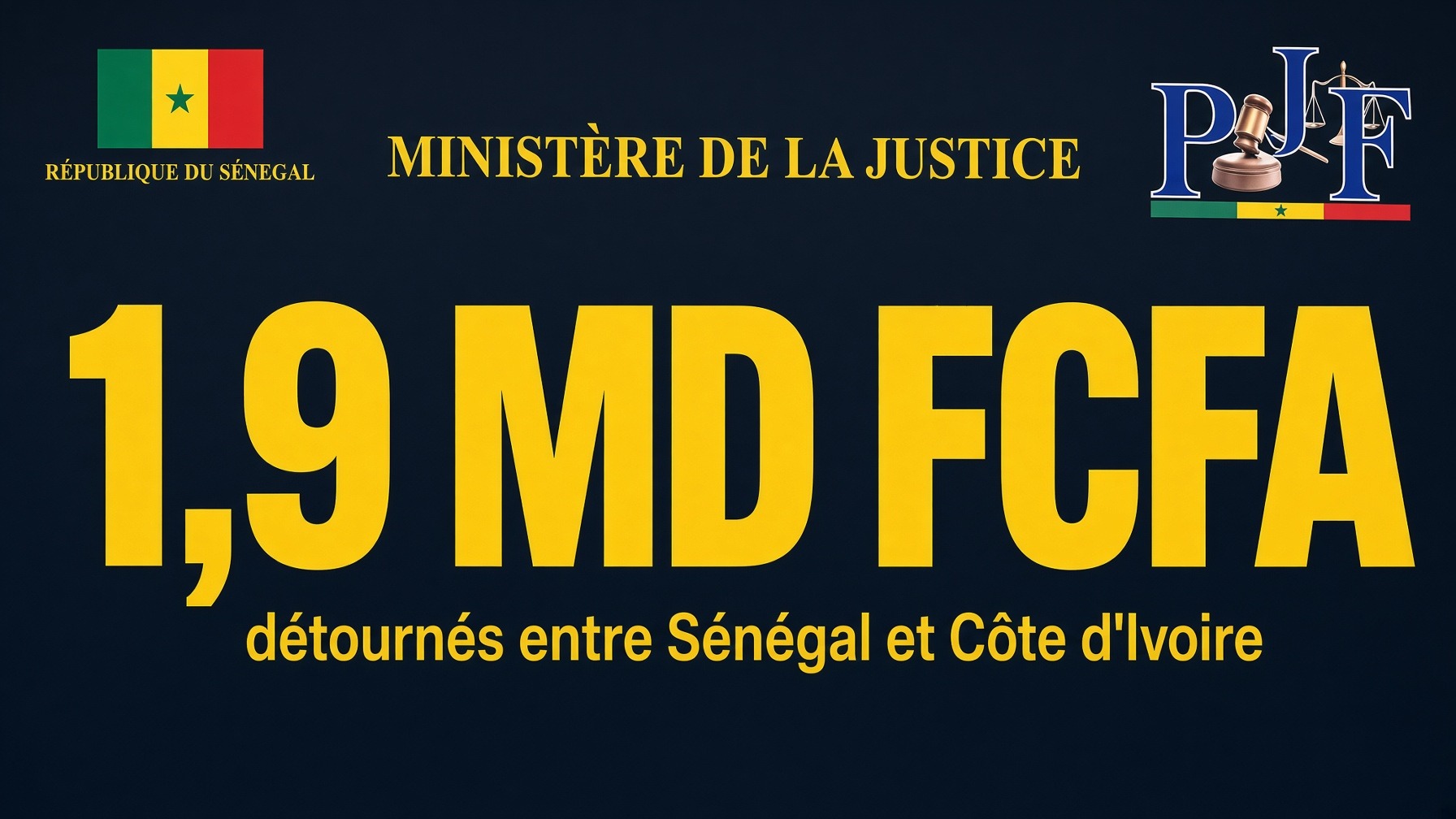
The investigation into an alleged bank fraud scheme involving 1.9 billion CFA francs between Dakar and Abidjan has reached a decisive turning point. Two financial institutions were reportedly caught in a web of fake transfer orders, and the first arrests by Dakar’s elite investigation unit signal a major shift in the case. What began as a complex cross-border puzzle has now moved into a phase of decisive action, with authorities racing to trace the money and establish who is responsible.
The staggering loss at the heart of the case
The sheer scale of the alleged fraud is staggering: 1.9 billion CFA francs. This substantial sum sits at the center of an investigation involving two banks operating between Senegal and Côte d’Ivoire.
Initial findings suggest the banks were manipulated through forged wire transfer instructions. This technique, which involves passing off fraudulent orders as legitimate transfer requests, poses a serious threat to banking security, especially when multiple players and financial channels are involved.
In such schemes, perpetrators typically exploit validation procedures, gaps in document verification, or weaknesses in internal controls. A falsified transfer order, if not properly authenticated, can trigger a transfer of funds to unauthorized beneficiaries.
However, the exact circumstances of this case remain unclear. Investigators must determine how the fake documents entered the banking system, when the irregularities were detected, and how the funds were moved.
Unraveling the method: fake transfer orders
The use of fake transfer orders is the primary known element in this case. While the technical details have not been publicly established, this method raises several questions about the control mechanisms in place at the banks involved.
In a legitimate bank transfer, the order must undergo checks on the identity of the instructing party, the authenticity of the instruction, the availability of funds, and the necessary authorizations. When these controls are bypassed or inadequately applied, the risk of fraud increases dramatically.
The potential sophistication of the scheme, the use of forged documents, and the possibility of multiple individuals being involved are all lines of inquiry that investigators may examine. It would be premature, however, to claim that internal complicity, a cyber intrusion, or identity theft was used in this case.
The challenge now is to accurately reconstruct the chain of operations: from the preparation of the fraudulent orders to their processing by the banks, including the recipient accounts and any subsequent movement of the funds.
This reconstruction will be crucial to understanding whether the events resulted from an organized operation, a series of failures, or a combination of factors.
Dakar’s investigation unit takes decisive action
In Dakar, the investigation has taken a major step forward with the arrest of suspects by the Section de Recherches. This unit of the national gendarmerie, responsible for complex judicial investigations, will play a key role in shedding light on the circumstances of the alleged fraud.
The initial arrests are a significant development, but they do not prejudge the guilt of those involved or the outcome of the proceedings. Investigators still need to gather statements from suspects, compare available evidence, and search for material or documentary proof.
Analyzing bank statements, the disputed transfer orders, communications between parties, and transaction trails could be essential in establishing the facts. The investigation must also determine who prepared the documents, who transmitted them, and who benefited from the funds.
At this stage, the exact number of people involved, their respective roles, and the potential criminal charges cannot be considered definitively established.
The ongoing investigation could lead to further hearings or arrests if sufficient evidence emerges to identify others who may have participated in the operation.
Cross-border complexity: Dakar-Abidjan dimension
The Senegal-Côte d’Ivoire dimension of this case presents an additional challenge for investigators. When banking operations span multiple jurisdictions, investigations may require information exchanges between competent authorities and cooperation with the financial institutions involved.
The priority will be to trace the 1.9 billion CFA francs allegedly diverted. Investigators must identify the beneficiary accounts, verify any successive transfers, and determine whether the funds were withdrawn, moved to other accounts, or converted into assets.
This process is essential to measure the true extent of the loss and assess the chances of recovering the sums. In financial fraud cases, the speed of the investigation can be decisive, as transfers can occur rapidly and complicate locating the funds.
Cooperation between the parties involved, in compliance with applicable procedures, could therefore prove crucial to consolidating evidence and preventing financial movements from making the investigation more difficult.
Bank security under scrutiny again
Beyond the amount at stake, this case raises a fundamental question: the reliability of controls on banking operations. Financial institutions regularly face fraud attempts that exploit administrative procedures, digital tools, and human behavior.
Systematic verification of sensitive instructions, separation of authorization and execution functions, confirmation of unusual requests with clients, and monitoring of atypical transactions are among the measures that can help limit these risks.
Banks are also urged to strengthen staff training and improve mechanisms for detecting suspicious operations. Particular vigilance is required when amounts are high or transactions have unusual characteristics.
It would be premature, however, to conclude that a specific failure occurred at the banks involved before the investigation’s conclusions are published. Only the investigation will establish whether control weaknesses actually contributed to the alleged events.
Awaiting answers on responsibility and the fate of the funds
The case of the 1.9 billion CFA francs allegedly diverted between Dakar and Abidjan has now entered a phase of investigations whose conclusions will be decisive. After the initial arrests by Dakar’s Section de Recherches, several questions remain: How was the fraud executed? Who are the true beneficiaries? Can the funds be recovered? And did others participate in the operation?
These are questions investigators must answer based on verifiable evidence.
Meanwhile, this case reminds us that bank fraud is not limited to an immediate financial loss. It can undermine customer trust, expose institutions to legal risks, and test cooperation between authorities in multiple countries.
The case remains open, and responsibilities must still be established. One certainty stands out: in an economy where financial flows cross borders daily, securing transactions and ensuring a swift judicial response are major challenges. The next steps of the investigation will determine whether this alleged operation was the work of an organized network and clarify the fate of the funds at the center of this financial scandal.