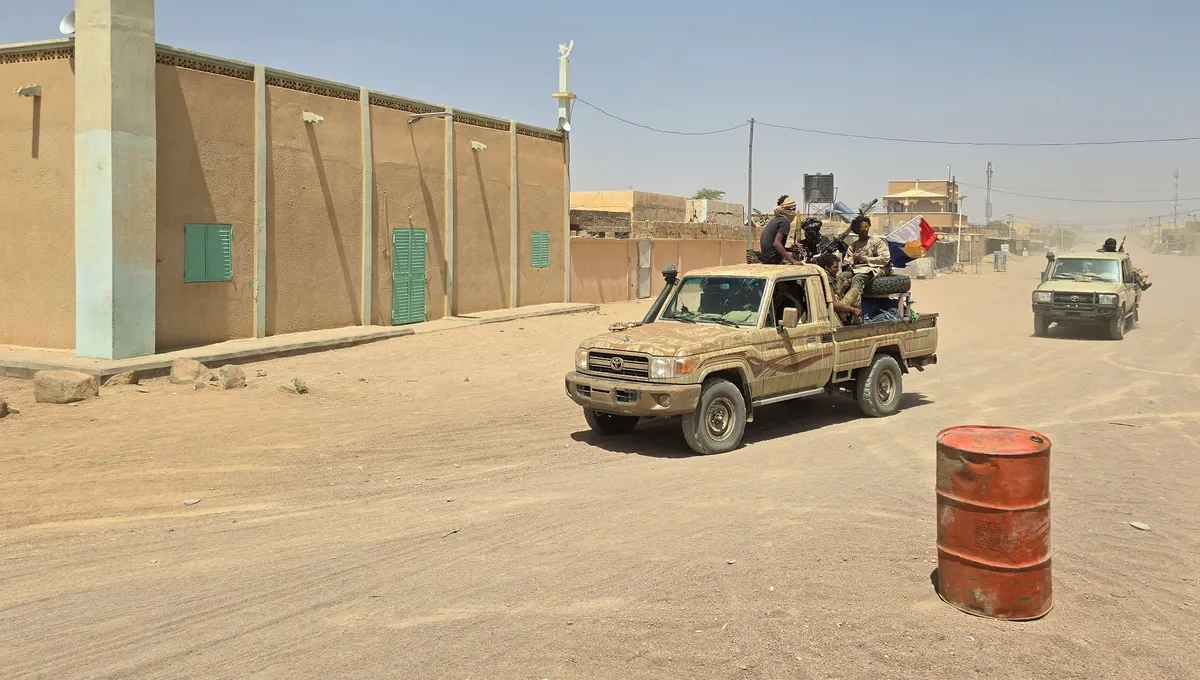
A coordinated offensive across several regions, including the capital city of Bamako, by Touareg insurgents and allied militant groups is currently destabilizing the Malian military administration. In a surprising turn of events, Russian forces, who took over security roles from French troops, recently withdrew from the northern stronghold of Kidal without engaging the enemy.

The sight of Russian military convoys leaving Kidal has sent shockwaves through the region. This bloodless retreat saw the city fall into the hands of a coalition involving Touareg rebels and jihadist factions. This retreat is a significant development in African politics, highlighting a shift in the security landscape of the Sahel.
This tactical withdrawal is even more noteworthy given that the GNIM (Group for the Support of Islam and Muslims) recently claimed responsibility for a series of simultaneous raids throughout the country. In their official communications, the militants explicitly advised the Russian contingents to remain neutral to avoid jeopardizing any potential future arrangements. Such developments are becoming a focal point of West Africa news.
Currently, there are roughly 2,500 personnel from the Africa Corps—the successor to the Wagner Group—stationed in the country. Their lack of action during Mali’s most critical security threat in half a decade has left the junta in a vulnerable position. After dismissing French assistance in 2022, the Malian leadership now faces the reality that their new partners may not provide the protection they expected, a major topic in pan-African news circles.
Significant setbacks for the Malian military leadership
The government suffered a devastating blow last Saturday when the influential Defense Minister was killed during an assault on his home. Simultaneously, insurgent groups managed to launch undetected attacks in various provinces, successfully expanding their influence over wide swaths of the nation. These events are being closely monitored by Africa news English services.
The loss of Kidal carries heavy symbolic weight. The city, a known center for Touareg separatism, was recaptured by the Malian army with Russian support in 2023 after being held for eleven years by Azawad loyalists. That previous success had significantly enhanced the reputation of Colonel Assimi Goïta, the leader of the transitional government.
The collapse of a three-year security strategy
The junta’s consolidation of power, characterized by the banning of political parties and the postponement of elections, is facing growing domestic opposition. Just months ago, Bamako was effectively blockaded, cutting off vital fuel supplies from neighboring states. While the total collapse of the regime is not certain, they are undoubtedly facing their most difficult period yet, impacting the African economy today.
The current instability poses a two-fold risk. Within Mali, there is a danger of the country being split between northern separatists and various jihadist groups. Regionally, the GNIM’s affiliation with Al Qaeda suggests broader ambitions. If Bamako were to fall, fellow members of the Alliance of Sahel States, such as Niger and Burkina Faso, would likely be the next targets, potentially threatening coastal nations already seeing militant activity.
A decade of unsuccessful foreign interventions
The present crisis is the culmination of more than ten years of failed efforts to stabilize the region. Following the 2014 intervention that initially saved Bamako and allowed the government to reclaim northern territories, the long-term results have been disappointing.
The lack of sustained progress fueled public anger, leading to military coups and the eventual replacement of French forces with Russian contractors. Four years into this transition, the security situation remains dire, leaving the Malian people in a state of perpetual uncertainty.