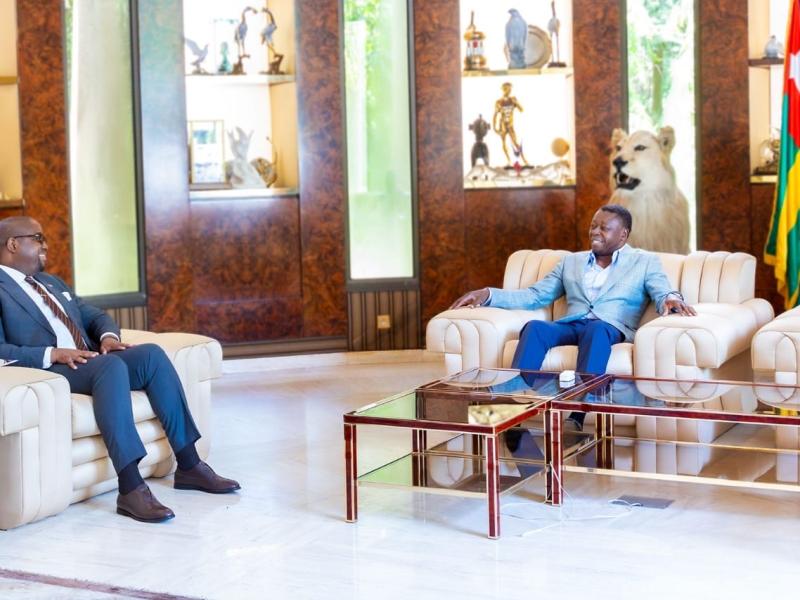
The Togolese Head of Government and African Union mediator for the Democratic Republic of Congo-Rwanda conflict, Faure Essozimna Gnassingbé, hosted Floribert Anzuluni, the DRC’s Minister of Regional Integration, on Tuesday, July 14, 2026, at the presidential residence in Pya, Kozah Prefecture.
The high-level meeting focused on strengthening bilateral cooperation between Lomé and Kinshasa, while addressing the persistent security challenges plaguing eastern Democratic Republic of Congo and the ongoing mediation efforts to restore lasting peace in the Great Lakes region.
The Togolese Presidency confirmed that discussions centered on advancing regional collaboration and evaluating the progress of peace initiatives in the conflict-torn region.
Mediation efforts in the Great Lakes region
According to the official statement, Mr. Anzuluni expressed gratitude to President Gnassingbé for his sustained commitment to resolving the Great Lakes conflict, which has persisted for over three decades. As the designated African Union mediator for the DRC crisis, President Gnassingbé continues to engage with key stakeholders to facilitate a peaceful resolution.
“The Congolese envoy commended the Togolese leader’s personal involvement in seeking a sustainable solution to the regional conflict. As the African Union’s mediator, President Gnassingbé is actively pursuing consultations with all relevant parties to ensure a peaceful and lasting resolution,” stated the Togolese Presidency.
Before arriving in Lomé, Mr. Anzuluni had visited Kampala, where he delivered a message from President Félix Tshisekedi to Ugandan President Yoweri Museveni. These diplomatic exchanges occur against a backdrop of intensified hostilities in eastern DRC, where the M23 rebel group—allegedly backed by Rwanda according to Kinshasa and international observers—continues its military campaign against government forces.
The rebel group maintains control over substantial territories in North Kivu and South Kivu, consolidating its positions despite diplomatic efforts in Washington and Doha yielding limited progress toward a sustainable peace agreement.
These discussions also coincide with national political debates in the DRC regarding potential constitutional amendments ahead of the 2026 elections, given President Tshisekedi’s impending term limit.
Regional diplomacy intensifies
The meeting in Lomé follows a series of high-level consultations across the region. Kinshasa and Luanda have maintained regular exchanges on bilateral relations and regional security concerns. These talks build upon recent diplomatic engagements led by Burundi’s President Évariste Ndayishimiye, who met with religious leaders and opposition figures in the DRC as part of the African Union’s mediation efforts.
Another significant diplomatic development involved President Tshisekedi’s visit to Brazzaville for discussions with his Congolese counterpart, Denis Sassou Nguesso. This visit followed President Ndayishimiye’s state visit to Kinshasa, during which he also engaged with Cardinal Fridolin Ambongo to address political and institutional challenges in the DRC.
Lomé peace process review
The discussions in Lomé took place weeks after the semi-annual technical review of the peace process, held from June 7–8, 2026, at the initiative of President Gnassingbé. The session emphasized the need for enhanced coherence and coordination among regional and international mediation mechanisms to strengthen the peace process in eastern DRC.
The Togolese mediator underscored the importance of collective and sustained efforts to promote stability, peace, and security in the region. He stressed that only a unified approach by regional, continental, and international actors could consolidate progress and pave the way for a durable peace in the Great Lakes region.
This latest meeting builds on the January 2026 high-level summit in Lomé, which brought together former heads of state, the Togolese Foreign Minister Robert Dussey, representatives from the East African Community (EAC) and the Southern African Development Community (SADC), as well as international partners. The summit aimed to foster trust, advance dialogue, and ensure compliance with commitments made by all parties involved in the peace process.
President Gnassingbé’s initiative reflects ongoing efforts to reinforce African-led solutions to the DRC crisis, building on months of diplomatic engagement to restore peace and stability in eastern Democratic Republic of Congo.