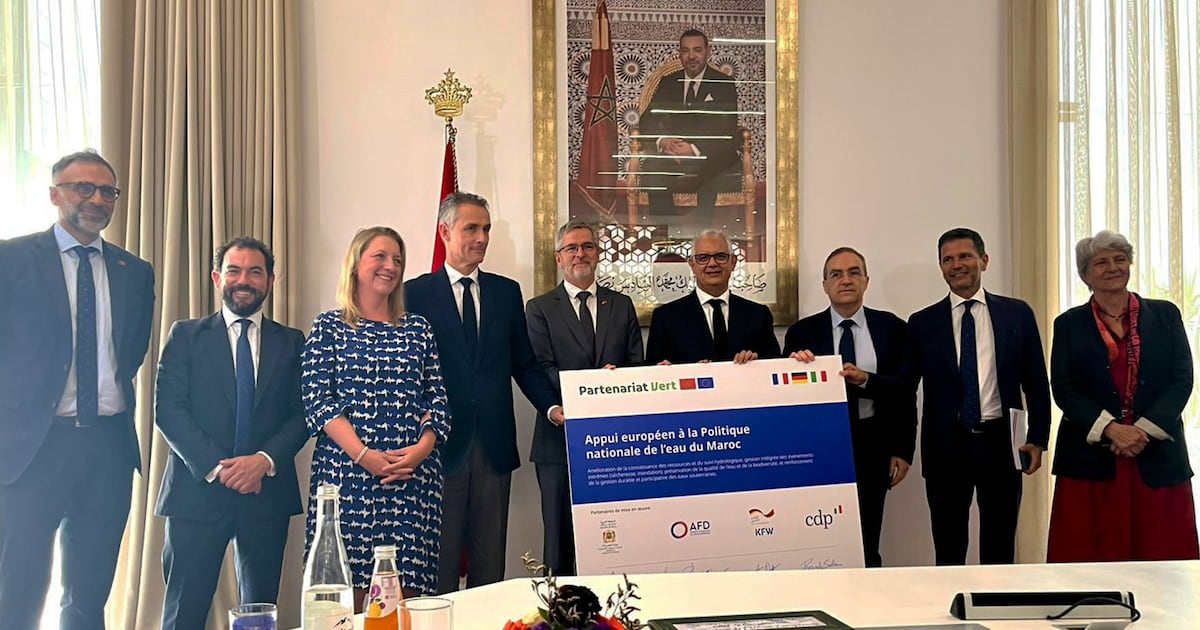
In a landmark agreement signed in Rabat, the European Union (EU) and key European development agencies have pledged a substantial €348 million (approximately 3.7 billion Moroccan dirhams) to bolster Morocco’s national water strategy over the next three years. The funding was formalized at the Ministry of Equipment and Water, with Minister Nizar Baraka and ambassadors from the EU, France, Germany, and Italy in attendance.
The initiative follows a previous agreement reached in November 2024, during a high-level meeting between King Mohammed VI of Morocco and the President of France, which underscored the urgency of addressing water scarcity in the region.
This financial commitment is a joint effort, with the French Development Agency (AFD) leading the project as the primary contributor. The German development bank KfW and Italy’s Cassa Depositi e Prestiti (CDP) are also key partners in this collaborative endeavor. The new French ambassador to Morocco, Philippe Lalliot, marked his first official engagement in the country by highlighting France’s prior contributions of nearly one billion euros to Morocco’s water sector, while commending the EU’s ongoing efforts.
The EU’s ambassador to Morocco, Dimiter Tzantchev, emphasized the bloc’s commitment to water security, particularly in the face of climate change. He noted that the funding will prioritize rural communities, ensuring access to potable water and supporting agricultural irrigation. «The EU places water at the forefront of its priorities, especially amid the challenges posed by climate shifts», Tzantchev stated.
During the ceremony, Minister Baraka outlined Morocco’s ambitious water strategy, driven by the vision of King Mohammed VI. He highlighted the nation’s reliance on 26 operational dams, which currently irrigate around 1.5 million hectares of farmland. Looking ahead, Morocco aims to source 60% of its drinking water from desalination plants in the near term. «A nation that does not control its water supply cannot control its future», Baraka declared.
The minister also stressed the need for efficient governance and results-driven implementation to ensure the success of this new program. He extended gratitude to the ambassadors for their steadfast support in advancing Morocco’s water agenda.
The German ambassador to Morocco, reflecting on the strong Moroccan-German partnership, underscored the strategic importance of water cooperation through KfW’s involvement. His tenure as ambassador is nearing its end, marking the conclusion of a fruitful mission in the Kingdom.
This EU funding will significantly enhance Morocco’s capacity to tackle water stress, accelerating the implementation of its national water strategy. From desalination and dam construction to rural water supply and irrigation, the initiative addresses critical infrastructure needs while safeguarding the country’s hydrological, agricultural, and social stability.