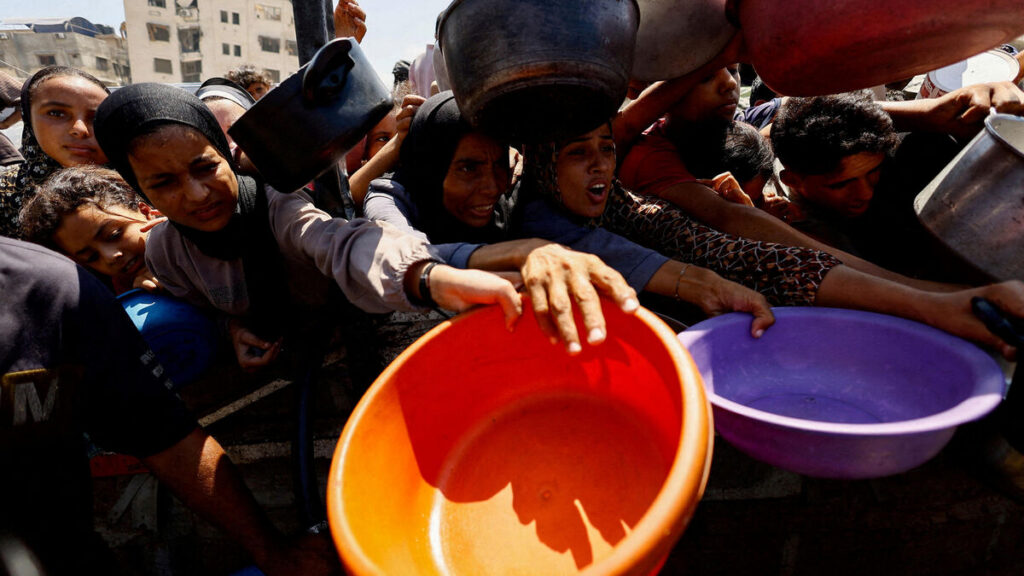
FILE PHOTO: Palestinians wait to receive food from a charity kitchen after the global hunger monitor, Integrated Food Security Phase Classification (IPC), said that Gaza City and surrounding areas are officially suffering from famine that will likely spread, in Gaza City, August 28, 2025. REUTERS/Mahmoud Issa/File Photo
The United Nations has raised a critical alarm about a worsening global hunger crisis, highlighting 16 acute food insecurity hotspots where millions face imminent risk of famine. This stark warning comes as funding shortfalls and escalating conflicts deepen vulnerabilities in already devastated regions.
In a joint report by the Food and Agriculture Organization (FAO) and the World Food Programme (WFP), experts emphasize that Haïti, Mali, Palestine, South Sudan, Sudan, and Yemen are among the nations teetering on the brink of catastrophic hunger. These areas, plagued by prolonged instability and economic shocks, now confront a dire scenario where survival itself is uncertain.
regions grappling with severe food insecurity
Beyond the most critical zones, several other regions face severe food insecurity. Afghanistan, the Democratic Republic of Congo, Myanmar, Nigeria, Somalia, and Syria are classified as highly concerning, while Burkina Faso, Chad, Kenya, and the Rohingya refugee crisis in Bangladesh add to the growing list of humanitarian emergencies.
The report underscores that conflicts, economic turmoil, extreme weather events, and severe funding gaps are exacerbating an already dire situation. Cindy McCain, WFP’s Executive Director, warns: “We are on the verge of a preventable food catastrophe that could trigger widespread famine in multiple countries. Failing to act now will only fuel instability further.”
humanitarian aid under severe strain
The financial shortfall for global humanitarian assistance is alarming. Of the $29 billion urgently needed to support vulnerable populations, only $10.5 billion has been secured. This funding gap has pushed critical aid—including food distributions for refugees—to the brink of collapse. The WFP has already reduced rations and suspended school feeding programs in some nations, while the FAO warns that agricultural livelihoods and food production systems are at risk.
Qu Dongyu, FAO’s Director-General, stresses the broader implications: “Preventing famine isn’t just a moral obligation—it’s a strategic investment in long-term peace and stability.”
urgent calls for collective action
As the global community watches these crises unfold, the UN’s latest report serves as a urgent call to action. With millions of lives hanging in the balance, immediate and sustained funding is essential to avert what could become one of the worst humanitarian disasters in decades.