The events unfolding in the spring of 2026 signify more than a simple tactical defeat; they represent a fundamental collapse of the political framework established by the Malian military leadership.
Despite the bold rhetoric from the authorities, it is increasingly clear that without the presence of Russian Africa Corps mercenaries, the regime’s control over Bamako would have likely evaporated long ago. The junta’s legitimacy was built on the concept of “security sovereignty,” promising that an independent Mali, free from foreign interference, would finally stabilize its territory. However, years later, these promises have been thoroughly contradicted by the escalating violence.
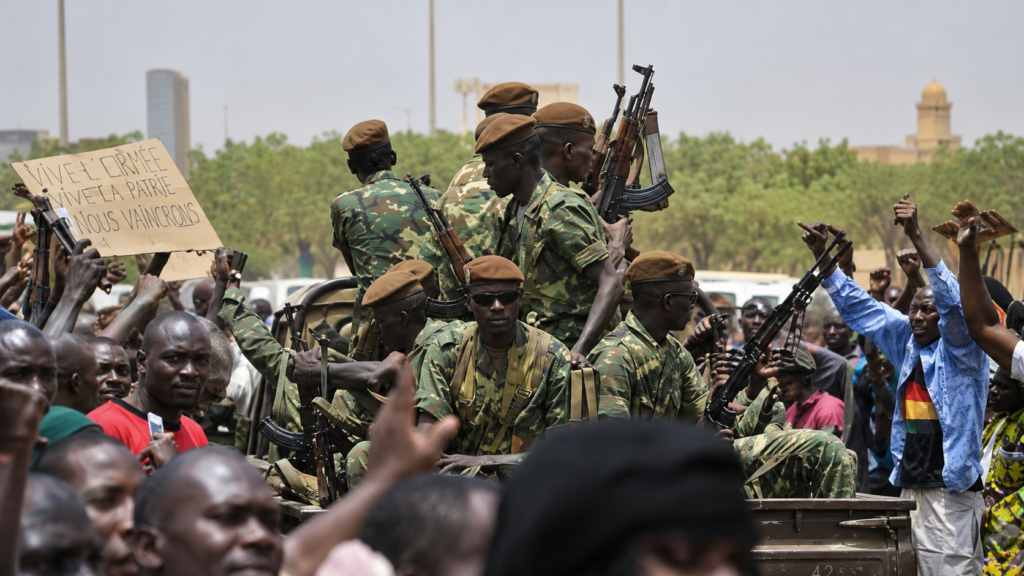
The coordinated offensive launched in late April by the JNIM, in alliance with Tuareg rebels from the Front de libération de l’Azawad, hit strategic hubs including Kidal, Gao, and Mopti. The fact that these operations reached the gates of Bamako represents a massive strategic failure for the state. The death of Defense Minister Sadio Camara, a central figure in the military apparatus, was not just a symbolic blow; it exposed the deep vulnerabilities of a security system the junta claimed was modernized and invincible. Far from neutralizing the threat, the military government appears powerless against an insurgency capable of striking the very heart of the state.
While the security situation is disastrous, the economic climate in Mali is proving to be even more catastrophic. Furthermore, this period confirms a major evolution in the JNIM. The group has transitioned from a rural insurgency into a sophisticated actor capable of executing complex, politically targeted operations. This surge in power has occurred despite—and perhaps because of—the junta’s decision to sever ties with Western partners in favor of a heavy reliance on Russian security actors whose actual effectiveness is now under intense scrutiny.
Official statements regarding the resilience of the FAMAs and the strength of the state now sound more like political propaganda than a realistic assessment of the ground situation. It is a narrative that few in Mali still find convincing. While state institutions may still technically exist, their credibility is rapidly vanishing. By failing to provide lasting security and allowing attacks to creep toward major urban centers, the military regime is dismantling the very foundation of its own authority.
The crisis is further complicated by the fact that local dynamics are slipping away from Bamako‘s influence. The tactical cooperation between the JNIM and certain Tuareg armed groups highlights the failure of a purely military strategy. By framing the conflict solely as a security issue, the junta has ignored the vital political, social, and territorial dimensions of the crisis, inadvertently strengthening a diverse front united by their opposition to the central government.
Ultimately, the military’s gamble has not only been weakened but has proven to be structurally flawed. Increasing military hardware and bringing in external partners have failed to shift the momentum of the conflict. On the contrary, extremist groups have shown a superior ability to adapt, capitalizing on governance failures, communal friction, and the absence of basic public services.
On a regional level, the current impasse also reveals the shortcomings of the Alliance des États du Sahel. Marketed as a sovereign solution to regional instability, the alliance is struggling to deliver concrete results against agile, transnational armed groups. Rather than a solution, it risks becoming a symbol of collective stagnation in West Africa news circles and African politics.
The current situation exposes a fatal contradiction: the junta justified its power through the restoration of safety, yet it is on this specific front that its failure is most visible. The JNIM is no longer just a sign of state weakness; it has become the most brutal evidence of the junta’s inability to manage the deeply political nature of the crisis it claimed to solve.