- News
- Politics
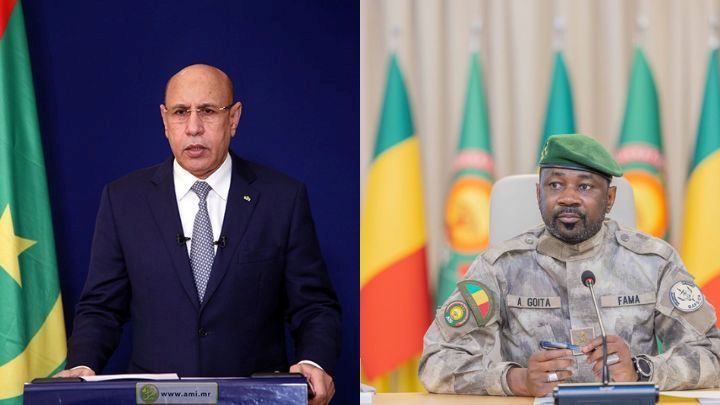
Mauritania distances itself from Mali’s transitional leadership amid deepening border tensions
Recent cross-border truck fires along the Sahel frontier are more than isolated security incidents—they signal a profound shift in relations between Mauritania and Mali’s transitional leadership under Colonel Assimi Goïta. Once reliable trade arteries linking Mauritania, Morocco, and northern Mali have become dangerously unstable, cutting off essential supplies to communities already struggling with food shortages and economic hardship.
The once-thriving commercial corridors that channeled goods from Mauritanian ports to cities like Gao and Timbuktu have narrowed to a trickle. Saharan trade routes, critical to regional commerce for generations, now face frequent disruptions, further straining an already fragile northern Malian economy.
For decades, Mauritania served as a linchpin in trade networks connecting Morocco to northern Mali. Goods flowed through its ports before reaching inland markets, supported by longstanding merchant networks with roots in ancient desert caravan traditions. As one analyst noted, “Mauritania wasn’t just a transit hub—it was a lifeline. The country absorbed Mali’s displaced populations and goods alike, maintaining open borders for refugees since 1991. Today, over 300,000 Malians—refugees and asylum seekers—reside in eastern Mauritania, with many settled in Mbera camp and surrounding villages.”
Erosion of trust along the frontier
This cooperative model began to unravel as regional security deteriorated. Mali’s transitional authorities, supported by foreign military partners, implemented border policies that clashed with Mauritania’s approach. Increased military operations near the shared border and accusations of civilian collaboration with armed groups fueled tensions. Communities that once relied on cross-border trade—herders, merchants, transporters, and traditional leaders—found their networks fraying under the strain of arrests, clashes, and mutual distrust.
“Every incident—whether an arrest, abduction, or accusation—erodes the trust that historically stabilized these zones,” explained the analyst. “Without these networks, once-safe routes become contested spaces where armed factions exploit the vacuum.”
Mauritania’s recalibrated regional role
Once viewed as a stabilizing force for Bamako, Mauritania has adopted a more cautious stance. The shift reflects broader tensions: changing security alliances, diverging counterterrorism strategies, and a reassessment of regional priorities. While Mauritania had previously contained armed threats through early intervention, the escalation of military activity in northern Mali—particularly with foreign actors—reshaped perceptions in Nouakchott.
Today, the roads between Mali and Mauritania are marked by insecurity, with commercial convoys frequently disrupted. The breakdown in cooperation doesn’t just impact trade—it isolates northern Mali further, deepening humanitarian and economic crises.
The transition from partner to wary neighbor underscores a stark reality: regional stability in the Sahel cannot be taken for granted. As alliances shift and threats evolve, the consequences ripple across borders, leaving communities caught in the middle.