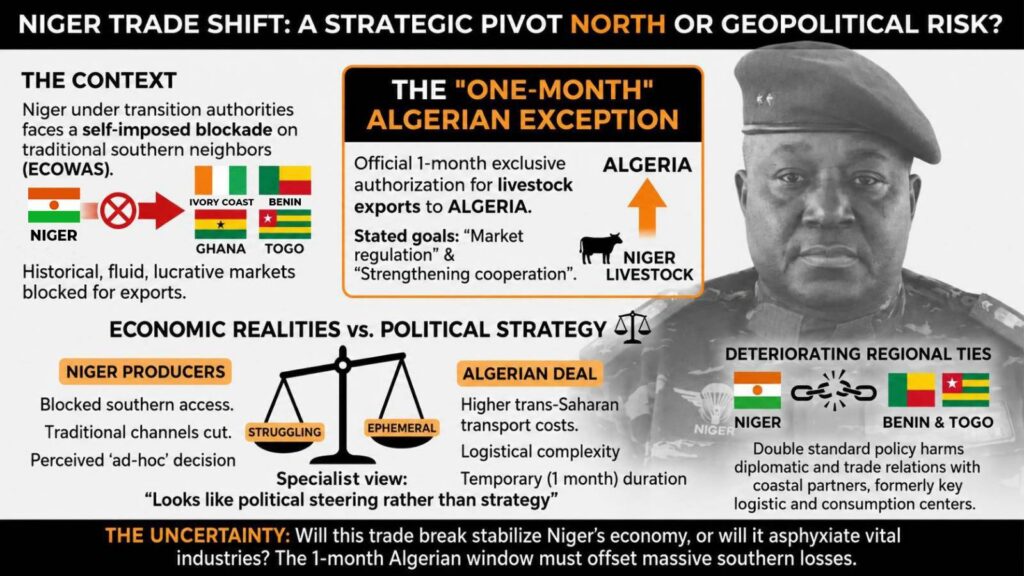
The fragile economic landscape of West Africa has recently witnessed a sharp shift in Niger’s trade policies, prompting deep concern among regional economists and business leaders. While commercial borders remain tightly controlled for exports to Southern neighbors such as Côte d’Ivoire, Bénin, Ghana, and Togo, Niamey has taken a bold, unilateral step toward the North.
An unexpected lifeline to Algiers
In a surprising move, Niger’s transitional authorities have granted Algeria a single-month exemption for livestock exports. Official statements frame the decision as part of an effort to “stabilize domestic markets” and “enhance economic cooperation” between the two capitals. Yet beneath this rhetoric lies a more intricate and potentially perilous economic strategy for local producers.
From natural markets to geopolitical bargaining chips
For decades, the coastal nations of the Gulf of Guinea have served as Niger’s primary, most efficient, and most profitable trade routes for livestock. The abrupt redirection of exports toward Algeria raises serious questions about the long-term logic of such a policy.
“To block access to traditional Southern markets while opening a fleeting Northern window for just one month reflects short-term political maneuvering rather than a coherent economic vision,” noted one analyst specializing in Sahelian cross-border trade, speaking on condition of anonymity.
Regional relations strained by uneven trade policies
By favoring Algeria over its immediate neighbors in the Economic Community of West African States (ECOWAS), Niger’s leadership appears to be forging a new ideological path—one that risks destabilizing the pastoral sector already reeling from recurrent crises.
This asymmetric approach has done little to reassure regional partners and continues to erode diplomatic and fraternal ties with coastal countries. Bénin and Togo, long-standing logistical hubs and major consumers for Nigerien goods, now find themselves sidelined in favor of a Sahara-centered trade route that is both logistically challenging and costlier.
Short-term relief or long-term risk?
With producers caught in the crossfire of shifting geopolitical winds, doubts persist over whether a one-month export window to Algeria can offset the losses incurred from shuttered Ivorian, Bénin, and Ghanaian markets. Transport costs across the Sahara threaten to swallow a significant portion of expected profits, leaving many wondering whether this policy is sustainable—or even wise.
The coming weeks will reveal whether this break from regional norms will stabilize Niger’s economy or further strain its vital economic sectors.