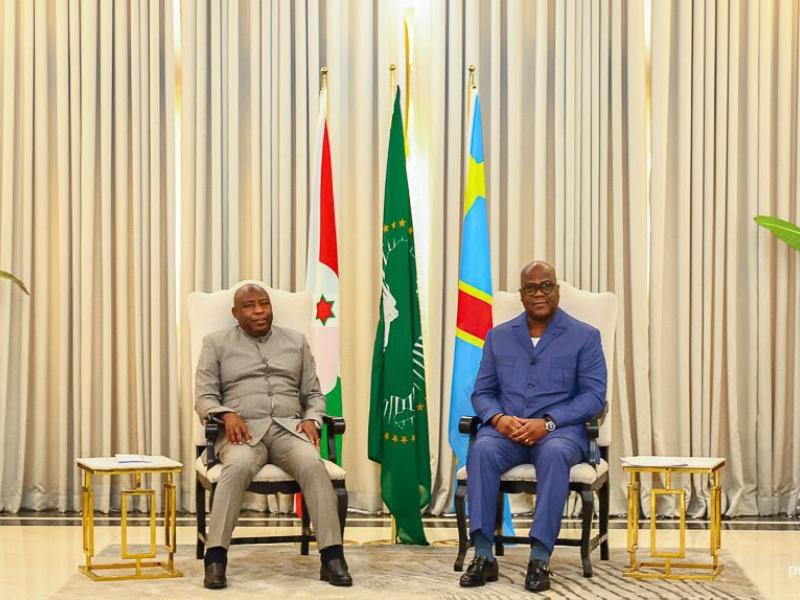
Burundi’s president urges regional collaboration to resolve eastern DRC crisis
During a two-day state visit to Kinshasa, Burundi’s President and current African Union chairperson Évariste Ndayishimiye emphasized the critical need for unified regional action to address the escalating security crisis in eastern Democratic Republic of Congo (DRC). The deteriorating situation, fueled by armed group activities and cross-border tensions involving the M23 rebellion supported by Rwanda, has prompted urgent diplomatic interventions.
In a joint press conference with DRC President Félix Tshisekedi at the African Union City in Kinshasa, Ndayishimiye outlined the gravity of the situation and outlined Burundi’s unwavering commitment to stabilizing the region. He noted that the eastern DRC’s security challenges were a central focus of their discussions, stressing that sustainable peace required more than temporary ceasefires.
“The security situation in eastern DRC demands our immediate and collective attention. We cannot afford fragmented responses when the stability of our entire region is at stake,” Ndayishimiye stated. He highlighted that while recent diplomatic efforts—particularly the Washington and Doha processes—have laid important groundwork, their success hinges on robust regional cooperation and adherence to agreed frameworks.
The Burundian leader underscored the importance of addressing both immediate security threats and long-term socio-economic development in conflict-affected areas. He warned that the presence of foreign armed groups and terror networks in eastern DRC posed a direct threat to regional peace, calling for enhanced intelligence-sharing and coordinated military strategies among member states of the Southern African Development Community (SADC) and the East African Community (EAC).
Support for ongoing diplomatic initiatives
Ndayishimiye reaffirmed Burundi’s strong endorsement of the Washington and Doha peace processes, describing them as vital frameworks for dialogue and reconciliation. He also praised the role of the African Union’s mediation panel, led by former African heads of state, in facilitating these discussions. The Burundian president personally pledged to actively support these initiatives, including establishing a dedicated monitoring mechanism to track progress and ensure accountability.
“The African Union cannot remain passive while our people suffer. We must translate our commitments into tangible actions. My government will spare no effort in supporting these peace processes, ensuring they deliver results on the ground,” he asserted.
Challenges to peace implementation
Despite the diplomatic momentum, challenges persist. Multiple ceasefire agreements have been signed over the years, yet sporadic violence continues to disrupt communities in North Kivu, South Kivu, and Ituri provinces. Analysts point to a persistent gap between diplomatic agreements and their practical enforcement, as conflicting parties often interpret terms differently, leading to renewed hostilities.
The ongoing instability has displaced hundreds of thousands of civilians, with humanitarian agencies warning of a deepening crisis. International observers have repeatedly called for all parties to honor their commitments, but enforcement mechanisms remain weak. The recent escalation of clashes between the M23 and government forces, supported by local militias, has further complicated the search for a durable solution.
Regional unity as the path forward
Ndayishimiye’s visit to Kinshasa signals a renewed push for regional solidarity. His emphasis on mutualizing efforts aligns with growing calls from civil society and regional blocs for a more cohesive approach to the DRC crisis. The African Union has also reiterated its support for the Doha and Washington frameworks, urging all stakeholders to prioritize dialogue over confrontation.
As the DRC grapples with one of its most complex security challenges in decades, the international community continues to watch closely. The outcomes of these diplomatic initiatives and regional collaborations will not only determine the future of eastern DRC but also shape the broader stability of the Great Lakes region.