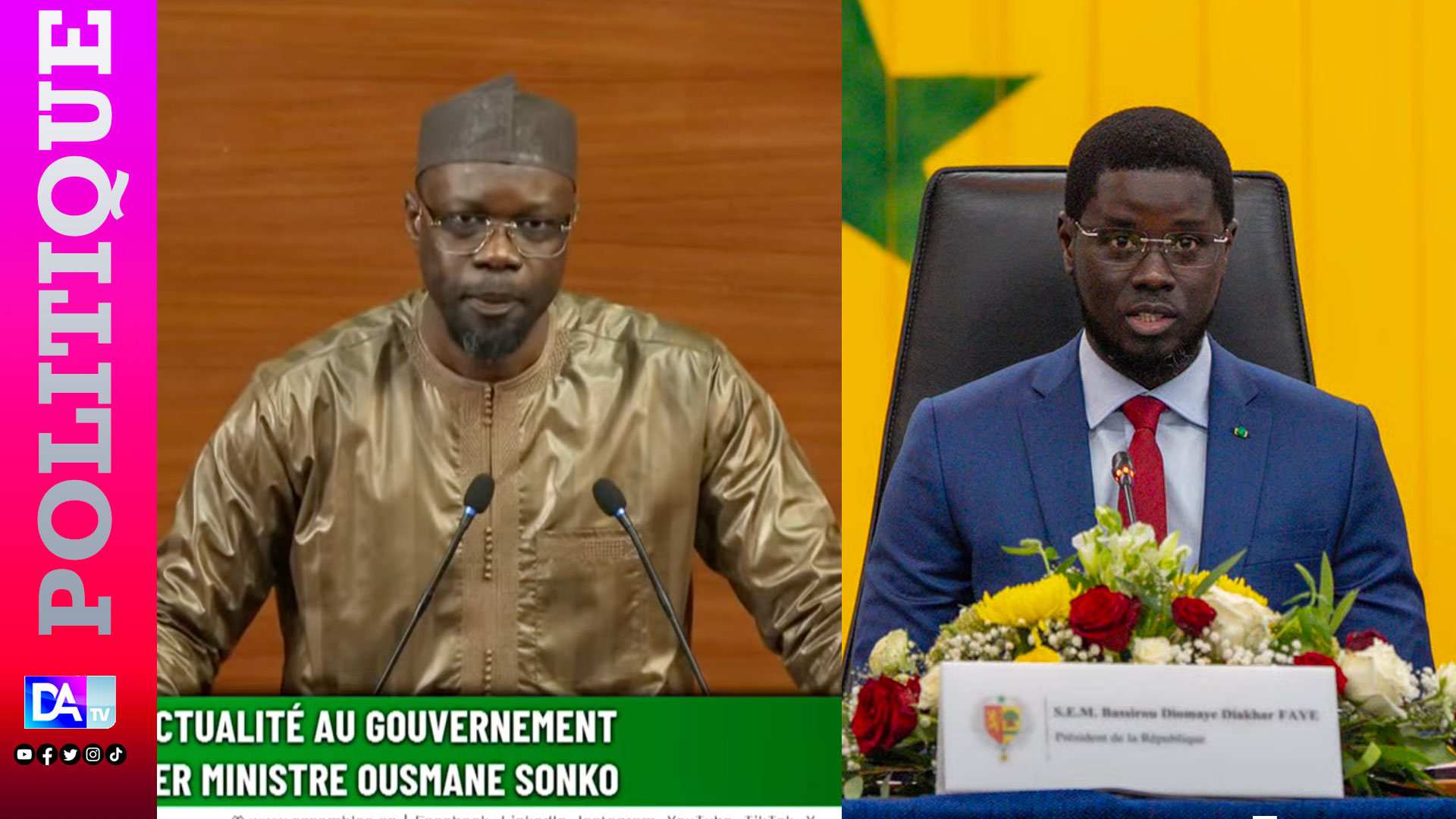
In a rare public display of internal government disagreement, Senegal’s Prime Minister Ousmane Sonko has openly challenged President Bassirou Diomaye Faye over the handling of political funds—a reform that was a flagship issue during their election campaign.
The tension emerged when Mr. Sonko, addressing lawmakers, disclosed that Guy Marius Sagna, a fellow legislator, had spearheaded the parliamentary initiative to legislate political funding oversight. While the Prime Minister acknowledged the importance of the reform, he expressed reservations about the process, arguing that such a critical policy should originate from the executive branch rather than the National Assembly. He went on to reveal that he had already raised these concerns directly with the Head of State, urging decisive action rather than inaction.
Instead of a firm commitment, the President responded with caution, requesting additional time to assess the feasibility of the proposed changes without setting a clear deadline. This measured approach appears to have frustrated the Prime Minister, who issued a stark warning: if the President continues to delay a decision, he will take the initiative himself by submitting the bill to the Council of Ministers for approval.
This public disagreement between the two leaders of Senegal’s executive branch underscores deeper governance challenges, highlighting the strains within their political alliance. The dispute over political funds reform not only reflects differing views on policy execution but also raises questions about the balance of power between the Prime Minister and the President in shaping Senegal’s legislative agenda.
Governance tensions spill into the open
What began as a technical debate over financial oversight has evolved into a political standoff, exposing cracks in the cohesion of their ruling party. The Prime Minister’s insistence on executive-led policymaking clashes with the President’s cautious approach, creating uncertainty about the future direction of key reforms. Observers note that such high-level disagreements, aired in front of legislators, could weaken public confidence in the government’s ability to deliver on its promises.
The Prime Minister’s threat to bypass the Presidency by pushing the bill through the Council of Ministers signals a potential escalation. It also suggests that the political partnership between Sonko and Faye may be tested in ways that could reshape the dynamics of Senegal’s government in the coming months.