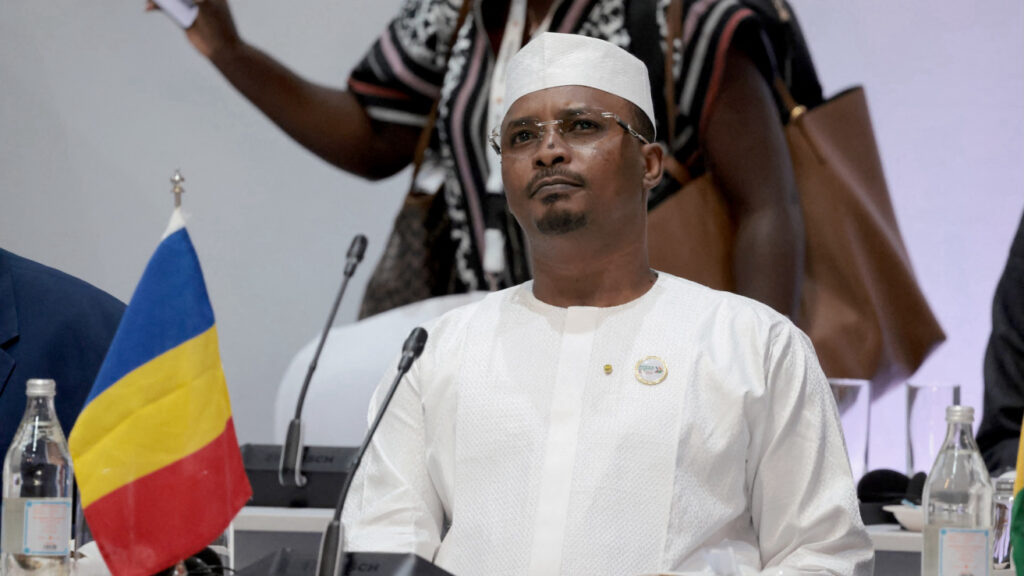
Chad's President Mahamat Idriss Deby attends the working lunch on reform of the international financial architecture at the Africa Forward summit in Nairobi on May 12, 2026. (Photo by Ludovic MARIN / AFP)
Tchad’s democratic retreat: opposition crushed as one-party rule looms
A wave of arrests and legal repression signals a dangerous return to past authoritarian patterns
The Tchadian government has taken another decisive step toward silencing political dissent, sentencing eight opposition leaders to eight years in prison for allegedly plotting an anti-government march. Their coalition, the Groupe de concertation des acteurs politiques (GCAP), had planned a protest on May 2nd to highlight worsening governance failures.
The very next day, the Supreme Court dissolved the GCAP entirely, effectively eliminating the country’s main opposition bloc. Among those imprisoned is Succès Masra, leader of the Transformateurs party, already serving a 20-year sentence since August 2025 for alleged “incitement to hatred.” With their top figures behind bars, the opposition’s ability to challenge the ruling Mouvement patriotique du salut has been crippled.
The crackdown follows a disturbing trend: public protests have been banned for over six years, and those that have occurred—such as the October 2022 demonstrations that left around 200 dead—were met with brutal repression. Legal experts and human rights advocates argue these arrests reflect a disturbing pattern of using the judiciary as a political weapon. The accused were convicted in a swift trial on charges including “criminal association,” “insurrection,” and “illegal arms possession,” accusations their lawyers vehemently deny.
International observers, including the United Nations, have repeatedly condemned these tactics, emphasizing the need to uphold freedom of expression, assembly, and association as guaranteed by international law. Yet the repression persists. Earlier this year, armed militants attacked a gathering celebrating the eighth anniversary of the Transformateurs, leaving one dead, two seriously injured, and the party’s treasurer kidnapped and tortured. While the government pledged to investigate, such violence has become disturbingly routine.
The erosion of democratic freedoms in Tchad has accelerated since the 2021 political transition following the death of former President Idriss Déby Itno. Analysts warn the country risks sliding back into a one-party system reminiscent of the regimes of François Tombalbaye (1960–1975) and Hissène Habré (1982–1990), eras marked by controlled opposition and state propaganda. Even under Déby’s 30-year rule (1990–2021), elections were routinely disputed, and constitutional term limits were repeatedly removed.
Tchad’s history is one of cyclical violence, from the 1964 independence-era conflicts to the 2022 crackdowns. The recent constitutional amendment—increasing presidential terms to seven years in October 2025—further underscores the ruling party’s determination to monopolize power. Critics argue this move, pushed through less than three years after a constitutional return, betrays the promises of inclusive dialogue that once defined the transition.
To prevent further democratic backsliding, urgent reforms are needed. The government must restore fundamental freedoms, ensure judicial independence, and adopt proportional policing measures during protests. Security forces require retraining under civilian oversight, with human rights monitors embedded in operations. Failure to act risks radicalizing disillusioned citizens, particularly youth, who may turn to violence in response to entrenched repression.
Without credible domestic opposition, regional and global bodies—including the African Union, Economic Community of Central African States, and United Nations—must intensify diplomatic pressure for dialogue. While international condemnation has been voiced, stronger advocacy directly engaging Tchadian authorities may yield more meaningful change. The stakes could not be higher: Tchad stands at a crossroads between democratic revival and a return to the dark days of authoritarian rule.