After Niger, now Chad, and likely more regional countries to follow. Algeria is turning its strategy for Sahel stability through economic and social development into concrete projects.
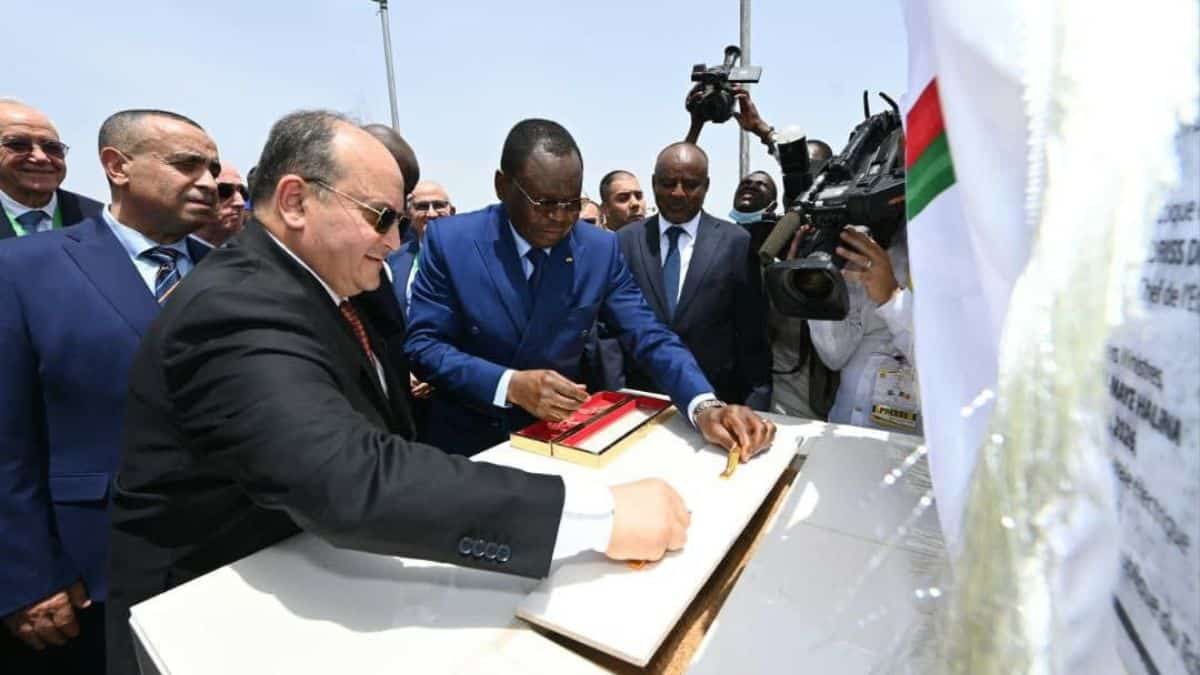
Prime Minister Sifi Ghrieb began a visit to Chad this Monday, June 8, where he laid the foundation stone for a power plant donated by Algeria. This is the second such plant Algeria has built in the region, following the one inaugurated in Niger on Wednesday, June 3, after its record completion time of just 70 days by Sonelgaz International.
Algeria donates a 40-megawatt power plant to Chad
The 40 MW plant, also to be built by Sonelgaz International, is a gift from the Algerian Republic to this Sahel nation, in line with the directives of President Abdelmadjid Tebboune.
The groundbreaking ceremony for this “Algerian-Chadian solidarity” power plant took place in the Farcha industrial zone in N’Djamena, Chad’s capital. It was co-chaired by the Algerian prime minister and his Chadian counterpart, Allamaye Halina.
In a speech at the event, Sifi Ghrieb said the project launch embodies the “unwavering political will” uniting the leaders of both countries and brings to life the high directives of President Tebboune and Chadian President Marshal Mohamed Idris Déby Itno to elevate bilateral relations to a “solid strategic partnership based on genuine solidarity, shared development, and mutual interests.”
Beyond its “symbolic importance for development,” Ghrieb added, the event marks “a decisive step” in strengthening Algerian-Chadian ties, which have moved “from consultation and planning to the implementation and realization of joint projects on the ground.”
Approved by President Tebboune, this project is one of the first fruits of the new momentum sparked by President Déby Itno’s official visit to Algeria in April 2026, Ghrieb stressed.
“The Africa we believe in is one of concrete initiatives”
The power plant carries significant economic, social, and human weight because it boosts Chad’s energy capacity and supports its development efforts, the prime minister argued. He noted that energy today is “one of the fundamental pillars on which national economies rest, and a key factor in attracting investment, developing industry, improving public services, and raising citizens’ living standards.”
“Where energy exists, growth prospects widen, the pace of economic and social transformation accelerates, and well-being levels rise,” he stressed.
Ghrieb reaffirmed Algeria’s “deep conviction” that effective African cooperation can achieve shared development through concrete projects that directly benefit citizens and help build strong, sustainable national economies.
“The Africa we believe in is one of genuine solidarity, concrete initiatives, productive investments, and partnerships that create wealth on its soil and for its people,” he said.
Energy in Africa and the Sahel: Algeria’s full-court press
Other strategic partnership projects are planned between Algiers and N’Djamena, including support for a refinery in N’Djamena, expanded cooperation in geological exploration and seismic studies, experience exchange and training, and the establishment of permanent joint consultation and coordination mechanisms across the energy value chain, Ghrieb recalled.
During the Niamey plant inauguration on June 3, Energy and Renewable Energies Minister Mourad Adjal noted growing demand for Sonelgaz International’s expertise from several African countries, including Chad, Côte d’Ivoire, and Mozambique.
The company, created last March to carry out international projects, has begun preparations for new initiatives in many African nations, the minister revealed.
Beyond electricity, Algeria has also launched oil and gas projects in the region, such as developing the Kafra oil field in northern Niger. On June 4, work on the Algerian section of the TSGP gas pipeline was officially inaugurated in Adrar, with the oil ministers of Nigeria and Niger in attendance.