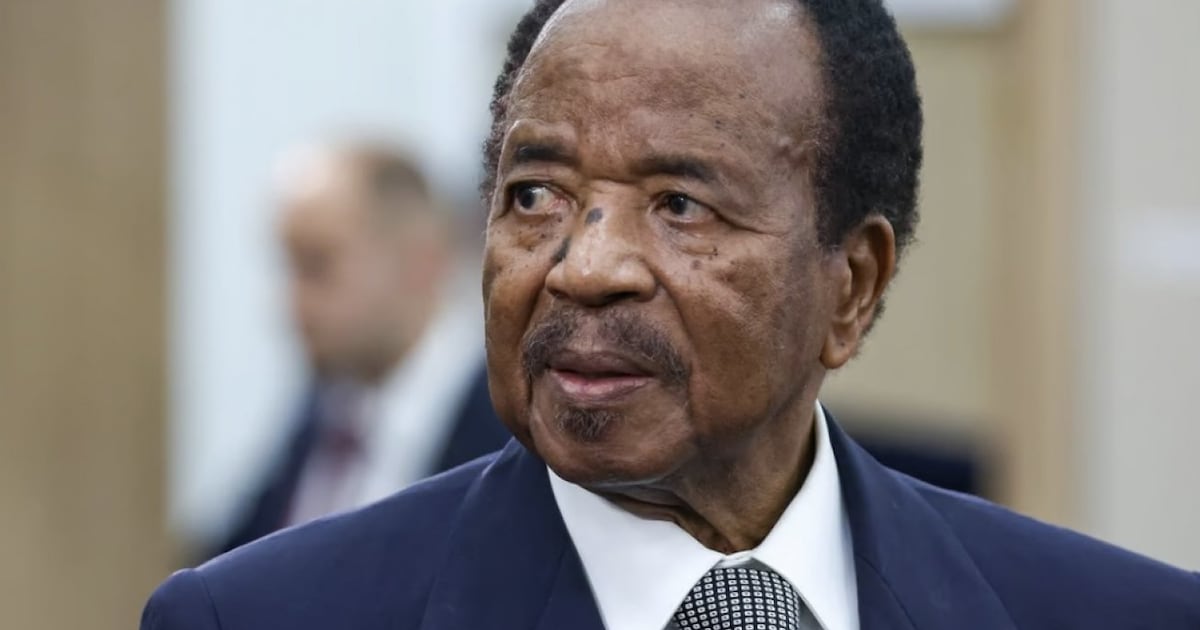
Cameroon’s Head of State, President Paul Biya, has led the country since 1982 and remains the world’s oldest serving leader at 93 years old. As of this past Saturday, he had been away from Cameroonian soil for 48 consecutive days, departing on June 7 for what official statements described as a brief private stay in Europe, accompanied by his wife, Chantal Biya.
Rumors surrounding the President’s health have persisted for years, particularly due to his frequent visits to Geneva, though government officials have repeatedly dismissed these claims. On June 18, Communications Minister René Emmanuel Sadi issued a statement denying reports that the Head of State was hospitalized in a Geneva clinic.
Opposition voices concerns over institutional paralysis
Cameroonian opposition groups argue that the President’s prolonged absence exposes a deep institutional void. Mamadou Mota, Vice President of the Movement for the Renaissance of Cameroon (MRC), took to social media last Friday to denounce what he termed a “striking power vacuum.”
Patricia Tomaïno Ndam Njoya, leader of the Democratic Union of Cameroon (UDC), called on authorities in mid-July to establish a transparent procedure for assessing whether the President is temporarily or permanently incapacitated. Meanwhile, James Fame Ndongo, a senior member of the ruling party and Minister of Higher Education, dismissed claims of a leadership vacuum, asserting that “wherever he is, the Head of State meticulously oversees the files submitted by his collaborators.”
These debates are not new. Late last year, Biya faced similar scrutiny after spending nearly two months abroad. The Social Democratic Front (SDF), another opposition party, went so far as to describe the country as operating in “autopilot mode.”
Viviane Ondoua Biwolé, a public management professor at the University of Yaoundé, acknowledged the growing frustration among citizens: “People are exhausted by the wait.” She pointed to two key factors fueling discontent: the government’s eight-year tenure—an unprecedented duration—and the aftermath of a contentious election marred by disputed results.
The October 2025 re-election of President Biya to an eighth term sparked violent protests, with the government reporting “several dozen” deaths without releasing an official death toll. Western diplomatic missions reacted with measured skepticism to the election outcome.
Two months after his re-election, Biya had pledged in his New Year’s address to form a new government “within days.” Yet seven months later, no such reshuffle has materialized. Compounding public unease, municipal and legislative elections have been repeatedly postponed, extending the mandates of current officials indefinitely.
Uncertainty looms over Cameroon’s political future
Despite these challenges, the government has initiated institutional adjustments, including the March replacement of parliamentary chamber leaders and a constitutional reform in early May to create a Vice-President position. However, nearly three months after the reform, no vice-president has been appointed, fueling speculation about the administration’s intentions.
The uncertainty reached a peak in June when an individual delivered a document to the Yaoundé headquarters of the national broadcaster, claiming it was a presidential decree appointing a Vice-President. The forged document bore official presidential seals and a signature attributed to Biya, but journalists quickly identified it as a fabrication, preventing its dissemination while stoking further rumors.
These maneuvers have intensified discussions about Cameroon’s post-Biya era, with analysts warning of deepening divisions at the highest levels of government. Viviane Ondoua Biwolé noted: “There is a visible crisis at the heart of the State, involving factions close to the President.”
Political scientist Stéphane Akoa corroborated this view, stating: “Increasingly, leaks suggest growing tensions between rival factions within the President’s inner circle.” Observers point to the growing influence of Chantal Biya, the First Lady, whose name has been repeatedly linked to key state decisions and high-level appointments.
Until a Vice-President is named, Senate President Aboubakary Abdoulaye remains constitutionally designated to assume interim leadership in the event of a power vacuum, pending a new presidential election.