The civil protection system in the Democratic Republic of the Congo (DRC) is undergoing a transformative shift—not just in structure, but in philosophy. At the heart of this evolution lies a fundamental question: how can the state fulfill its duty to protect its citizens before, during, and after disasters?
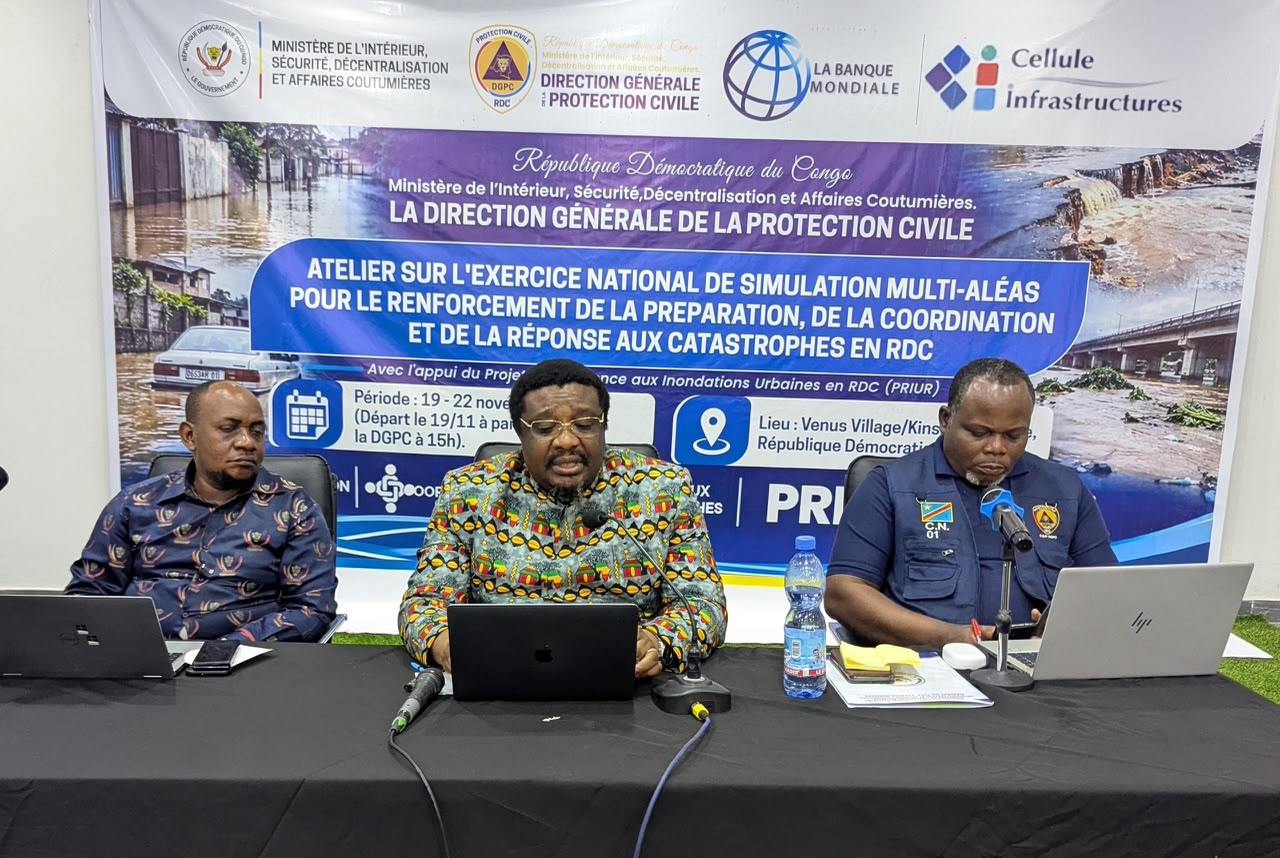
This question was at the center of the National Multi-Hazard Simulation Exercise held in Kinshasa, where officials reaffirmed that civil protection is not merely an administrative duty, but a core responsibility of the state toward every Congolese citizen.
The deeper purpose: building a culture of prevention, not just reaction
Joseph Nkinzo, Director-General of the General Directorate of Civil Protection (DGPC), made it clear: the goal is no longer to wait for disasters to strike. Instead, the emphasis is on prevention, anticipation, and early warning—shifting from a reactive model to a proactive one. “We cannot wait for floods, landslides, or extreme weather events to occur before we act,” he said. “Every life saved begins with a decision made today.”
The DRC faces diverse threats—floods, landslides, erosion, wildfires, and climate-related extremes—each requiring a system that is not only technologically equipped, but also deeply rooted in national culture. This means cultivating a culture of disaster preparedness across communities, institutions, and leadership at all levels.
Institutional synergy: the engine behind effective civil protection
Effective civil protection is not the work of a single agency. It demands a cohesive, multi-actor system, where roles are clearly defined and collaboration is not optional—it is essential. Nkinzo emphasized that no single entity can handle the full spectrum of disaster response alone. Instead, success depends on:
- Clear accountability: each institution must know its responsibilities
- Strategic coordination: under the leadership of the DGPC and the National Disaster Risk Management Platform
- Information sharing: real-time data and synchronized communication
- Resource pooling: leveraging strengths across sectors
“Coordination is not just a courtesy—it is a lifeline,” Nkinzo stated. “Without it, response efforts fragment, and lives are lost.”
Leadership in action: the role of government and partners
The renewed focus on civil protection reflects the vision of President Félix Tshisekedi, who has placed national resilience at the core of development policy. Central to this vision is the leadership of the Vice Prime Minister and Minister of the Interior, Sécurité et Décentralisation. Shabani Lukoo Jacquemain, in driving institutional and operational reforms within the civil protection sector.
This leadership is complemented by vital partnerships, including with the World Bank’s Urban Flood Resilience Project in DRC (PRIUR), which supports institutional and operational capacity-building. “A resilient nation is built through collaboration,” Nkinzo noted. “We are grateful for this partnership, and we call for its deepening to sustain a robust, national disaster management system.”
The simulation exercise itself served as a testing ground for these principles. Teams evaluated alert systems, decision-making processes, response strategies, and evacuation procedures—ensuring that when a crisis hits, the system responds with precision and speed.
Outcomes for the future: clarity, accountability, and resilience
As the exercise concluded, several key outcomes were anticipated:
- A National Integrated Flood Preparedness and Response Plan, incorporating El Niño-related risks
- Clear delineation of roles, resource needs, and implementation timelines
- Strengthened public-private-community engagement in disaster risk reduction
“Every disaster leaves behind stories of loss,” Nkinzo reflected. “Behind those stories are families waiting for the state to fulfill its promise of protection and safety. Our work today is not just about saving lives—it is about preserving dignity, stability, and hope.”
In the end, civil protection in the DRC is not just a policy or a program—it is a pledge to the people: a promise that the state will stand not only in the face of disaster, but long before it arrives.