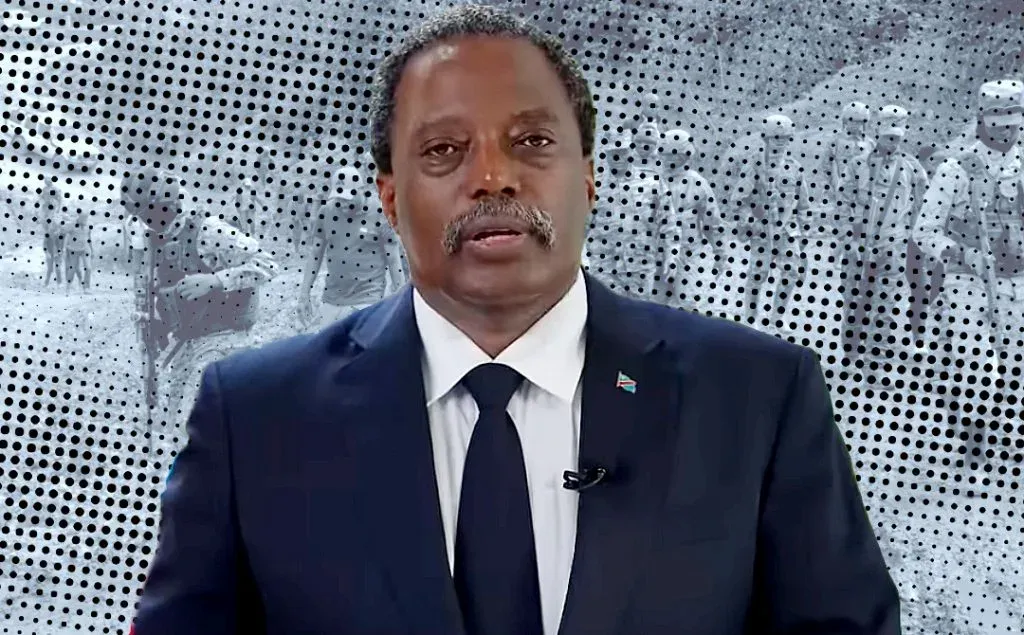
The Democratic Republic of Congo (DRC) is witnessing a seismic shift in its decade-long conflict as Joseph Kabila, the country’s former president, has taken the helm of a newly formed politico-military coalition. The Front for National Refoundation (FRN) was officially launched on October 12 in Goma, the eastern provincial capital, signaling a major escalation in the power struggle against President Félix Tshisekedi’s administration.
From opposition figures to armed alliance: the birth of FRN
The FRN emerges as a merger of prominent political factions, including the Alliance of the Congo River (AFC) and the March 23 Movement (M23), both long-standing critics of Kinshasa’s governance. The coalition’s leadership is a powerhouse of former and current power brokers: Kabila himself will serve as president, with Cornelius Nangaa, ex-head of the Independent National Electoral Commission and AFC leader, and Bertrand Bisimwa, M23’s political chief, as vice-presidents. The military command is entrusted to General Sultani Makenga, M23’s military commander, while Freddy Rukema Kaniki assumes the role of secretary-general.
Declaration of intent: force as a means to an end
In a bold declaration, the FRN vows to unify resistance forces and dismantle what it describes as a « tyrannical regime » in Kinshasa. The coalition’s founding statement explicitly reserves the right to use « all means necessary, including force, » to achieve its goals. While the document outlines the FRN’s objectives—ending institutional decay, combating corruption, and reversing the alleged illegitimacy of the 2023 electoral process—it notably omits a concrete action plan or timeline for military operations.
M23 and AFC’s institutional merger under one banner
The creation of the FRN marks the dissolution of the AFC, which the coalition’s charter states is now subsumed into the new front. The role of the M23 within this structure remains ambiguous, with no separate provisions detailing its continued existence or integration. The announcement has raised questions about the coalition’s internal cohesion and long-term strategy, particularly as the M23 has been a dominant armed actor in eastern DRC since its resurgence in 2025.
Accusations and grievances fuel the coalition’s narrative
The FRN’s manifesto levels serious charges against Kinshasa’s government, accusing it of systemic corruption, institutional weakening, and systemic discrimination. It also challenges the legitimacy of President Tshisekedi’s administration, claiming the 2023 elections were neither free nor fair. These allegations, while central to the FRN’s rhetoric, lack independent verification. The coalition further asserts that the government has violated ceasefire agreements and failed to release political prisoners, though these claims have not been corroborated by external observers.
Conflict dynamics intensify amid diplomatic stalemates
The FRN’s emergence coincides with a critical juncture in the DRC’s eastern conflict, where the M23 and allied armed groups maintain control over significant territories, including Goma. International actors, including the UN and Western governments, have repeatedly accused Rwanda of backing the M23—a claim Kigali firmly denies. Diplomatic efforts, including high-level talks in Doha, have so far failed to yield lasting peace, while the FRN’s formation adds another layer of complexity to the crisis.
Kabila’s shifting stance and the specter of renewed violence
Joseph Kabila’s leadership of the FRN represents a dramatic turn in his political trajectory. Once a steadfast denier of ties to the M23, he now stands at the forefront of a coalition accused by Kinshasa of fomenting rebellion. In 2025, a military court sentenced Kabila in absentia to death for treason, war crimes, and rebellion-related offenses—a verdict he dismisses as politically motivated. The FRN’s call for forceful action raises concerns about a potential escalation in violence, even as peace negotiations remain stalled and the humanitarian toll in eastern DRC continues to rise.
Unanswered questions loom over the FRN’s future
With the coalition’s leadership now firmly established, critical questions remain unanswered. How will the FRN coordinate its military strategy, particularly given the M23’s entrenched presence in eastern Congo? What are its long-term objectives beyond the immediate goal of toppling the current regime? And how will this development impact the already fragile peace talks? As the FRN consolidates its position, the specter of prolonged conflict looms large over a nation already grappling with political instability, economic decline, and a devastating humanitarian crisis.