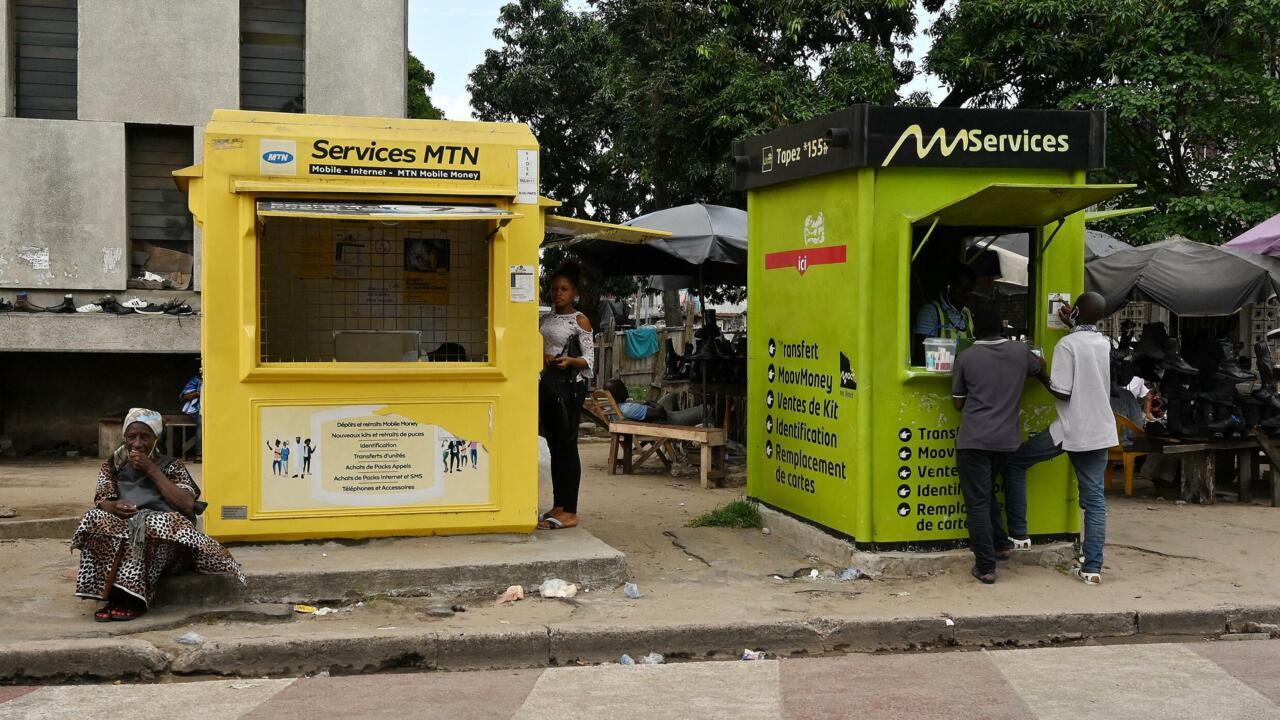
Côte d’Ivoire now boasts over 400,000 mobile money service points, according to the Financial Inclusion Promotion Agency – that is 300 times the total number of ATMs in the country. Ivorians rely on these kiosks daily to deposit wages and withdraw cash, yet agents often face cash shortages that hurt their business.
Late afternoon in the Angré Château neighbourhood. Time for shopping or commuting, but at this busy junction the mobile money kiosk has run out of cash. Rosette shrugs – she came to withdraw 10,000 CFA francs (about 15 euros). ‘When you show up, they don’t have what you need, it happens, so you just deal with it,’ she says.
Seated in the yellow kiosk, cashier Nema asks customers to wait. ‘Some days there are many withdrawals and we run out of cash. We apologise and tell clients we are in deposit-only mode,’ she explains.
Rather than queue, some customers go elsewhere to withdraw. Affoué, the kiosk manager and a former accountant, sees losing a customer as lost earnings. ‘You lose the client and the commission, so you have to treat them well to boost commissions and turn a profit,’ she says.
Customer loss, profitability decline
Mobile money operators such as Orange, Moov, MTN and Wave pay commissions to kiosk managers. For example, they earn between 20 and 60 CFA francs (3 to 9 euro cents) per 10,000 CFA franc transaction. The more and larger the transactions, the higher their income.
The system breaks down when cash or credit runs short. Agents must close shop to restock from operators or banks. They suffer customer loss and dwindling commissions, making it unprofitable – they have to go to distributors.
Motorcycles for faster response
Gertrude Yapi, operations director at Leya, an Abidjan-based startup, runs a motorbike cash courier service to replenish mobile money points. ‘We supply credit in under four minutes and deliver cash in less than 30 minutes to satisfy clients. We help vendors increase their turnover by 50%,’ she says. Leya now claims over 3,000 active customers across four Ivorian cities: Abidjan, Bondoukou, Bouaké and Korhogo.
Ivorian economist Kassoum Timité stresses that service continuity is vital for overall economic activity. ‘Mobile money directly reaches the informal sector, which accounts for the largest share of economic activity in Côte d’Ivoire – up to 40% of GDP, according to the IMF. So cash shortages slow transactions and reduce economic output,’ he explains.
In 2024, over 140 billion CFA francs (more than 210 million euros) were exchanged daily via mobile money, according to the Ivorian agency for financial inclusion – nearly four times the volume in 2020.