Since the military coup in July 2023, Niger has witnessed a sharp decline in human rights, with authorities intensifying repression against political opponents, dissidents, union leaders, and journalists. Arbitrary detentions remain rampant, including that of former President Mohamed Bazoum and his wife, former government officials, journalists, and human rights activists. These individuals are held incommunicado, with no access to legal counsel or family visits.
The security situation has deteriorated further as Niger continues to battle multiple Islamist armed groups, including the Islamic State in the Sahel (EIS), the Support Group for Islam and Muslims (GSIM or JNIM)—linked to Al-Qaeda—as well as Boko Haram and the Islamic State in West Africa (ISWA). These groups operate primarily in the western regions of Tillabéri and the southeastern border areas with Mali and Burkina Faso, where clashes have escalated, posing severe threats to civilian populations.
military junta consolidates power
In March 2025, General Abdourahamane Tiani, head of the military junta, was sworn in as transitional president for a five-year term without holding elections, further entrenching the junta’s grip on power. This move delayed any prospects of a return to democratic governance. The junta also abolished multiparty politics nationwide through a decree, further restricting political freedoms.
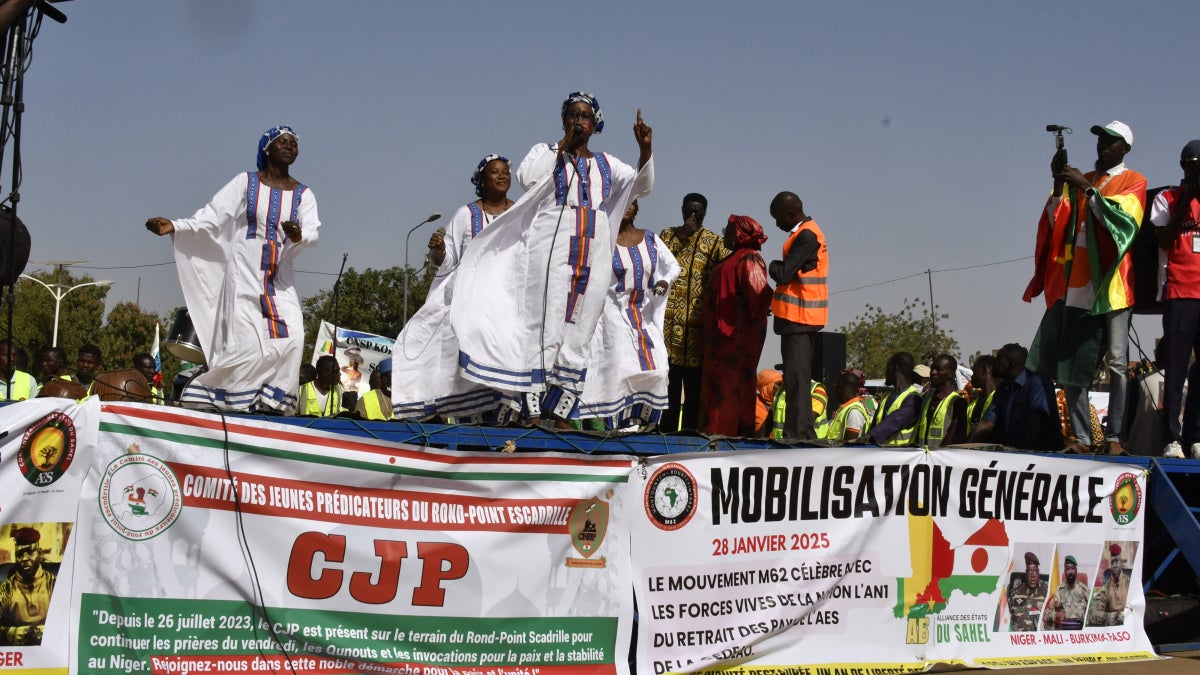
In January 2025, Niger, alongside Mali and Burkina Faso, withdrew from the Economic Community of West African States (ECOWAS), weakening regional accountability mechanisms. By September, these three countries announced their intention to exit the International Criminal Court (ICC), raising concerns about impunity for atrocity crimes.
In August, the junta launched ‘Garkuwar Kassa’ (‘Shields of the Homeland’), a civilian militia initiative in the Hausa language, recruiting and training civilians to support government forces. While framed as a counterterrorism measure, critics warn this could lead to unchecked abuses by armed civilian groups.
escalating islamist violence against civilians
Islamist insurgencies originating in northern Mali in 2012 have spilled into Niger and Burkina Faso, fueling over a decade of widespread abuses. In 2025, EIS escalated attacks in Tillabéri, executing civilians, burning homes, and looting villages. Survivors report that the military often failed to respond to advance warnings from local communities.
Key incidents include:
- A March 21 attack on a mosque in Fambita killed 46 worshippers, including three children, and destroyed 20 homes and market shops.
- A May 13 assault on Dani Fari resulted in five men and two boys killed, with 12 homes burned and dozens looted.
- A June 21 attack on a mosque in Manda left over 70 dead, including five children, and destroyed 10 homes.
- A June 20-23 spree in Abarkaize saw the execution of a village chief and five abducted men, whose bodies were later found with throats slit.
- A June 23 attack in Ezzak killed six men and looted homes.
In each case, EIS fighters accused locals of collaborating with the Nigerien military or failing to comply with demands, such as paying zakat (Islamic tax).
suppression of dissent and political freedoms
Mohamed Bazoum and his wife remain detained in the Niger presidential palace in Niamey since the coup. The United Nations Working Group on Arbitrary Detention ruled their detention unlawful in February 2025, calling for their immediate release. Despite this, Bazoum faces potential trial after the junta revoked his immunity in 2024 through a procedurally flawed process.
Since the coup, the junta has arbitrarily arrested dozens of former officials, including ministers, presidential aides, and allies of Bazoum, often denying them fair trials. While 50 detainees were released in April 2025, many others remain imprisoned for political reasons, including prominent human rights defender Moussa Tiangari.
Tiangari, a vocal critic of the junta, was arrested in December 2024 and held incommunicado for two days before being located at the Central Service for Combating Terrorism and Organized Crime. In January 2025, he was charged with ‘conspiracy against state authority in collusion with enemy powers’ and ‘association with a terrorist enterprise’—offenses that carry the death penalty if convicted. His trial has been repeatedly delayed, and a July appeal to dismiss the case was rejected.
crackdown on free speech and civil society
Since 2023, Niger has seen severe restrictions on press freedom, with journalists facing harassment, threats, and arbitrary arrests. Many now practice self-censorship to avoid reprisals. In January 2025, the government suspended the private television channel Canal 3 TV for 30 days and revoked the press card of its editor-in-chief, Seyni Amadou, after a critical broadcast about government ministers. The suspension was later lifted.
In February 2025, the military authorities expelled the International Committee of the Red Cross (ICRC) from Niger without explanation. In May, three journalists from Sahara FM in Agadez were arrested for reporting alleged rifts in security cooperation between Niger, Russia, and Turkey. Though a judge ordered their release the next day, they were re-arrested and remain detained.
The junta has also targeted labor rights, dissolving four judicial unions in August 2025. The Nigerien Bar Association and the Union of Nigerien Trade Unions condemned the move, calling it a grave violation of workers’ rights and demanding its reversal. Lawyers staged a two-day strike in protest.