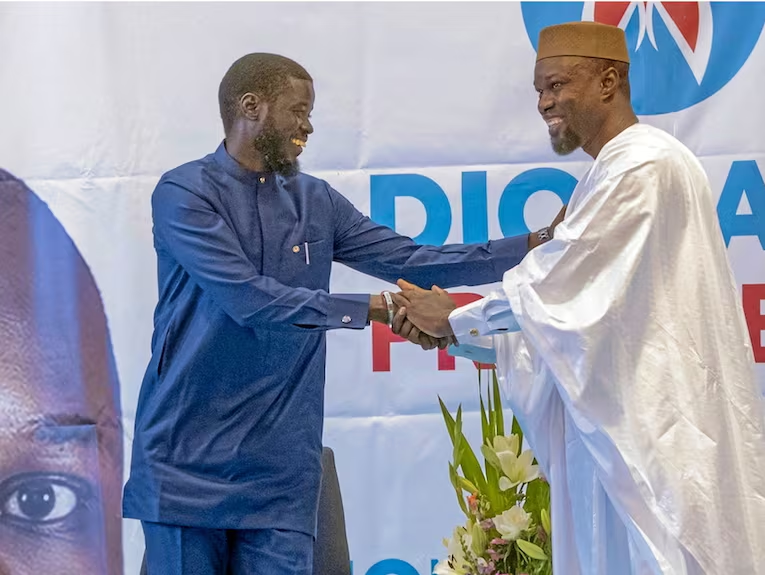
Senegal’s President Bassirou Diomaye Faye abruptly terminated the mandate of Prime Minister Ousmane Sonko in a televised address delivered by the presidential secretary-general, Oumar Samba Ba. The decision, announced late Friday, effectively dissolved the entire outgoing government, leaving ministers and state secretaries to handle «current affairs pending» until a new administration is formed.
The move brings to an end a political partnership forged in opposition to former President Macky Sall, whose final years in office were marked by intense confrontation with Sonko’s camp. After Sonko was barred from running in the February 2024 presidential election due to a defamation conviction that stripped him of civil rights, he endorsed Faye as the coalition’s candidate—an endorsement that played a pivotal role in securing Faye’s victory.
Growing rivalry behind the breakup
Since taking office, tensions between Faye and Sonko had steadily escalated, fueled by power struggles and clashing visions over governance. Sonko, a charismatic figurehead of Senegal’s youth and a prominent advocate of sovereignist and pan-African ideals, continued to wield significant influence, positioning himself as the true architect of the political shift that brought Faye to power.
Disputes intensified following the November 2024 parliamentary elections, which saw the ruling party secure a sweeping victory—results closely tied to Sonko’s enduring popularity. Recent incidents in Dakar had exposed widening rifts between the presidency and the prime minister’s office, fueling speculation that a breakup was imminent.
Within minutes of the announcement, Sonko took to social media, posting a concise message: «Alhamdoulillah. Tonight, I will sleep peacefully in Keur Gorgui», referencing the Dakar district where he resides. Soon after, videos circulated online showing dozens of supporters gathering outside his home, chanting his name in solidarity.
A parliament at risk of instability
The president’s decision plunges Senegal into a period of profound political uncertainty, especially as Sonko’s camp retains strong influence in the National Assembly. The ruling party’s parliamentary dominance could escalate this personal rift into a broader institutional conflict, particularly given Sonko’s status as one of the country’s most popular political figures.
The rapid rise of Faye and Sonko was built on a shared rejection of the political elite, criticism of ties with France, and a promise of sweeping democratic renewal. For months, their movement mobilized urban Senegalese youth, galvanized largely by Sonko’s sharp rhetoric and calls for systemic change.
By removing the man who once mentored him, President Faye now risks alienating a militant base whose loyalty remains deeply tied to the former prime minister. In Dakar, the prospect of a swift reshuffle at the highest levels of government is already stoking political unrest in a nation where institutional stability has, until now, endured despite recurring crises.