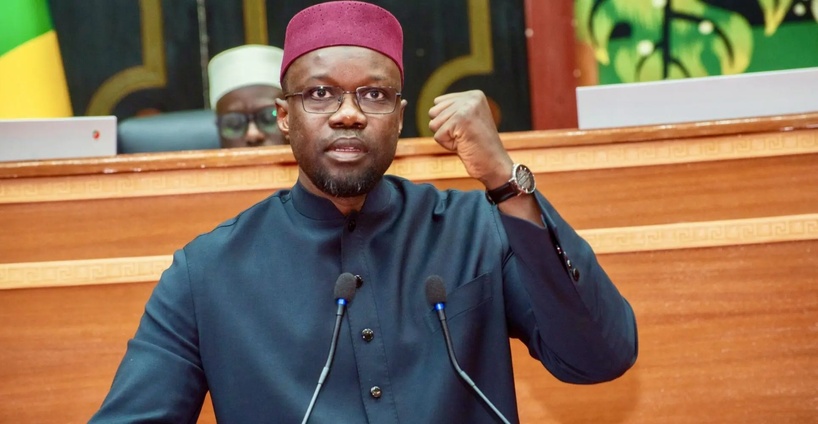
Senegal’s Prime Minister Ousmane Sonko stood before the National Assembly this morning to participate in a high-stakes session of Questions d’Actualité, a pivotal forum where government leaders are held accountable for their policies and decisions. The fifth installment of this quarterly exercise unfolded in a charged political climate, reflecting the nation’s ongoing dialogue about electoral reforms and economic challenges.
The session, broadcast live to the public, provided Sonko with an opportunity to clarify the government’s stance on critical national issues. Among the most pressing topics was the recent amendment to articles L.29 and L.30 of the Electoral Code, which has sparked intense debate across the country. Critics argue these changes were designed to pave the way for Sonko’s eligibility in the 2029 elections, despite his claims that he is already eligible for all Senegalese elections. The Prime Minister emphasized that the reforms were aimed at strengthening democratic processes rather than serving individual interests.
Beyond electoral concerns, the session delved into the everyday struggles of Senegalese citizens. Sonko, accompanied by his full cabinet, addressed urgent economic realities, including the rising cost of living and efforts to stabilize food and energy prices. The government’s strategy to mitigate inflation and support vulnerable households took center stage, with the Prime Minister outlining specific measures to ease financial burdens on families.
Macroeconomic stability was another focal point, as Sonko fielded questions about ongoing negotiations with the International Monetary Fund (IMF) and the progress of the national economic recovery plan. The upcoming budget proposal also featured prominently, with discussions centered on fiscal responsibility and priorities for public spending. Key sectors such as agriculture, family safety nets, and preparations for Eid al-Adha (Tabaski) were highlighted, with Sonko underscoring the government’s commitment to supporting farmers and ensuring food security.
The relationship between Sonko and President Bassirou Diomaye Faye was a recurring theme, with the Prime Minister describing it as a harmonious cohabitation. This dynamic, characterized by mutual respect and shared governance, has been noted as a stabilizing force amid Senegal’s evolving political landscape. As the session concluded, Sonko reiterated his government’s dedication to transparency, dialogue, and addressing the needs of the Senegalese people.