The recent detention of two French nationals in northern Togo has cast a glaring spotlight on the deep-seated governance failures plaguing the country. Incarcerated for days before being formally charged on Monday, their fate appears to have been sealed by a direct directive from Faure Gnassingbé himself. Reports indicate the Togolese leader personally instructed his Justice Minister, Pacôme Adjourouvi, to ‘resist any external interference,’ setting the stage for a contentious diplomatic confrontation.
Beyond the immediate diplomatic fallout, this episode underscores a far graver concern: the erosion of Togo’s institutional foundations. A pressing question now looms over the nation: who truly governs the country, and what authority legitimizes their rule?
The institutional overhaul: Redefining power without accountability
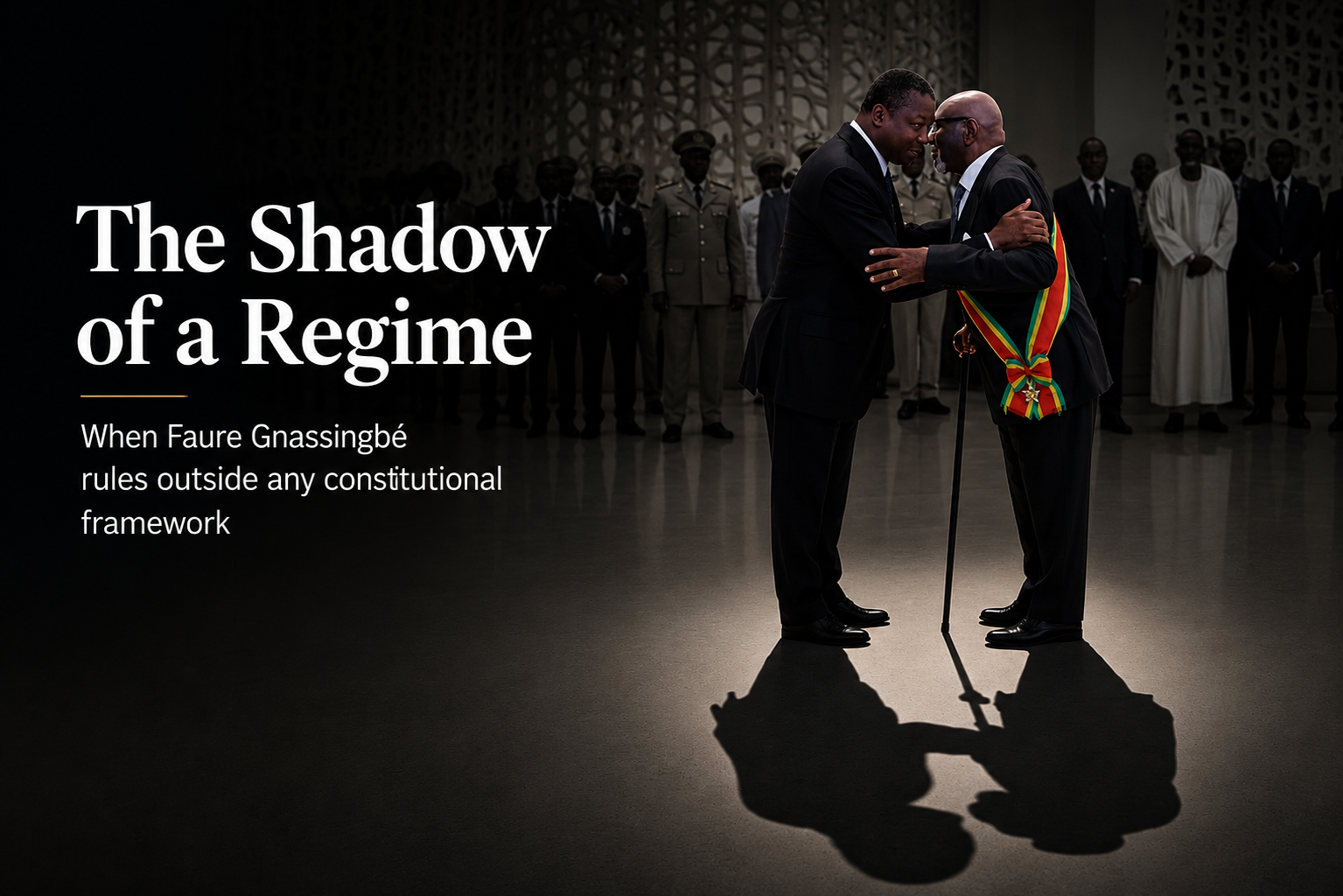
Faure Gnassingbé, in theory, no longer occupies the presidency of the Republic. Through constitutional amendments and the installation of a ceremonial Head of State, he has engineered an unprecedented shift in Togo’s political landscape. The new framework dismantles traditional checks and balances by creating the role of ‘Council President’ a position he has held since May 3, 2025 while stripping the symbolic President of any real authority. This reshuffling of titles and powers reveals a stark reality: governance in Togo now operates under a personalized system detached from democratic norms.
Under the 2024 constitutional reform, Togo transitioned from a presidential system to a ‘parliamentary’ model, though the shift is purely cosmetic. The Head of State, Jean-Lucien Savi de Tové, now serves as a figurehead, while the Council President Faure Gnassingbé commands the executive branch. This role faces no term limits, rendering the 1992 Constitution’s two-term restriction obsolete. The National Assembly, dominated by the ruling UNIR party with 108 of 113 seats following boycotted 2024 elections, ensured the outcome was predetermined. What emerges is not democratic rotation but a dynastic continuity masked by institutional facades.
Judicial subjugation: The weaponization of justice
The case of French journalists Sébastien Perez Pezzani and Gaël Mocaër, arrested while filming for a France Télévisions production, is not an isolated incident. It reflects a broader pattern in which intelligence services and the Ministry of Justice act on direct orders, eliminating any semblance of judicial independence. The alleged instruction to ‘resist any pressure’ signals a command structure where the executive branch dictates legal outcomes, rendering the separation of powers a hollow concept.
This manipulation extends beyond isolated arrests. It permeates the handling of June 2025 protests, the targeting of dissenting voices, and the selective enforcement of laws. The judiciary functions less as an arbiter of justice and more as an instrument of political control, deployed or sidelined based on expediency.
The illusion of legitimacy
The question of who governs Togo now demands a clear, if unsettling, answer: a leader who has held power since 2005, fortified it over two decades, and rewritten institutions to retain it indefinitely. Crucially, the Togolese people have not been consulted via referendum on these sweeping changes. Legislative elections took place amid widespread boycotts and systemic repression. The Senate, with one-third of its members appointed by the Council President, further consolidates this unaccountable authority.
What unfolds is not a democratic transition but a consolidation of personal rule beneath a veneer of constitutional legitimacy. Titles shift, procedures proliferate, yet the locus of decision-making remains unchanged: Faure Gnassingbé, now Council President, majority leader, Commander-in-Chief, and ultimate authority.
A ticking time bomb
When arbitrary rule supplants legal frameworks and institutions become empty shells, the social contract frays at its seams. Togo is no longer grappling with mere constitutional disputes; it faces a regime that has chosen to govern outside stable, predictable republican norms.
The question is no longer merely ‘who rules?’ but rather: how long can such a system persist before internal contradictions or mass dissent force a reckoning?