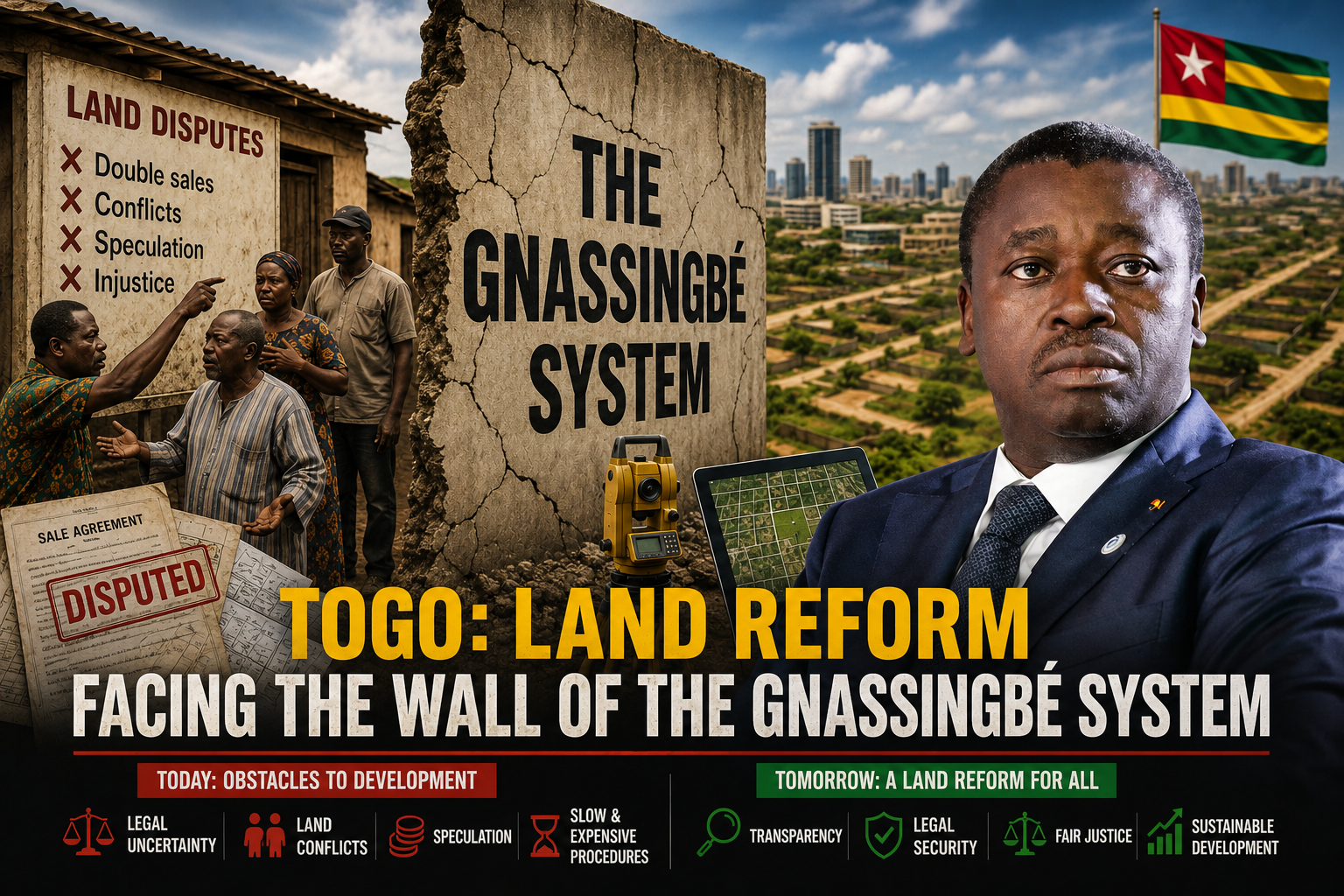
For sixty years, Togo’s land management system has been widely criticised for its inconsistency and inefficiency. Today, the government presents a bold new vision: transforming the land sector into a cornerstone of economic growth. While this ambition appears compelling on the surface, it faces significant hurdles rooted in the country’s entrenched systemic issues. Observers warn that without addressing these structural flaws at their core, this initiative could join the long list of reform attempts that remain unfulfilled.
Deep-rooted obstacles to land security
The fundamental challenge lies in pervasive disputes, fuelled by recurring issues such as double sales, ownership disputes, fragmented record-keeping, and murky transactional practices. How can sustainable development be fostered when property rights remain precarious? A land title or deed does not always offer adequate protection, as a single parcel may be claimed by multiple parties. This legal uncertainty discourages investment, destabilises household savings and occasionally traps individuals in financial limbo.
Administrative inefficiencies and unequal access
The additional burden of lengthy, costly, and opaque administrative procedures exacerbates the problem. When access to land information is restricted and processes lack transparency, those with financial means, influential connections, or insider knowledge gain an unfair advantage. A meaningful reform must therefore prioritise clarity in land records rather than merely increasing the issuance of land titles. Ensuring that every citizen can verify a parcel’s history before purchase is a critical yet overlooked necessity.
Judicial delays and systemic inequities
Protracted land disputes extend beyond administrative inconvenience; they devastate families, stall inheritances, freeze land use and obstruct economic progress. Legal decisions must be implemented swiftly, fairly and without bias regardless of social standing, political influence or financial clout. Without a robust, independent, and well-resourced land judiciary, no administrative reform will achieve lasting impact.
The political-economy of land governance
The land sector involves a complex web of stakeholders: customary owners, families, brokers, surveyors, government agencies, local authorities and political figures. When some actors maintain close ties to dominant political or economic networks, conflicts of interest and favouritism become endemic. A credible reform must dismantle these grey areas rather than replicate them under new guises.
The spectre of speculative land practices
In rapidly urbanising zones, soaring land values foster speculative behaviour multiple sales, artificial parcel manipulations and predatory acquisitions. Vulnerable populations, lacking safeguards, are disproportionately affected. The land that once represented a generational asset now risks becoming a speculative commodity accessible only to those with substantial capital.
Social tensions and intergenerational disputes
Land conflicts frequently pit relatives against each other, divide neighbouring communities or pit generations against one another over inheritance rights. As long as customary rights remain poorly integrated with formal legal frameworks, such tensions will persist. An effective reform must therefore integrate mediation, conflict prevention and public education on legal procedures.
The promise and limits of digitalisation
Digitalisation holds transformative potential but must not be reduced to mere bureaucratic rhetoric. A reliable, accessible, and regularly updated land database could drastically reduce double sales and streamline transaction verification. However, digital systems alone cannot rectify systemic fraud if underlying data is incomplete, manipulated or selectively accessible.
Transparency across the governance chain
Transparency must permeate every layer of land governance: parcel allocation criteria, transaction oversight, disciplinary mechanisms for irregularities, and protections for citizens challenging administrative decisions. Without clear documentation of these processes, scepticism will endure, and each new reform proposal will be met with justified doubt.
Economic stakes: from uncertainty to opportunity
A secure land sector enables individuals to invest, businesses to expand, banks to secure collateral and the state to plan territorial development effectively. Conversely, insecurity immobilises capital, stifles projects and fosters an economy rooted in distrust. This is not merely a matter for landowners it directly impacts the nation’s capacity to attract and safeguard investment.
The path forward: political resolve over cosmetic reform
The question is no longer whether Togo can implement land reform, but whether it is prepared to embrace the political, administrative and judicial consequences of a truly transformative agenda. Meaningful change demands transparency, enforceable penalties for fraud, faster justice delivery, stronger institutional oversight and stronger protections for vulnerable citizens.
Without genuine political commitment to dismantle entrenched networks of influence, strengthen the rule of law and purify the land justice system, new laws or reform commissions risk serving only as cosmetic cover. Until the protection of vested interests gives way to transparency and equal application of the law, land will remain a source of conflict not the engine of progress it is meant to be.