A wider table for Benin’s schoolchildren
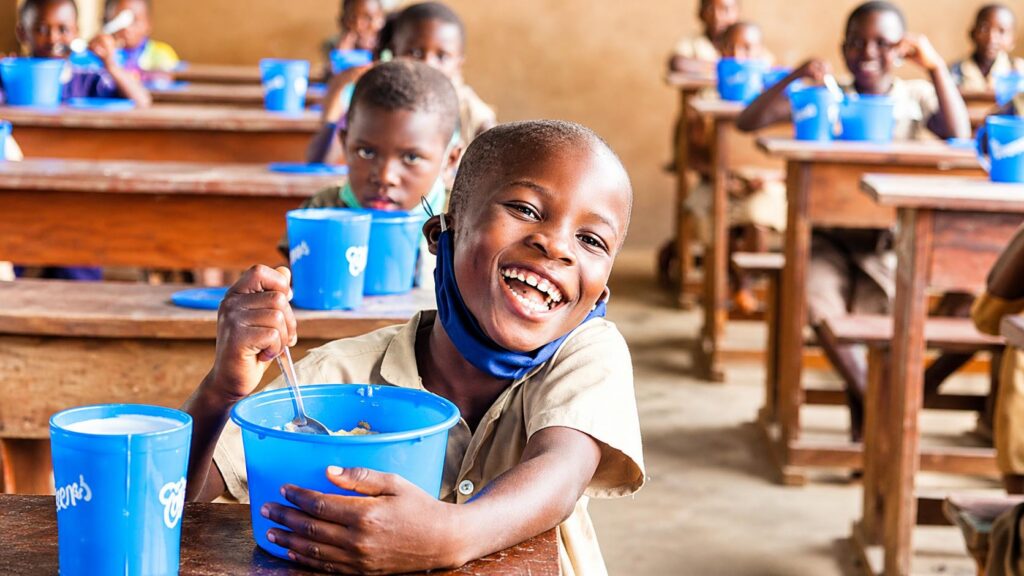
When classes resumed for the 2026-2027 academic year, close to 1.9 million pupils in Benin sat down to a hot meal on every school day. Twelve months earlier, that figure stood at 1.4 million. The gap between the two numbers — roughly half a million additional children — tells the story of a school feeding policy that keeps expanding rather than slowing down.
Behind the statistic lies a deliberate choice by Benin’s authorities: treating a plate of food at school as a tool that works on several fronts at once, from hunger relief and household support to the growth of rural trade.
Three decades of coverage in one decade of effort
The scale of the shift becomes clearer when set against the past. In 2016, only about 30% of the country’s schools were covered by a canteen. By 2022, that rate had climbed to 75%, with more than 1.1 million children already receiving meals. Each subsequent year has added weight to the programme, and the latest intake confirms a steady, upward trajectory rather than a one-off spike.
For the authorities in Cotonou, the canteen is not charity. It is framed as spending on schooling, on nutrition and, ultimately, on the country’s own development.
What a midday meal takes off a family’s shoulders
The first visible effect is felt inside the home. Feeding a school-going child every day is a real cost for many households, particularly in the poorest ones. When the school takes charge of lunch, part of that burden simply disappears.
Money that would have gone into a single meal can then be redirected: exercise books, a uniform, a visit to the health centre, or food for the other members of the family. Small savings of this kind accumulate, and they often translate into a better daily life for the household as a whole.
Better conditions for learning
Children gain something equally concrete. A pupil who eats at school faces the afternoon with more energy. Hunger during lessons fades, and with it some of the obstacles to attention, participation and memorisation. Expanding the number of beneficiaries is therefore a direct answer to a basic question: how do you let children — especially those from vulnerable families — study under decent conditions?
From 1.5 billion to 48.7 billion FCFA
None of this happens without money. The budget allocated to school canteens rose from 1.5 billion FCFA in 2016 to 48.7 billion FCFA in 2022, a leap that reflects how far the policy moved up the list of national priorities.
Under the 2025 finance law, more than 29 billion FCFA were again set aside to keep the canteen programme running. Read over the long term, these sums look less like day-to-day spending and more like an investment in human development, since they act on nutrition, attendance and well-being simultaneously.
The stated aim is not merely to serve meals. It is to build the conditions in which children stay in school, learn in better circumstances and prepare what comes next.
When school kitchens become markets for farmers
A second strength of the scheme lies in its economic reach. Canteens generate steady, predictable demand for foodstuffs, and part of the money mobilised can be channelled towards national producers and suppliers.
Buying locally creates outlets for farmers. Public spending on school meals can thus lift producer incomes, energise rural activity and strengthen local commercial circuits. Figures released by the authorities show that food purchases from local growers have grown, surpassing 13 billion FCFA in 2024.
The result is a loop that feeds itself: children eat, parents breathe more easily, and farmers find an additional market for what they harvest.
Towards broader coverage and long-term gains
With 1.9 million beneficiaries at the start of 2026-2027, the programme has crossed another threshold. The half-million children added in a single year give a tangible measure of how fast the net is being cast.
The ambition now is wider coverage of public schools, with the authorities determined to anchor school feeding as a lasting component of Benin’s education and social policy.
The canteen has become a multi-purpose instrument. It fights hunger, supports parents, improves the classroom environment and opens doors for local agriculture.
By pouring substantial resources into the scheme, Benin is not simply paying for meals. It is putting money into today’s children, into their families and into local commerce — and above all into the human capital that will define the country’s prosperity tomorrow.