After the vote: how Burkina Faso’s capital punishment debate is reshaping national discourse
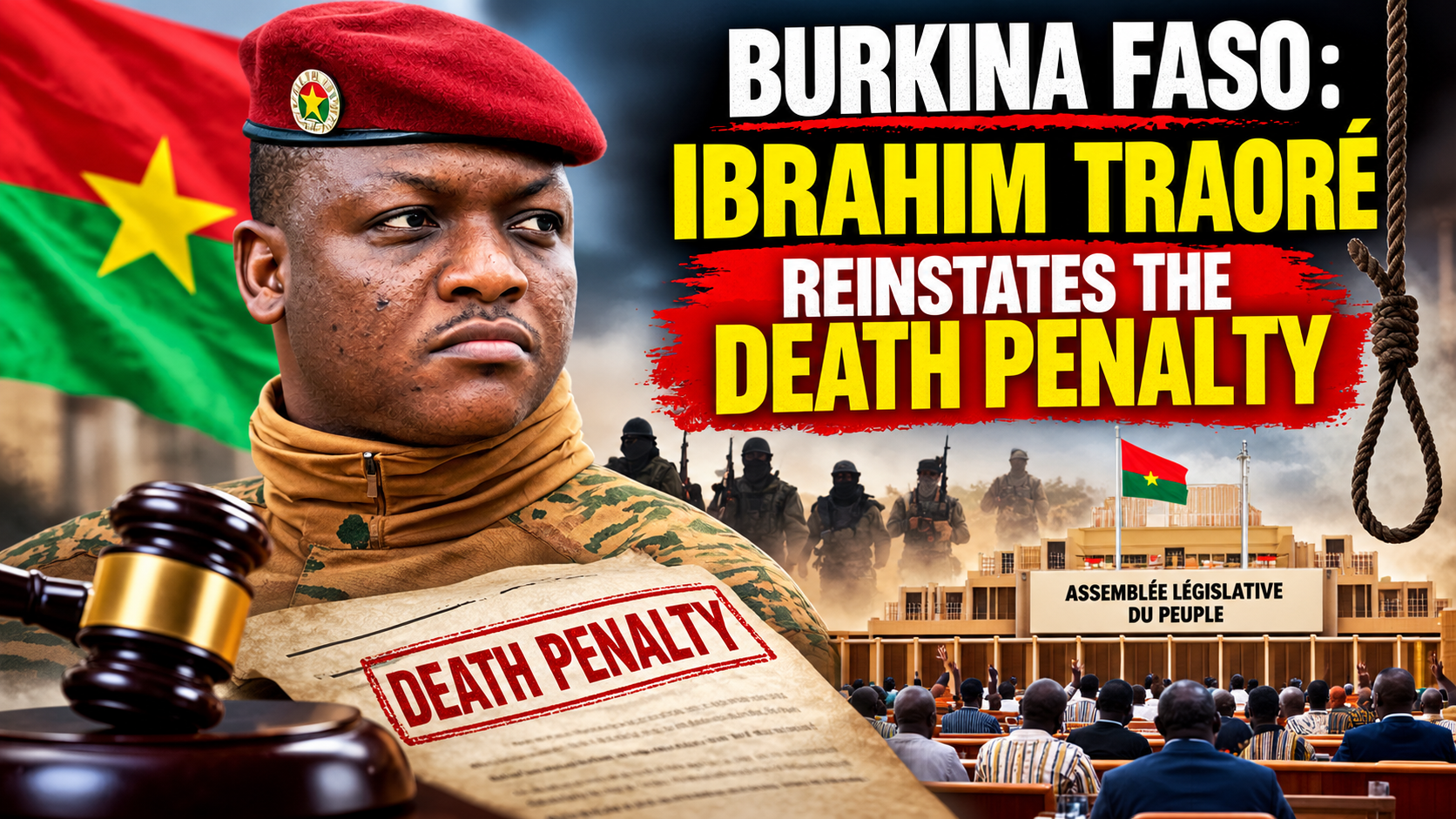
Burkina Faso has entered uncharted legal territory after lawmakers approved a sweeping penal reform reintroducing capital punishment. While authorities frame the move as a necessary weapon against rising jihadist violence, critics warn it risks entrenching fear rather than restoring order. The unanimous passage of the new penal code by the legislative assembly signals not just a shift in criminal policy, but a broader transformation in how governance and justice are perceived under Captain Ibrahim Traoré’s leadership.
The reaction has been swift and polarized. Supporters argue that extreme violence requires extreme measures, insisting that the death penalty will deter terrorism and restore public confidence in the state. Opponents, however, caution that in a context of shrinking civic space and recurring allegations of judicial overreach, the reform may do more to silence dissent than to silence armed groups.
As the dust settles, two questions dominate public debate: Can a policy of harsh punishment effectively curb insecurity? And at what cost to democracy and human rights?
From deterrence to authoritarianism: the double edge of Burkina Faso’s penal reform
Burkina Faso’s journey to this pivotal moment began with years of escalating violence. Since 2015, the country has faced relentless attacks by armed Islamist factions, resulting in thousands of civilian casualties and the displacement of over two million people. In response, the military-led government has pivoted from emergency measures to structural reforms, culminating in the restoration of the death penalty in October 2026.
The new penal code classifies capital punishment for crimes including terrorism, treason, espionage, parricide, and the importation of expired or banned goods that result in death. Authorities present these sanctions as a clear message: certain acts will not go unanswered. Yet the introduction of such drastic penalties raises concerns about proportionality and the risk of judicial error in a system already under scrutiny for its lack of transparency.
Critics point out that severity in sentencing does not automatically translate into security. Effective counter-terrorism depends less on the harshness of punishments and more on intelligence, operational capacity, and sustained state presence in affected regions. Without these foundations, capital punishment becomes not a tool of protection, but a symbolic act one that projects strength while doing little to address the root causes of violence.
The reform also extends beyond terrorism, reintroducing criminalization of certain press offenses a move that echoes earlier concerns about restrictions on free expression. The convergence of punitive justice and tightened control over public discourse suggests a broader agenda: using law as both shield and sword.
Ibrahim Traoré’s gamble: authority through fear or accountability through action?
The president’s public statements leave little room for ambiguity. Speaking in late September, he declared that traitors and spies would face “uncompromising justice,” sending a clear signal that the regime prioritizes loyalty and control over procedural safeguards. This rhetoric aligns with a pattern of centralizing power under military governance, where state authority is reinforced through visible displays of resolve.
Yet a justice system built on fear rather than fairness risks deepening societal fractures. The death penalty, once carried out, cannot be undone. In a context where due process is already questioned amid reports of forced conscriptions, arbitrary detentions, and targeted intimidation there is real danger that justice becomes a political tool rather than a public service.
The reform’s architects argue that extreme measures are justified by extreme circumstances. But this logic presupposes a level of institutional resilience that Burkina Faso’s justice system has yet to demonstrate. Without independent oversight, transparent investigations, and meaningful access to defense counsel, the new code risks becoming an instrument of repression masquerading as security.
Security without liberty: the unsustainable equation
Burkina Faso’s slide toward increasingly repressive policies coincides with a decline in civic freedoms. Reports from human rights monitors and international observers have documented cases of enforced disappearances, suppression of critical voices, and threats against journalists and magistrates. These developments paint a picture of a government tightening its grip under the banner of national security.
In many ways, the reintroduction of the death penalty is not an isolated legal change, but part of a broader pattern of governance. By combining extreme penalties with tighter controls on dissent, the regime appears to be constructing a narrative in which loyalty to the state is conflated with loyalty to the leadership. This blurring of lines between national interest and regime survival poses a fundamental challenge to democratic principles.
The right to question authority remains essential, especially in times of crisis. Journalists must be able to investigate, citizens must be able to voice concerns, and judges must be able to interpret the law without fear of retribution. When punishment is escalated while criticism is restricted, the result is not strength it is a hollow authority that rules through intimidation rather than trust.
Fear may silence, but it does not protect
The ultimate test of any security policy is not the severity of its threats, but its effectiveness in delivering safety. For most Burkinabè, daily life remains a struggle: markets shut prematurely, schools close indefinitely, and families flee their homes under the threat of night raids. The state’s ability to restore such basic conditions depends not on the death penalty, but on intelligence-led operations, community engagement, and the restoration of public services.
Traoré’s government now faces a critical dilemma. It has chosen to brandish the ultimate penalty as a symbol of resolve. But symbols alone cannot rebuild trust or rebuild villages. Citizens do not long for harsher punishment they long for protection they can believe in. And belief requires more than fear; it requires justice that is seen to be fair, institutions that function transparently, and a government that prioritizes people over power.
Justice or spectacle? The lasting impact of Burkina Faso’s capital punishment revival
Whether the new penal code reduces violence or deepens divisions will only become clear in the months ahead. What is already evident, however, is that this reform marks a turning point not just in Burkina Faso’s criminal law, but in its political culture. A country fighting terrorism cannot afford to confuse coercion with control, nor punishment with prevention.
The death penalty does not feed children caught in crossfire. It does not stop armed groups from striking. It does not return the displaced to their homes. It does, however, risk embedding a culture of fear into the fabric of the state. And once fear becomes the foundation of governance, the fallout both in terms of human rights and national cohesion could far exceed the immediate gains promised by the regime.
The question now facing Burkina Faso is not whether the state can punish more harshly, but whether it can protect more effectively. The answer may well determine not just the country’s security, but its survival as a functioning democracy.
By Ousmane Tandja — Journalist